


2. To 15,000 BCE - Mother Earth and Great Goddesses?
Female goddesses in all their sexualized glory can be found across the globe in the ancient world. What can these goddesses tell us about ancient faiths, and what can they tell us about gender dynamics? Quite a lot! However, was there ever a great goddess, more powerful than the male gods? Probably not. During the Paleolithic Era, people lived in caves, huts, or tepees. They gathered and hunted for food, used basic stone and bone tools, as well as crude stone axes for hunting birds and wild animals. Women and men shared responsibilities and were mutually reliant on one another, but this relationship shifted with the advent of settled agriculture. During this period, everywhere around the world, female goddesses or feminine beings appeared in the religions that formed. Who were these goddesses, and where did they go?
How to cite this source?
Remedial Herstory Project Editors. "2. T0 15,000 BCE- MOTHER EARTH AND GREAT GODDESSES?." The Remedial Herstory Project. November 1, 2025. www.remedialherstory.com.


Join the Club
Join our email list and help us make herstory!
[object Object]

Religion
Polytheistic (adj.), relating to or characterized by belief in or worship of more than one god. Matriarchal (adj.), relating to or denoting a form of social organization in which a woman is the head. Yoga (n.), a Hindu theistic philosophy teaching the suppression of all activity of body, mind, and will in order that the self may realize its distinction from them and attain liberation. Asceticism (n.), the practice of strict self-denial as a measure of personal and especially spiritual discipline. Pantheon (n.), the gods of a people. Manifestation (n.), a version or incarnation of something or someone. Deity (n.), a god or goddess. |
Religions during the Paleolithic Era were distinctly different from modern religions. They were heavily influenced by nature, were usually polytheistic, and, importantly, they honored almost as many female goddesses as male gods. Some also made little distinction between male and female or did not have gendered characteristics.
Goddesses and gods were thought to have power over many aspects of human life, and worshipers would pray to a particular god or goddess to address a particular need or problem. Worship was ritualistic, spiritual, and varied from society to society, region to region. Sexuality was evidently important as images of gods and goddesses showed extenuated genitalia, and many of the early myths included details of procreation.
The historical record is sprinkled with textual evidence of a matriarchal or divine feminine past that was passed down for centuries by oral tradition and later recorded. One ancient Indian proverb stated, “Woman is the Creator of the Universe, the Universe is her form. Woman is the foundation of the world. There is no prayer equal to a woman, there is not, nor has been, nor will there be any yoga to compare with a woman, no mystical formula nor asceticism to match a woman.”
Mesopotamia was among the first civilizations with recorded history. At first, gods and goddesses were represented as gender fluid. Later, gods and goddesses exemplified characteristics later associated with one gender or another. None demonstrates this more than Inanna. She was the goddess of love, beauty, sex, war, justice, and political power.

Ishtar on an Akkadian seal
A Mesopotamian hymn from the Sumerian city-states describes Inanna as a virgin who wanted to know more about sex, so she asks her brother to take her to the underworld where she could taste the fruit of a tree that grows there and thus learn about sex. This story was passed down over centuries and was eventually transformed into the Adam and Eve tale recorded in the Torah, or Old Testament, by authors in the 6th century BCE.
In time, Inanna begins a courtship and eventually chooses the God of Shepherds. There are several versions of their relationship. In one, she goes on an epic journey to save him from the underworld. As she ventures into the underworld, she passes through seven gates, at each she must strip off a layer of her clothing. This is intended to humiliate and destroy her power. When she arrives, she is completely naked. Eventually, the God of Shepherds is permitted to visit Inanna for half the year but must stay in the underworld the other half. In other versions, Inanna killed him.
Inanna evolved into the character of Ishtar by 2500 BCE. Some Mesopotamian empires elevated her to the highest deity in their pantheon - even over their national gods. Ishtar’s strength and fearsomeness is featured in the oldest story in the world, The Epic of Gilgamesh, written between 2900 BCE and 2350 BCE. The epic includes fantastic adventure tales and tales of women taming men, but it also holds warnings about female power and sexuality.

The Goddess Ishtar, clay relief panel
In one tale, Ishtar falls in love with King Gilgamesh, but he rejects her because she had killed her previous lovers. Gilgamesh asked her, “Which of your lovers did you love forever? What shepherd of yours pleased you for all time? [...] And if you and I should be lovers, should not I be served in the same fashion as all these others whom you loved once?”
Facing rejection, Ishtar got a demonic bull to terrorize Uruk (one of the Mesopotamian city-states which was ruled by Gilgamesh) and cause widespread devastation. The bull lowered the level of the Euphrates River, and dried up the marshes. It opened up huge pits that swallowed 300 men. Without any divine assistance, the epic’s heroes - Enkidu and Gilgamesh - were able to kill the bull. In the end, Ishtar mourned with the courtesans and harlots, while Gilgamesh celebrated with the craftsmen switching his loyalty to the Sun God.
Ishtar was not always destructive or vengeful. Later in The Epic of Gilgamesh, we read of the Great Flood, which resembles the story of Noah’s ark in the Old Testament. According to the epic, when the flood came, Ishtar mourned the destruction of humanity and swore to stop future floods.
Archeologists have found hundreds of clay cylinders depicting scenes from the epic that were used to help generations learn and remember these important tales. They have also discovered temples that were devoted to Ishtar through different empires in Mesopotamia, and the lion icon most associated with her is displayed prominently in the region. Ishtar continued to thrive long after the Greek and Romans conquered the region, and likely influenced the development of the Greek goddess Aphrodite. A cult to her continued to flourish until its gradual decline between the first and sixth centuries CE in the wake of Christianity.
Hinduism developed around this same time. In Hinduism, the world’s oldest religion still practiced today, there is a long tradition of Goddess worship. This divine feminine is known as Devi, the Goddess, or “‘Great Mother.” She is the embodiment of shakti, the “creative power of the universe.” While this power is eternal and formless, all other Hindu goddesses are considered to be manifestations of Devi. Devi is not the consort of a male deity; she is independent. In some traditions, Devi is even regarded as superior to male deities.
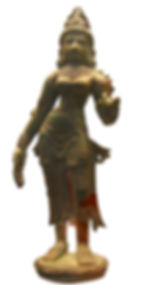
Sculpture of Lakshmi, a manifestation of Devi
Shaktism acknowledges the creative potential of women who maintain familial and social order. Shakti is also considered the counterpart of the masculine purusha (meaning spirit or self), but neither can survive without the other, suggesting a model for gender equality.
Similarly, many Aztec gods were genderless or exhibited dual gender characteristics. The Aztec goddess Coatlicue was considered the mother of all gods who embodied opposites: life and death, light and dark, male and female. Almost all representations of Coatlicue depict her deadly side because Earth is a loving mother as well as an insatiable monster that consumes everything that lives. She represents the devouring mother, in whom both the womb and the grave exist.
Creation Stories
Creation stories (n.), a cultural, religious, or traditional story that explains the origins of the universe, life, earth, and humanity. Primordial (adj.), existing at or from the beginning of time. Aboriginal (adj.), relating to the indigenous peoples of Australia or their languages. |
Creation stories were recorded in almost every world culture and give us great insight into the oral traditions passed down for millennia.
For example, this is the story of the Chinese goddess Nuwa. In the beginning, surrounded by chaos was a sleeping giant named Pangu. The hairy horned giant woke up and, upon standing, split the heavens and the earth. After thousands of years, he died and his body became the sun, moon, stars, mountains, rivers and forests and all else in creation. From this primordial creation, the goddess Nuwa arrived and found that the four pillars holding heaven and earth apart were broken, so she repaired them. She then fashioned mankind from clay.
The book of Genesis in the Bible is clearly a combination of a variety of oral myths recorded. In the first chapter, God creates the earth from a void in six days, and in the second chapter, a heavenly garden appears and God creates a man (Adam) in his image and creates a woman (Eve) from that man’s rib. However, at another point in the narrative, God is said to have created man and woman in his image, thus contradicting the story of Adam’s rib. Ultimately, Eve convinces Adam to eat from the tree of knowledge, and both - and all humans who follow - are then doomed to a life of labor and trouble. Interestingly, linguists studying the ancient texts have noted that different authors recorded these two stories because the Hebrew words they use for God changed from story to story as different authors used different titles (in the King James Version this is represented by using the words “God” in some places and “Lord” in others).
In Japan, ancient origin stories were recorded in a text called The Kojiki between 500-700 CE. As in the common rendition of Genesis, the earth is created from nothing by a few deities. The story goes,
Izanami examined her body and found that one place had not grown, and she told this to Izanagi, who replied that his body was well-formed but that one place had grown to excess. He proposed that he place his excess in her place that was not complete and that in doing so they would make new land. She greeted him by saying “What a fine young man.” They procreated and gave birth to a leech-child, which they put in a basket and let float away for they did not recognize it as one of their children. Disappointed by their failures in procreation, they consulted the deities who explained that the cause of their difficulties was that the female had spoken first when they met to procreate. Izanagi and Izanami returned to their island and again met behind the heavenly pillar. When they met, he said, "What a fine young woman," and they mated and gave birth to the eight main islands of Japan and six minor islands.

Izanagi and Izanami
In Australia, many aboriginal myths attempt to explain the superiority of men but also suggest that there was once a time when women dominated. An oral tradition recorded in the 20th century tells the story of Mutjinga, the “man eater”. Mutjinga was an old woman who could speak with the spirits and was the caretaker of the spirit world where souls went after death, before being reborn. It begins,
In the dream time, in the land of the Murinbata people, a great river floats from the hills through a wide plane to the Sea [...] where lived an old woman named Mutujinga, a woman of power. [...] Mutjinga could speak with the spirits. Because she had this power, she could do many things which the men could not. She could send their spirits to frighten away game, to waylay people at night, or cause a child to be born without life. The men feared the power of Mutujinga and did not consort with her. [...] Mutujinga found no satisfaction in food, for she craved the flesh of men!”
To feed her craving, she turned herself into a lizard, and when hunters chased after her, they fell into a hole where they were eaten by Mutjinga.
When another man came in search of these hunters, he and his son were also nearly killed by Mutjinga, but when she tried this same trick again he saw through it and they killed Mutjinga, taking her place as the caretakers of the sacred cave where the spirits rested. In Mutjinga’s stead, he became the communicator of the spirit world and held power as a religious figure.
A Great Goddess?
Utopia (n.), an imagined place or state of things in which everything is perfect. |
One historian explained, “The prevalence of the Venus figurines and other symbols all across Europe has convinced some, but not all, scholars the Paleolithic religious thought had a strongly feminine dimension, embodied in a great goddess and concerned with the regeneration and renewal of life.” Was it possible there was a time when a goddess reigned supreme?
There is some evidence that goddesses were honored above the male gods. The most compelling part of this theory is our evolutionary ancestors’ inability to perceive cause and effect, thereby their inability to understand birth. To them, women were magical, capable of producing offspring out of nowhere and producing life-sustaining milk. Every month, in sync with the moon cycle, women bled and didn’t die.
When Sir Arthur Evans revealed the existence of the lost Minoan civilization to Europeans in the 20th century, he believed the goddess figurines he found represented the Great Mother, worshiped under various names and titles. This Great Goddess was the creation mother and in full control of all other gods.
The divine feminine is present in nearly all early mythology, and she represents creation. Ishtar is considered the cosmic uterus. The Roman mother earth Gaea and the Norse Ymir emerged from a birth canal. In Egypt, the goddess Nut makes an even stronger claim for power in an engraving, “I am what is, what will be, and what has been. No man has uncovered my nakedness, and the fruit of my birthing was the sun.”
Many scholars take issue with the theory that these goddesses ever served as a Great Goddess. In Gentlemen and Amazons: The Myth of Matriarchal Prehistory, 1861–1900, historian Cynthia Eller explained how attractive this theory is to her as a woman and yet how improbable it is. She dismisses the theory as wishful fantasy of a utopia. Eller adds, “The myth of matriarchal prehistory is not a feminist creation, in spite of the aggressively feminist spin it has carried over the past 25 years. The majority of men who champion the myth of matriarchal prehistory during its first century (and have mostly been men) have regarded patriarchy as an evolutionary advance over prehistoric matriarchies. If the myth now functions in a feminist way, its anti-feminist past can become merely a curious historical footnote.”
Conclusion
Whether or not a Great Goddess existed, these stories tell us how human development was similar across the globe and that, at one point, feminine attributes were considered divine. Eventually, feminine attributes were replaced in most of the world by a single male God with male prophets or messengers. It also shows us how important nature, procreation, and mystery were to early people.
By the end of this era, so much remained in question. Can we know for sure if there ever was a Great Goddess? How reliable are oral traditions recorded centuries or millennia after they were first told as evidence of prehistoric culture? What happened to these goddesses as communities settled and adapted agriculture?


