


10. Women Travelers and Merchants on the Silk Roads
The Silk Roads connected people, spread ideas, religions, and commerce, and created empires for those able to control the roads. Women were integral to every aspect of the roads. They served as primary producers of crucial items sold and transported along the roads, and were also sold themselves as brides to help establish peace between governments.
How to cite this source?
Remedial Herstory Project Editors. "10. 100-500 CE - WOMEN TRAVELERS AND MERCHANTS ON THE SILK ROADS" The Remedial Herstory Project. November 1, 2025. www.remedialherstory.com.
Between the first century BCE and the third century CE, a vast network of trade routes emerged from smaller regional trading zones and ultimately connected markets from China to the Mediterranean. Through these trade routes, the world became more culturally diverse than we have been taught to expect in ancient history. The trade network is known as the Silk Road, but it was never just one road, and silk was far from the only trade item. Ideas, belief systems, arts, and disease accompanied the caravans as they crossed the continent. Many of the merchants and migrants on these trade routes were men, but women played lead roles every step of the way.
Han Dynasty China serves as the foundational state in the growth in trade during this era, notably because the silk, which gave the roads their name, came from China. As far back as 3000 BCE, the Chinese established a monopoly over silk production. Women were important in the trade as producers and consumers of this precious commodity, and the emergence of large, stable empires made long distance trade across Afro-Eurasia possible.
Large states offered a number of advantages that made trade possible. There were fortified cities and armies to offer protection. There were several established roads as well as infrastructure such as bridges and canals. Market towns dotted the route, and in the desert these towns emerged at oases where water was available. Trade route towns boasted more than marketplaces—the weary traveler could find inns, stables, temples, and entertainment in towns such as Turfan and Dunhuang. People tended to travel in great caravans including dozens or even hundreds of people—sometimes entire extended families migrated in this way. At the height of Silk Road traffic, it was possible to join a new caravan if you found one heading to a different city. One Sogdian woman awaiting family in Dunhuang in the fourth century, wrote to a friend that at least five caravans had departed in one day.
Oases (n.), a fertile spot in a desert, where water is found (plural form of oasis).
Caravan (n.), a group of people, especially traders or pilgrims, traveling together across a desert in Asia or North Africa
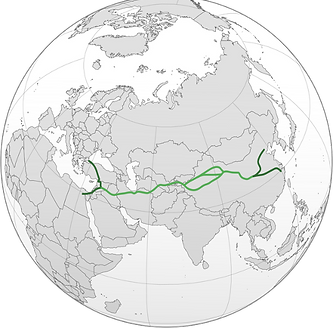
Map of the main Silk Road routes

Marco Polo’s caravan on the Silk Road
Join the Club
Join our email list and help us make herstory!
The Silk Road Princesses
China gradually built its military defenses, but force alone was never enough to ensure peace in central Asia. Diplomacy was also essential, and the easiest way to seal a treaty with a Xiongnu or Mongolian chieftain was to offer a Chinese princess as a bride. The term ‘princess’ in this context did not necessarily mean the daughter of the emperor but might refer to any other lady of the palace.
The first recorded princess bride was Liu Xijun, sent to marry the king of the Wusan tribe at the end of the 2nd century CE. She was not thrilled with her fate, writing in a poem, “My family sent me off in marriage to the end of the world [...] All day my heart aches with pains of home: Were only I a brown goose and could fly home!”
Among the most famous such princesses was Wang Zhaojun, who married the Khan of the Southern Xiongnu in 33 BCE. There are many stories about Wang Zhaojun, praising her great beauty and sharp wit. It is said the Chinese emperor had never actually met her when he assigned her to marry the Khan, and that he regretted his choice when he met her, but the treaty was too important to go back on his word. Wang Zhaojun had a son with the Khan and, after her first husband’s death, asked if she could return to China. But Xiongnu custom was for the Khan’s widow to marry his successor, and Chinese Confucian ideals dictated that she stay with her late husband’s family, so that is what Wang Zhaojun had to do. She stayed and had additional children with the new Khan, and her children went on to help maintain friendly ties between the Chinese and the Xiongnu. She became such a legend in Chinese culture that poetry, art, and even operas were produced to honor her memory for centuries. To many Chinese people, Wang Zhaojun’s acceptance of her role represented a huge personal sacrifice.
Wencheng Gongzhu was another princess who was sent to marry the emperor of Tibet in 641 CE. Her marriage actually brought an immediate end to war between Tibet and the Tang Dynasty in China. Like other princesses before her, Wencheng became a legend in later China because she was said to have been the one to introduce many Chinese innovations to Tibet, thus enlarging the cultural impact of China on much of the Asian continent. In any case, she must have brought a great deal of wealth to her new husband. Her entourage included servants, educators, and inventors. A diplomatic caravan took months to make the journey from the imperial capital of China to the home of the royal bridegroom. Royal caravans were well-guarded and stopped for days at a time to make sure the bride was not too taxed.
Khan (n.), a title given to rulers and officials in central Asia, Afghanistan, and certain other Muslim countries.

Painting of Wang Zhaojun
Imperial (adj.), relating to an empire.
Bridegroom (n.), a man on his wedding day or just before and after the event.
Religion and Art
The market towns and oases of the Silk Road were home to hundreds of sedentary peoples who ran the town and catered to the caravans, and there would have been women running the inns and selling goods in the market. Buddhism also flourished along the Silk Road, and nuns were less likely to travel than Buddhist monks, so the towns were often home to women who had taken religious vows - including princesses avoiding arranged marriages. Dunhuang alone was home to five nunneries by the 9th century, the largest of which was home to 200 nuns. Devout Buddhist women who had not taken vows were still able to support the stupa shrines and nunneries with donations.
Some women served as entertainers and courtesans. A steady traffic of travelers created eager audiences, and the art of the Sogdian people was very popular in the oasis towns. The Sogdians being those who occupied what is now Uzbekistan, Tajikistan, Kazakhstan, and Kyrgyzstan. The trademark dance of the 3rd and 4th centuries was a swirling dance in which the dancer whirled inside of a circle to mesmerizing music. Enterprising entertainers also offered Indian-style operas and Chinese drumming.
Larishka is the best-known example of a Silk Road entertainer, although she lived in the 9th century, when much of the long distance trade was temporarily interrupted. Regional markets were still thriving and Larishka started out as a singer and dancer in the town of Kucha. As Uyghur armies passed through, however, Larishka caught the eye of a general who took her under his protection. With other servants and enslaved people, she traveled with the army’s caravan until they reached Dunhuang, where she was left behind by her patron but soon picked up by a Chinese general. Later in life, her fortunes changed again and for a time she ran a school in Chang‘an, where she trained girls to dance and sing. After a violent rebellion took the city, Larishka was forced to flee, and she ended her days as a refugee, arriving back in Kucha with only the clothes on her back.
Stupa shrine (n.), a dome-shaped structure erected as a Buddhist shrine.

Bodhisattva from Kucha, 500-700 CE
Patron (n.), a person who gives financial or other support to a person, organization, cause, or activity.
Trade
Finally, the impact of women on the Silk Road resided in their activities as consumers. In many cases, women bought the trade goods that made life sweet—silks to wear, art to decorate their homes, and spices to flavor their food. While all elites could enjoy fine dining and beautiful clothing, Pliny the Elder blamed the expensive tastes of women for the money Romans wasted on Eastern goods. He himself lived in a splendid oceanside estate but it was the pearls, gems, and silk worn by women that offended him. At the same time, Roman sources reveal that Eastern trade goods appealed to many women for reasons deeper than vanity or decadence.
Whatever else shaped life on the Silk Road, the trade goods themselves deserve a closer look. Silk itself dates back to the Neolithic Era in China. According to legend, Princess Xi Lengshi discovered silk fibers when a silk cocoon dropped into her teacup as she relaxed under a mulberry bush. As she watched the cocoon unravel in the warm water, she realized that it was a delicate but strong fiber. For many centuries, China had a monopoly on silk production, and the country profited handsomely. Silk can be easily dyed to almost any color and it can be woven into simple, light fabric or heavy, intricate patterns.
Women were usually entrusted with caring for silkworms, processing of the fiber, and weaving the cloth. China was so invested in supporting this industry that families willing to dedicate even a small plot of land to mulberry bushes and silkworm farming earned tax exemptions and other benefits. Thus, the work women did helped to support their families.
Silk was an ideal trade product. It was as valuable as gold but was far lighter, so it was easy to carry. In many cases, wages were paid in bolts of silk fabric. Silk was also among the sapta vatna, or the “Seven Treasures” of Buddhism, becoming central to Buddhist worship and the veneration of the Buddha. In Persian and Roman elite families, wearing silk was a mark of status and wealth. Romans loved the fabric so much that they often unwound heavier cloth to make sheer fabrics and increase their profit. Conservative Romans were scandalized at the almost transparent outfits of the rich and famous women of the city. Pliny the Elder complained further that the Eastern trade in luxury goods was bankrupting the great Roman families. Romans had no idea what silk was made of—they thought it was a plant. Persians were among the first to learn the secrets of silk, and some stories suggest that a resentful princess bride hid silk cocoons in her elaborate headdress as a gift to her Persian husband.
Another product traded was pearls. A pearl is formed when a microscopic irritant gets stuck inside a bivalve like a clam or an oyster. The bivalve will naturally protect itself by developing a smooth layer around the irritant. This layer is made of the same smooth and shiny layer that lines the shell as the creature grows. For thousands of years, natural pearls were harvested from the Persian Gulf, the Red Sea, the Indian Ocean and the Gulf of Mannar in Sri Lanka. During the Han Dynasty, a pearl industry emerged in the South China Sea.
In India, the pearl industry employed both men and women. Though the pearl trade was highly profitable, the danger of pearl diving and the tedium of shucking oysters meant that the real labor was carried out by low-ranking people who rarely got rich from the pearl industry.
Also regularly traded among the Silk Roads were spices. A 1st century Roman cookbook by Apicius includes pepper, ginger, turmeric, and other Eastern ingredients in just about every recipe. As in Buddhist traditions further east, the traditional religions and mystery cults of the Roman Empire placed a high value on the incense and spices used in prayer and spices were also used in medicine.

Women making silk

Silk Production
Conclusion
The Silk Road trade routes shifted along with every political and economic change over time. Some parts of the network still exist today or are in the midst of being recreated. But for centuries, the great empires of Europe, Africa, and Asia did business with each other in ports and markets run by regular folk.
How did these trade networks broaden the horizons of women in their path? What new benefits or risks might they present for women? How might women use the Silk Roads to establish agency?


