10. Women and Reconstruction
During the Reconstruction Era, following the American Civil War, women faced many new challenges. Freedwomen struggled to find their place in society as a result of family separation, mistreatment from former masters, racism, and lack of assistance or resources. Some white Northern women worked with the Freedmen's Bureau and helped African Americans where they could. Whereas, white Southern women worked to pick up the pieces of their society while honoring their dead and mythologizing the Confederacy.
How to cite this source?
Remedial Herstory Project Editors. "10. WOMEN AND RECONSTRUCTION" The Remedial Herstory Project. November 1, 2025. www.remedialherstory.com.




After the Civil War, the struggle to truly emancipate African Americans in the US began. Slavery was a complex and dynamic system of oppression and so was the period of Reconstruction that followed it. To combat rising white terror in the South the Federal Government created the Freedmen's Bureau which supplied food, built schools, and enforced peace in Southern states.
Northern and Southern women also found themselves trying to figure out their place in the aftermath of the Civil War. Black women tested the limits of their newfound freedoms and worked to reconnect with family. Northern white women moved towards helping in the Freedman’s Bureau and teaching African Americans. Whereas, Southern white women began their memorial efforts through Ladies Memorials Associations, which eventually transitioned into a national organization known as the United Daughters of the Confederacy. Southern women are responsible for helping create the Lost Cause and mythologizing the efforts of the Confederacy.

“Glimpses at the Freedmen”, Public Domain
Join the Club
Join our email list and help us make herstory!
Freedmen's Bureau
From its beginning, the Freedmen's Bureau attempted to bring the free labor society and culture of the Antebellum North to the post-Emancipation South. Executing these ideals proved very difficult. The bureau, which oversaw 14 states throughout the South and Washington, D.C. had less than 1,000 officers to help newly freed black people build hospitals and schools, negotiate labor contracts, and legalize marriages, alongside any other issues that ex-slaves faced. The officers were housed in small buildings with a desk, a bed, and stove, and saw a nearly- constant line of Blacks and whites knock on the door and ask for assistance. They also face harassment from disgruntled whites, including receiving threats from organizations such as the Ku Klux Klan.
A multitude of newly freed Black women asked the Bureau for help to find food and shelter, what we considered to be the necessities. These women were largely illiterate and most of them were mothers. They spent most of their energy trying to find information on their children, seeking protection from their former masters, and acquiring legal justice to help recover the wages they were being denied and any other form of exploitation that they were facing. Women of color fought for their lives and families in any way they could.
Testing Freedoms
In many areas of the South, African American women found themselves and their families living with their former masters. They continued working for their previous owner in exchange for shelter and support as they began to grapple with freedom. Another challenge that Black women had to overcome was the anger of their former masters and mistresses as their previous owners struggled with the after effects of the Civil War. White owners found themselves destitute, homeless, traumatized by death, and now, they felt like they were being forced into a position of giving relief to their former slaves at the direction of an occupying northern army. The anger and resentment of their previous owners impacted the lives of African Americans, especially African American women, who were more likely to depend on the welfare of their former masters, as they were often the sole providers of basic necessities for their children. These women found themselves in tragic positions, being abused by their old masters and mistresses so that they could provide their children with the necessities in life. The Freedmen’s Bureau has a multitude of letters and reports showing these accounts of abuse and hardship.
After the war, African American women traveled for many miles on landscapes they knew nothing about seeking some kind of recourse for abuse, to gain the money that was due to them, and to find a safe haven for their families. Laura Scott, an African American woman owned by Robert Garrett, senior on the Greenway Plantation in King William County, Virginia explained that Garrett, Jr., beat her, refused to support her and her five children, who, she claimed, were fathered by Garrett Jr.. Laura also reported that the elder Garrett “left his entire estate to the colored people living on it” and the younger Garrett, unsurprisingly, denied this claim. Not only then, did African American mothers have to worry about supporting their children after freedom, but they were forced to deal with the fact that their children were a product of slavery and were illegitimate children of their previous owners or the owners family. These former masters felt no obligation to the children they fathered and left the women with no legal foundation to stand on for protection.
African American women sought help from the legal system to recover lost wages. Maria Barnett of New Kent County filed a complaint about Isiah Higgins because he promised to pay her, but “kept her till the crop was secured and turned her off, beating her severely.” In July 1866, Julia Reynolds presented her case to Provost Marshal Cook in Staunton, Virginia stating that Susan Alexander owed her forty-five dollars for labor stretching from April 1865 to March 1866. The date of when she claimed her labor began is telling. Julia insisted on being paid the same month the Civil War ended. The fact that Julia waited a year to file this complaint is intriguing, but perhaps Alexander could not pay her and kept promising her she would get paid.
In a complaint filed in August 1865, Sally Jackson visited P.S. Evans, a Bureau officer seeking justice and likely protection from John Taylor of King William County who “promised to feed and clothe her and her three children till Christmas.” According to Jackson, Taylor “with no provocation beat her very severely and drove her and her little ones away paying her nothing and threatening to shoot her if she returned.” Black women often found themselves in a convoluted web of expectations and realities that left them focused on food, shelter, and protection for themselves and their children, but left them forced to deal with labels of dependency, laziness, “sassiness”, and situations involving beatings and rape. The sacrifices that African American women made during slavery for their children did not simply vanish after
the war; in many ways the challenges of womanhood and motherhood and merging of the two were only now beginning.
One of the first things that women sought after being freed was to reunite, if possible, with their families. These hopes are reflected often in the letters of the Freedmen’s Bureau. In November 1866, Mary Robinson of Winchester, Virginia visited the local Freedmen’s Bureau office to inquire about her two sons, George and Shirley, 16 and 11 years old, both of whom were sold in Richmond in 1862. Mary asked that an advertisement be placed in a local Richmond paper with “the largest southern circulation” for any word of her children. African American newspapers assisted with this effort for years after emancipation, which must have been a daunting task. These women, as chattel with no rights to their own children, are left with relying on strangers, extended family, newspapers, and word of mouth to find their families. Trying to communicate with displaced family members must have also limited the women’s opportunity to travel to find shelter and work. If a woman moved, she would jeopardize her chances of a loved one being able to find her. Her reluctance to move contributed to the false idea that African American women refused to migrate to find work and were lazy and insubordinate.

Mary Fields, the first black women employed for US Postal Service, circa 1895, Public Domain
Women Reformers
Kay Ann Taylor wrote about two black women who became educators during this period. She said, “The status of all women during this time was embedded in oppression. Black women lived in greater oppression than White women, thus making it more difficult for Black women to secure sponsorship to participate in the education of the freedpeople. Within this context, the accomplishments and self-determination of Mary Mary S. S. Peake and Charlotte Forten during this time become more significant and compelling.”
The Penn School, which is still around today, was run by abolitionists Charlotte Forten, Ellen Murray, and Laura Towne. The school provided literacy and history instruction as well as practical skills like basketmaking, shoemaking, and carpentry to African-American children.
Mary Ames was a northern white woman who traveled to the south to help educate formerly enslaved people, specifically children. She wrote in her diary, “The school was in a building once used as a biller room, which accommodated a large number of peoples. We often had 120, and word went forth that supplies had come, the number increased. Indeed, it was so crowded that we told the men and women they must stay away to leave space for the children, as we considered teaching them more important…”
In 1868, Martha Schofield, a Quaker from Pennsylvania, brought her life savings of $468 to Aiken, South Carolina to establish a school for newly freed African-American folks. Students could learn basic academics and life skills—like cooking and sewing. The Schofield Normal and Industrial school is now a public middle school.

Belle Kearney, Public Domain
White Southern Women
In the South, women not only had to adjust to the loss of free labor, they were also coming to terms with their newfound poverty and the defeat of the Confederacy. The ladies came to terms with their future in many ways. Some spoke out against Reconstruction. Others focused on the slaves who were freed. Ultimately, though, Southern women as a whole came together to honor their dead to to shape the narrative around the ideals of the Confederacy and the reason why the Confederacy lost the war.
Frances Butler Leigh was one of the women who spoke out against Reconstruction. She was a white woman from the South who opposed the Federal Government’s Reconstruction policies, especially when the Radical Republicans imposed military governments in Southern states, forcing the Southern states to rewrite and reformed their Constitutions if they wanted the military forces to leave. Leigh wrote about her frustrations with the new government structure in a letter, “We are, I am afraid, going to have terrible trouble by-and-by with the Negroes, and I see nothing but gloomy prospects for us ahead. The unlimited power the war has put into the hands of the present government at Washington seems to have turned the heads of the party now in office, and they don’t know where to stop. The whole south is settled and quiet, and the people too ruined and crushed to do anything against the government, even if they felt so inclined, and all are returning to their former peaceful pursuits, trying to rebuild their fortunes and thinking of nothing else. Yet the treatment we receive from the government becomes more and more severe every day the last acting to divide the south and to five military districts putting each under the command of the United States general, doing away with civil courts and law.”
Belle Kearney however focused on how she perceived the freeing of her fathers slaves. Kearney, who was the daughter of a white slave owner, observed the practicality of Reconstruction first hand. She wrote, ”As soon as father was physically strong enough to perform the trying duty,
he went to the negro quarters on his plantation, assembled his slaves, and announced to them that they were free. There was no wild shout of joy or other demonstration of gladness. The deepest gloom prevailed in their ranks and an expression of mournful bewilderment settled upon their dusky faces. They did not understand that strange, sweet word—freedom. Poor things!... They were stunned. What were they to do? Where would they go? What would become of them? Who would feed and clothe them, and care for them in sickness, when they went out from the “marster” free?”
As the ladies shifted their focus from emancipation and Reconstruction they chose to funnel their efforts into honoring the dead with new cemeteries, monuments, and annual Decoration Day observances. Women’s societies created during the war years became Ladies Memorial Associations that helped bring together former Confederates from across the South to help provide funds and support towards reburying the confederate soldiers in newly created Confederate Cemeteries throughout the South. There were Ladies Memorial Associations in every state of the South, and their tireless efforts soon transformed the “ladies groups” into powerful civic organizations that helped shape the programs of local and state governments.
From 1865 to 1890, Ladies Memorial Associations created memorials throughout the South to honor the soldiers who served the Confederacy in the war. At the end of the 19th century, these groups joined together to create a national organization known first as the National Association of the Daughters of the Confederacy. The name changed to United Daughters of the Confederacy shortly after it was established due to the original name being a bit of a handful to say or write. The original mission statement for the UDC asserted that it had been formed to "tell of the glorious fight against the greatest odds a nation ever faced, that their hallowed memory should never die." Southern women truly found their place in helping keep the memory alive of the Confederacy and those who they lost. Just as Northern and Southern women began finding their place in society after the war, so did the newly freedwomen.
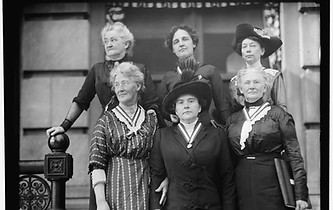
United Daughters of the Confederacy, Public Domain
Realities for Freedwomen
The Freedwomen were eager to test their freedom and had clear ideas of what being free really meant. One unnamed freewoman wrote, “One time some Yankee soldiers stopped and started talking to me—they asked me what my name was. I say Liza, and they say, “Do anybody ever call you [the n-word]?” And I say, “Yes Sir.” He say, “Next time anybody call you [that] you tell ’em dat you is a Negro and your name is Miss Liza.” The more I thought of that the more I liked it and I made up my mind to do jest what he told me to. . . . One evening I was minding the calves and old Master come along. He say, “What you doin’ [n-word]?” I say real pert like, “I’se a Negro and I’m Miss Liza Mixon.” Old Master sho’ was surprised and he picks up a switch and starts at me. Law, but I was skeered! . . . I jest said dat to de wrong person.”
Black women, now free, were not really free though. On May 25, 1911, Laura Nelson and her son L.D. Nelson were lynched from a bridge over the North Canadian River due to allegations that L.D. Nelson shot and killed George H. Loney, who was Okemah’s deputy sheriff. This killing transpired after the deputy sheriff and a mob of individuals showed up at the Nelson household and accused Laura Nelson’s husband, Austin Nelson, of stealing a cow. Although it is not documented who fired the shot that killed the deputy, it is said that he was shot in self- defense. It is also said that Laura grabbed the gun first and L.D. fired the shot, but there is no record of what actually transpired. Following this incident, Austin, Laura, and L.D. Nelson were taken into custody. Laura and L.D. were charged with murder and awaited trial in the Okemah county jail. Austin pleaded guilty to larceny and was sent to the state prison in McAlester for three years.
According to police officer,W.L. Payne, who was in charge of guarding the cells, a lynch mob of approximately forty white men, tied, bound, and gagged him at gun point. After doing this, they proceeded to kidnap Laura and L.D. Nelson. Although it is presumed that Laura had a baby with her during her stay in jail and lynching, there are no records indicating the existence or survival of the child. After their kidnapping on May 24, the press reported that Laura was raped and then hung along with her thirteen-year-old son L.D. from the Old Schoolton Bridge that ran over the North Canadian River.
Following the event, sightseers gathered to take photos with the hanging bodies. Although a grand jury was convened, Laura and L.D.’s killers were not identified or charged. Despite the fact that there is no exact recounting of the specific details of the events, it is evident that two African American individuals were denied their rights to go through the legal system, instead the community took it upon themselves to take justice into their own hands rather than allowing a fair judicial sentencing. This postcard is one of the few visual records of the lynching of a woman. Aside from the postcard, Laura and her family are memorialized through the works of Woody Guthrie and Andrew Hardaway. Guthrie produced a song entitled, “Don’t Kill My Baby and My Son,” and Hardaway wrote a two-act play, Falling Eve, inspired by the Nelson lynching.

Lynching of Laura and L.D. Nelson, Public Domain
Conclusion
By the end of this era, so much remained in question. Would Black women find freedom after Reconstruction? Would these women find a place in the reform movements of the period? How would Southern women’s new found roles impact the suffrage movement? And could former masters and enslaved women learn to respect one another?