7. 100 BCE- 100 CE Women and the Roman Empire
Roman history includes many powerful and fascinating women. Cleopatra helped to define Roman history through her relationships with Roman leaders. The wives of Roman leaders, such as Octavia and Scribonia, as well as their daughters, also played prominent roles in the empire’s history. Women also fought Roman expansion. Boudica, Zenobia, and Kandake were strong women who led powerful anti-imperial forces. Both inside and outside of Rome, women played politics, fought, and led.
How to cite this source?
Remedial Herstory Project Editors. " 100 BCE - 100 CE - WOMEN AND THE ROMAN EMPIRE" The Remedial Herstory Project. November 1, 2025. www.remedialherstory.com.
Trigger Warning: This chapter references rape and sexual assault.
As river valley settlements had become city-states, city-states became empires. The Mesopotamian empires that had dominated ancient times dissolved into the Persian and eventually Macedonian Empires, spreading Greek culture around the Mediterranean world. The Romans eventually surpassed the Greeks and conquered most of Europe, the Middle East, and North Africa, between 500 BCE to around 500 CE. In China, the first empire, the Qin, known for its harsh legal rule, was replaced by the Han from 200 BCE to 200 CE. But did women live and thrive in these empires? Likewise, were any opposed to these empires?
Join the Club
Join our email list and help us make herstory!
Rome
Si bien Roma superó a las ciudades-estado griegas, la cultura romana se construyó sobre los modelos griegos que la precedieron. Sus creencias religiosas politeístas explicaron el cambio de nombre de la mayoría de los dioses griegos por nombres romanos equivalentes. Roma también adoptó la mayoría de las ideas griegas sobre medicina, filosofía, cultura y el lugar de la mujer.
El control legal de los bienes de las mujeres frecuentemente recaía en su padre o tutor masculino. Sin embargo, para proteger la fortuna familiar, a veces se casaba a mujeres de la élite sin transferir el control legal de los bienes a sus maridos. Esto les permitía administrar su propia fortuna. Asimismo, durante el reinado de Augusto, este promulgó una ley que establecía que las mujeres libres que tuvieran tres o más hijos estaban exentas de tutela. De lo contrario, las mujeres estaban bajo el control de los hombres.
Las interminables conquistas de Roma implicaron que cientos de miles de mujeres y hombres fueran traídos al imperio como esclavos. La esclavitud estaba profundamente arraigada en la cultura romana como castigo de los dioses. Las esclavas realizaban trabajos domésticos, trabajaban en burdeles, eran bailarinas, actrices y, en ocasiones, sus dueños masculinos las utilizaban con fines sexuales.
A medida que Roma se expandía, se convirtió cada vez más en una sociedad guerrera donde la masculinidad estaba estrictamente definida y los hombres eran evaluados por sus éxitos como soldados y propietarios. En su vida privada, esto significaba que los hombres romanos tenían control absoluto sobre sus esposas, hijos y esclavos, incluyendo el derecho a matarlos sin interferencia de nadie, ni siquiera del gobierno. La libertad absoluta se convirtió en parte de la identidad masculina. A medida que el imperio se expandía y el control gubernamental se infiltraba en la vida privada, también lo hacía el poder decisorio del cabeza de familia.
Las mujeres participaban en esta cultura guerrera criando hijos valientes y transmitiéndoles los valores del estado guerrero. Las madres romanas, al igual que las espartanas antes que ellas, solían decirles a sus hijos que iban a la guerra: «Regresa con tu escudo o sobre él».
A pesar de la persistente creencia de que las mujeres no debían recibir educación, las mujeres romanas de clase alta aprovecharon la necesidad de formar guerreras fuertes y cultas para justificar su propia educación como madres y futuras esposas de líderes militares. Aun así, poco cambió para la mujer romana promedio. Las mujeres comunes recibían la educación justa para servir en el hogar y criar a sus hijos.
Los hombres contemporáneos se mantuvieron firmemente opuestos a la educación femenina. Tito Livio, uno de los primeros historiadores romanos, afirmó: «La mente de una mujer se ve influenciada por pequeñas cosas». Publio Siro dijo: «Una mujer que medita sola medita el mal». El poeta romano Décimo Junio Juvenal.
Escribió su misoginia en un poema: «Pero de todas las plagas, la mayor es la indescriptible; el libro de la esposa erudita, en griego y latín en negrita». Si los eruditos de la época tenían opiniones tan despectivas sobre las mujeres, había pocas posibilidades de formación, reconocimiento y archivo de los logros femeninos.
Sin embargo, sí conocemos a algunas mujeres, en particular a las más elitistas. Su poder o proximidad al poder significaba que sus vidas e historias quedarían registradas.

Relieve de Tellus Mater, la diosa romana de la tierra.
Cleopatra
Across the Mediterranean from Rome, Cleopatra, one of the most famous female rulers in World History, came to power. Cleopatra was the last leader of Ptolemaic Egypt, but her reign had a huge influence on Rome and was a crucial element of the transition of Rome into the Roman Empire. Cleopatra tried to keep Egypt in play as a major world power in the wake of crushing Roman conquest as well as both internal and external threats.
In 51 B.C., the Egyptian throne passed to 18-year-old Cleopatra and her 10-year-old brother, Ptolemy XIII. As is all too common in politics, her brother’s advisors soon painted her as a political threat, and she was forced to flee to Syria. Refusing to see her power stripped away, she raised an army of mercenaries and returned the following year to face her brother’s forces in a civil war. She was known to be financing the war, and she also made sure to be present on the battlefield.
She used all the weapons at her disposal, including her political guile. When Julius Caesar came to Alexandria, Cleopatra had herself smuggled into his headquarters to ask for his support in this war against her brother. Finding mutually beneficial ground, they eventually united against her brother, and successfully overthrew him. She also subsequently gave birth to Caesar’s son in 47 BCE.
After this, Cleopatra maintained a long, strained relationship with Caesar and Rome, where Caesar had relocated her, but after his assassination, she saw herself potentially in the crosshairs of the new Roman Empire. Returning to Egypt, she worked to gain the respect of the people for herself and her son, even identifying herself as a vessel of the goddess Isis, which was typical of Egyptian royalty trying to secure their power.
Internal strife always followed Cleopatra. Her younger sister Arsinoe, who had been exiled, was looking to dethrone Cleopatra. Seeking additional security, Cleopatra found herself in a political and romantic alliance with Caesar’s long-time friend and ally Mark Antony - her ultimate undoing. In her first formal meeting with the general, Plutarch wrote, “she brought with her her surest hopes in her own magic arts and charms.”
Antony was in his own power struggle with Julius Caesar's designated successor, his nephew Octavian (the eventual Augustus). As a result of this power struggle, the empire had been divided into three sections. In an attempt to secure peace, Octavian's sister, Octavia the Younger, had been married off to Antony. The marriage was initially successful, but tensions mounted and Antony and Octavian were soon at war. In 36 BCE, Antony left to command troops in Parthia resuming his alliance and romantic liaison with Cleopatra. Octavia, despite his betrayal and infidelity, personally brought him troops and money. When she arrived, he refused her, and three years later obtained a divorce.
Meanwhile, Cleopatra brought her ships and soldiers to aid Antony in the Battle of Actium in 31 BCE, but they lost and she and Antony fled to Alexandria, only to be cornered by Octavian’s forces. Both committed suicide, and their bodies were carried in a victory parade in Rome, while Octavia raised Antony’s children by Cleopatra along with their own children.
Cleopatra was labeled as a seductress by Roman historians because of her relationships with powerful men. These relationships were undoubtedly romantic in nature, and she used the opportunity to protect her power, which is perhaps fitting of the label. Yet, perhaps, in protecting her own power, she protected her people in the process. In all, Cleopatra stood with some of the most famous figures of the classical world.

Cleopatra y César

Painting titled, “The Triumph of Cleopatra”
Candace Amanirenas
Más al sur, otra monarca africana se preparaba para enfrentarse a Roma y poner fin a su expansión hacia el sur. A diferencia de Cleopatra, ella triunfaría, o algo así. Los romanos iniciaron incursiones hacia el sur, en dirección al Imperio de Kush, por lo que los kushitas planearon un ataque preventivo contra las ciudades ocupadas por los romanos en el sur de Egipto y tuvieron éxito inicialmente, pero su rey murió en batalla.
La reina Kandake Amanirenas (cuyo nombre significa "gran mujer") y su hijo lideraron de nuevo a los kushitas hacia el norte para enfrentarse a los romanos en el año 25 a. C. Los romanos respondieron liderando 10 000 soldados hacia el sur. Si bien ambos bandos lograron victorias y sufrieron pérdidas durante los tres años siguientes, el resultado fue prácticamente un punto muerto. Más importante aún, tras el éxito de las negociaciones, Kandake Amanirenas libró a su pueblo de la dominación al establecer una nueva frontera romana y un tratado de paz que se mantuvo vigente hasta el siglo III d. C.

Relieve que representa a Kandake Amanirenas
Emperatrices de Roma
Back in Rome, Cleopatra’s defeat and continued Roman expansion led to wealth and a long line of powerful empresses. Caesar’s successor, Octavian, was surrounded by powerful women who defined and navigated his political leadership.
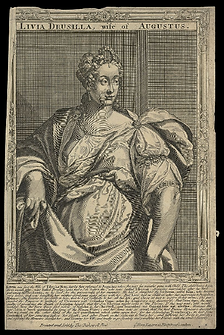
Octavian’s wife, Scribonia, bore only one child, a daughter, Julia. When she was only a few days old, Augustus fell in love with Livia Drusilla at first sight and they both promptly divorced their spouses. As empress consort, Livia was active in politics and governed her own affairs. She pushed him towards making her son, Tiberius, his heir.
Augustus forced Tiberius to divorce his wife and instead marry his daughter Julia, her second political marriage, for legitimacy. Julia already had two daughters with her first husband, another Julia and Agrippina the Elder, and this was a marriage neither Julia nor Tiberius wanted. When their only child died in infancy, any semblance of happiness they had was gone. Julia was left alone in Rome, where she lived a promiscuous life. Roman author Macrobius claimed she was a witty and intelligent woman who was loved by the people, but her sexual activity led Augustus to exile her as a “disease in my flesh.” She died from malnutrition while in exile.
Augustus gave his wife Livia the title of Augusta, guaranteeing that she would maintain her title after he died in 14 CE. He also left her one third of his estate. Her son Tiberius found her power hard to maneuver around, between her wealth and the influence she maintained through political allies. But Tiberius’s rule was problematic for other reasons; mostly because Julia the Elder’s daughters were wreaking havoc on his legitimacy. Agrippina the Elder accused him of murdering her husband, whom she had nine children with. When Tiberius’s son died, her sons came into the line of succession, so Tiberius used political maneuvering to have her and her older sons exiled. Agrippina died in 33 CE, but her cause of death is disputed.
Three of her daughters survived, and her remaining son became Tiberius’s successor, Emperor Caligula, in 37 CE. Caligula was by all accounts a terrible ruler, so his sisters - Julia and Agrippina the Younger - plotted to kill him. Agrippina was exiled for a short time, but when Caligula was finally murdered, her uncle and third husband, Claudius, brought her back to Rome. Agrippina was labeled by historians as the “first true empress of Rome.”
Despite coming out of exile, her path forward was not clear or easy. Claudius’ third wife was executed for having an affair with a Senator, so Agrippina the Younger needed to navigate her path cautiously, which she did. He eventually elevated her title to the one his grandmother, Livia, had: Augusta. He also elevated Livia to deity status. Despite being an empress consort, Agrippina wanted to exercise real power. According to some sources, Claudius was sickly, weak and not suited for imperial life, although by the standards of his successors he did a pretty okay job, and Agrippina was visible in politics and sat next to Claudius at occasions of state. For five years there was prosperity, but Roman historians tell us Agrippina wanted even more influence, so she murdered Claudius and installed her infamous son: Nero.
Her influence clearly continued, as gold coins from right after Nero became emperor show him nose-to-nose with his mom, with the title, “Wife of the Deified Claudius, Mother of Nero Caesar.” Yet, Roman historians who recorded Nero’s legacy sought to paint him as the epitome of a corrupt, debaucherous, and evil ruler and painted much the same picture of Agrippina. The Roman historian Tacitus alleged that Agrippina was so desperate for power after murdering her husband that she seduced her own son. Similarly, he had her killed because she was too powerful and Senators were teasing him for being “ruled by a woman” and his manhood was threatened.
Regardless of the likely exaggerations, Nero did order his mother killed. Later, Nero apparently had his first wife, and step-sister, Claudia Octavia (the daughter of Claudius) banished, bound, and stabbed before suffocating her in a hot bath. He then murdered his second wife, Poppaea Sabina, by kicking her pregnant belly. It’s hard to know what is true and what is not, because the authors of these texts were blatantly biased against Nero, but a lot of this probably tells us more about the historians. It is interesting that ill-treatment of women was used to demonstrate the evil nature of a ruler, which perhaps suggests that treating your women well was to be admired.
Although Nero is remembered now for killing Christians, intentionally burning Rome, and other ridiculous things, a lot of evidence shows that Nero was not unpopular with the people. He clashed with the Senate and wealthy elites because they wanted to maintain their wealth, but the Roman Empire could no longer be governed like a city-state. As Rome exploded across the known world, taxes had to be raised, and soldiers sent to defend land, as the government had difficulty defending its vast territory from the many “barbarian” tribes moving into Roman lands.
Livia Drusilla

Coins depicting Claudius and Agrippina
Libertino (adj.) , indulgencia excesiva en los placeres sensuales, indulgencia excesiva en los placeres sensuales.
Boudica de Gran Bretaña
En el año 60 d. C., a medio mundo de distancia, una reina icena de la isla de Britania, Boudica, asumió el papel de guerrera para su pueblo. Los icenos habían acogido con satisfacción a los romanos, viéndolos como un aliado poderoso y potencialmente beneficioso durante las primeras expediciones de César. Sin embargo, en los esfuerzos coloniales posteriores, los romanos se granjearon numerosos enemigos entre las tribus de Britania, incluyendo a aquellas que habían ofrecido alianzas a César años antes, al obligarlas a aceptar acuerdos económicos y políticos que solo beneficiaban a Roma. El aumento de la opresión con el paso de los años daría lugar a numerosas rebeliones, grandes y pequeñas, pero ninguna generó tanto temor como la de Boudica.
Al fallecer su esposo, dejó testamento que nombraba al emperador romano coheredero junto con sus dos hijas adolescentes. Esperaba que esto protegiera a su pueblo conservando parte de su poder y que también complacería a Roma al otorgarles una parte de su fortuna y tierras. Sin embargo, Roma no tenía ningún interés en obedecer la voluntad de un rey fallecido y reclamó la totalidad de las tierras de la tribu como suyas.
Pronto, los romanos parecieron arrebatarles sus tierras. Cuando Boudica se opuso, fue azotada sin piedad delante de su pueblo. Peor aún, arrastraron a sus hijas ante ella y las violaron. Boudica se rebeló y vengó a su propia familia, así como a su familia tribal. Consiguió el apoyo de las tribus vecinas, que se unieron para liberarse de la amenaza romana. Algunos argumentaron que utilizó falsos presagios y brujería para convencer a otros de seguirla, aunque esto proviene principalmente de historiadores romanos parciales.
Pronto, lideró a sus ejércitos tribales unidos contra las ciudades coloniales romanas. La brutalidad no era solo una táctica romana, pues sus ejércitos eran conocidos por brutalizar a la población, llegando incluso a incendiar un templo romano con cientos de personas en su interior. Su éxito parecía estar marcado por un resplandor de gloria al destruir múltiples ciudades romanas y aliadas, hasta el punto de que las autoridades romanas no tuvieron más remedio que enviar un ejército contra ella.
Diez mil romanos se enfrentaron a Boudica y su pueblo en un lugar desconocido. Cuando se encontraron, supuestamente contaba con un ejército de 230.000 hombres. Si bien esta cifra es exagerada, es probable que Boudica contara con una fuerza mayor, dado que se trataba de personas que defendían sus propias tierras, pero muchos de sus soldados estaban mal entrenados o mal equipados en comparación con las fuerzas romanas profesionales. Aun así, se dice que las fuerzas de Boudica estaban compuestas por hombres y mujeres, jóvenes y ancianos, que la seguían a ella y a sus hijas en su carruaje a la batalla. Según Tácito, ella cabalgaba al frente de su pueblo en un carro con sus hijas, «vengando, no como una reina de gloriosa ascendencia, su reino y poder arrebatados, sino como una mujer del pueblo, su libertad perdida, su cuerpo torturado por el látigo, el honor mancillado de sus hijas. La codicia romana había progresado tanto que ni sus propias personas, ni su edad, ni su virginidad, quedaron impolutas».
Desafortunadamente, sus fuerzas fueron derrotadas por los legionarios romanos, y Boudica, al igual que Cleopatra, prefirió el suicidio a la captura. Sigue siendo un símbolo de libertad, unidad y valentía en la cultura británica. Irónicamente, su estatua se alza en la misma ciudad que incendió: Londres.

Boudica
Flog (v.), beat (someone) with a whip or stick as punishment or torture.

Estatua de Boudica y sus hijas liderando su ejército, Londres
Zenobia del Medio Oriente
Boudica was not the only leader to challenge Rome. Zenobia was queen of the Palmyrene Empire, formed as a breakaway kingdom from the Roman Empire amid power struggles in the Third Century CE. Unlike Boudica, who fought Rome directly, Zenobia cleverly constructed an expansive empire right under their nose until her power could no longer be ignored.
Born in a Roman province, Zenobia was a Roman citizen and possibly had ties to prominent, historic Roman families. However, she proclaimed that she was a descendant of Hellenistic royalty, including Cleopatra and Dido. Long before she came to power, Arabic histories indicate that she developed her characteristic stamina, equestrian skills, and her experience in leading men.
She later married the Roman governor of Syria from the city of Palmyra, which was an important trade center on the Silk Road where merchants had to pay taxes both on their way to and from Rome. Yet, with increasing incursions by the Parthian Empire, the Romans attempted to reassert their authority and reconquer their territories in the region, which failed epically until Zenobia’s husband, Odaenthus, marched against the Persians and reinstated Roman rule. He was rewarded with governorship of the eastern portion of the empire.
Odaenthus became more and more powerful. However, around 266 CE, he was assassinated by his nephew. Some ancient historians hinted that Zenobia herself was behind the assassination. Zenobia's son inherited the throne, but because he was still a child, she ruled in his place.
Palmyra had a solid relationship with Rome at the time, and Odaenthus was even considered a possible successor for the emperor. Initially, Zenobia saw the same potential for herself and her son, but as the chaos of the Crisis of the Third Century continued, she decided not to wait. In 269 CE, she sent her army into Roman Egypt and claimed it as her own, but cleverly did so under the guise of putting down a local revolt, and thereby looking like she was doing so in favor of Rome. Contemporary historians contended that she sent instigators to start the revolt. She not only gained control of Egypt, but soon the areas of the Levant and parts of Asia Minor, all while proclaiming loyalty to Rome. Only five years into her rule as regent, and two years after her conquest of Egypt, she created an empire that began to rival the two major powers on either side of her - the Roman and Persian Empires - but neither seemed to even realize what she was doing.
When Aurelian became emperor, he was a military man who was intent on bringing order back to Rome through force. He turned on Zenobia’s blooming empire in 272 CE, destroying everything in his path. Cities soon surrendered to him before he even reached them to ensure their safety. Zenobia tried to reach the emperor and assure him of her (questionable) loyalty, but he didn't respond, and in his silence, she raised her army in preparation for battle.
Unfortunately for the warrior queen, Aurelian’s forces slaughtered her’s, not only at the Battle of Immae, but again outside of Emesa where Zenobia had retreated to regroup. Though defeated, this is not to say her and her people didn’t put up quite a fight in the process. Aurelian wrote,
It cannot be told what a store of arrows is here, what great
preparations for war, what a store of spears and of stones; there is no section of the wall that is not held by two or three engines of war, and their machines can even hurl fire. Why say more? She fears like a woman, and fights as one who fears punishment. I believe, however, that the gods will truly bring aid to the Roman commonwealth, for they have never failed our endeavors.
She and her son fled toward Persia. The skilled equestrians had outpaced his pursuing cavalry for some time, but they were finally caught trying to cross the Euphrates River and were brought back to Rome.
Her fate is contested. Some historians claimed she was paraded through the capital city, as many prisoners had been, chained and publicly shamed. Some proclaim that she died on the way to Rome. Others say she was put on trial in Rome, but was ultimately acquitted when claiming that she was innocent and simply misled by advisors. Others still say that she was not only acquitted, but actually married a prominent Roman and had a daughter who was later married to Aurelian himself.
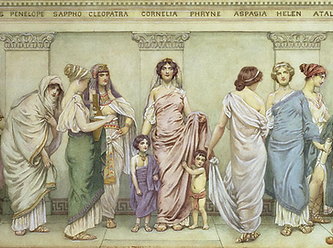
While she may or may not have met a noble end for the warrior queen that she was, Zenobia, like the other leading women of the ancient world, had proven her ability to weather the hardships and consequences of war. Historians described her as being a leader who worked her soldiers hard, and could out-hunt and out-drink any one of them. More modern historians have analyzed that she had deftly used the stereotypes of her gender both in her methods of building her empire and possibly in her trial after the fact, allowing the men around her to assume she was weaker or more naïve than she truly was. In doing so, she created a powerful army and empire, that while short-lived, was one of her own creation, and her authority became a primary target of the greatest empire of the ancient world. Zenobia was one of the most powerful, although under-appreciated figures of the ancient world.

Zenobia
Levante (n.) , una extensión de tierra que bordea el mar Mediterráneo en el oeste de Asia y que incluye los actuales Israel, Jordania, Líbano, Siria, los territorios palestinos y la mayor parte de Turquía al suroeste del Éufrates medio.
Asia Menor (n.) , la protuberancia más occidental de Asia desde el mar Mediterráneo al sur, el mar Egeo al oeste, el estrecho turco al noroeste y el mar Negro al norte.
Acquitted (v.), free (someone) from a criminal charge by a verdict of not guilty.
Cuadro titulado “Grandes mujeres de la antigüedad”
Conclusion
Dentro y fuera del Imperio Romano, las mujeres participaron en los asuntos de su época. Trabajaban en el ámbito doméstico como amas de casa y madres, actuaban en los mercados, eran prostitutas y esclavas, y competían por el poder.
Las mujeres también desempeñaron un papel destacado en la consolidación y el desafío del imperio. Ascendieron al poder en medio de las restricciones y expectativas de sus sociedades. Si bien estos casos excepcionales son conocidos, miles de mujeres líderes se han perdido en el tiempo.
¿Qué más podemos aprender sobre estas mujeres? ¿Cómo influyeron las diferencias de clase y región en sus experiencias? ¿Por qué estas mujeres simbolizan su época o región? ¿Qué lecciones encierran sus historias para el liderazgo femenino en los siglos venideros?