22. Women and the Cold War
Women were pivotal in many aspects throughout the Cold War. They were soldiers, pilots, code breakers, nurses, and more. They supported the Cold War either on the front lines or from home. Of course not every woman supported war; in the Vietnam war many found themselves sympathetic with the Vietnamese women. Towards the end of the Cold War women found their social positions constantly changing, but sexism routinely held them back.
How to cite this source?
Remedial Herstory Project Editors. "22. WOMEN AND THE COLD WAR." The Remedial Herstory Project. November 1, 2025. www.remedialherstory.com.


Following WWII, the US and its former ally, the Soviet Union, or USSR, entered into a Cold War. Though they were at odds, direct fighting between these two nuclear superpowers was somehow avoided. An “iron curtain” fell on Europe: dividing the eastern, totalitarian communists from the western, democratic capitalists. For the US, the Cold War was about stopping, or containing, the spread of totalitarianism and defending capitalism. US officials saw communist governments anywhere as an expression of Soviet power and influence. Thus the election of communist leaning governments or the popularity of communist leaning movements were seen as a threat not just to American power but to American prosperity more generally, a prosperity that relied on networks of free trade and exchange. For the Soviets, the Cold War was about stopping the corruption and exploitation of capitalism. Although the failures of communism would prove impossible to overcome, it was a long journey to the collapse of the USSR. In the meantime, the two superpowers backed opposite sides of many hot conflicts of the period. Some conflicts between the USSR and the US included the conflicts in Korea, Cuba, Vietnam, and many other disagreements. In the midst of these global crises, women played an important role.
Although tensions between the US and the USSR had long been present, this tension remained unnamed until the end of WWII. Though the US and USSR had, with their allies, defeated the Axis powers together, the US had also beat the Soviets in the race for nuclear power. Both countries’ rapidly advancing technologies launched them into a battle for nuclear supremacy, control of space, and influence around the world. The first major hot spot of the Cold War was in Korea.
Many women were already working as cryptologists from WWII, so in the Cold War, the US took women’s roles a step farther and employed them as spies. Since the US was doing it, the USSR was likely using women too. Some of the most well known Soviet spies were women--including Ethel Rosenberg, executed with her husband in 1953 for passing atomic secrets to the Soviet Union. And it was American women working in counter intelligence who helped bring them down, including one particular woman Angeline Nanni. Women like Nanni unmasked many now infamous Soviet spies embedded in the British and German government. These spies’ work was so highly classified that President Harry Truman likely didn’t even know about it. These women didn’t look like your stereotypical spies. They carried handbags, played bridge, and liked to picnic. Most started out as school teachers with a deep mastery of language and math.
While they had been allies during the war, with the end of war the US and the USSR became competitors, vying for military superiority and geographic influence globally. After Japan collapsed, the US tried to defend the formerly Japanese-occupied Korea from communist takeover. The Chinese had experienced their own communist revolution at the end of WWII, and Americans feared that as Korea’s closest neighbor, Chinese communism would not confine itself to China.
At the time, 120,000 women were on active duty in Korea. A third of them were healthcare providers, while the remainder were Women’s Army Corps (WACs), Women in the Air Force (WAFs), Navy Women’s Reserves and Women Marines. Many of these women had already been involved in WWII, they simply continued their duty. Also, Congress passed the Women’s Armed Services Integration Act in 1948, just two years before the outbreak of hostilities in Korea. The act opened the door for women to serve in the armed services on a more permanent basis. Sadly, 18 women died during the Korean War in service to the US.
A war medic, Shirley Gates McBride observed that the army treated women pretty equally, at least in regard to pay. “[We got] the same pay. You were not a female soldier; you were a soldier. And, you were a ‘corpsman’, not a ‘corpswoman.’ It was ‘yes, ma’am and ‘no, ma’am,’ and ‘yes, sir’ and ‘no, sir.’”
Private Doris Porpiglia recalled her time in the Army. While her immediate family was proud of her, her aunt was not and told her it wasn’t a lady's place. Porpiglia replied, “I am more of a lady than you’ll ever be!” Does war have anything to do with being a lady or a man?
A Navy recruiter, Patricia Johnson of Sterling, VA, believed that the growing acceptance of women in this traditionally male field was not only significant to the military field itself--but led to women’s advancement in broader society. The Korean conflict was long and difficult. The war started and ended with neither side gaining much territory. However, Korea was only the opening act to the Vietnam War that would almost immediately follow.
Totalitarianism (Noun.), a system of government that is centralized and dictatorial and requires complete subservience to the state.
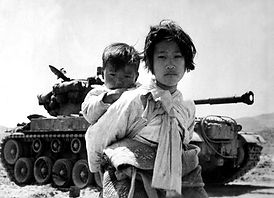
With her brother on her back a war Korean girl trudges by a stalled M-46 tank, at Haengju, Korea, Public Domain
Join the Club
Join our email list and help us make herstory!
The Cuban Missile Crisis of 1962
Juanita Moody was one of the few US women who had risen the ranks in cryptology and was actually in charge of a unit. It was her team that discovered that there was something suspicious going on in Cuba. She could see ships from the USSR bringing in supplies under the cover of night. Plus microwave towers were being installed. It was Moody’s report that was taken to the White House. President John F. Kennedy read it, but she worried not enough was being done. So she pressed the NSA to make an unprecedented move–publishing the info to the larger intelligence community. She said, “It has reached the point that I am more worried about the trouble we’re going to get in having not published it, because someday we’re going to have to answer for this. And if we do....”
The report thankfully pushed the government to investigate. They flew U2 planes over Cuba and saw nuclear launch sites. Cuba was not a nuclear country, so where were these weapons coming from? The presence of nuclear weapons in Cuba was particularly troublesome, because of its proximity to the continental United States.
As the crisis continued, Moody spent sleepless nights on a cot in her office. The Soviets sailed for Cuba with nuclear weapons. The US installed a naval blockade. Moody used a new technology called teletype to pass the most current, relevant, top secret information from her team to the powers that be. With ships facing off and active war as close as it could be, President Kennedy struck a deal with the Soviet’s leader Khrushchev. He would remove weapons from Turkey so long as the Soviets would not bring their weapons to Cuba. The crisis was averted.
Moody received the Federal Woman’s Award, established to honor “leadership, judgment, integrity, and dedication” among female government employees. Despite being the brains behind the most dangerous moment in human history when she was asked about her past by those outside the intelligence community, Moody would humbly say, “Oh, I’ve done lots of interesting things for a country girl from North Carolina.”
Being a woman at the National Security Agency was challenging. Female leaders were often alone in a world of men and subject to sexual harassment by their male colleagues. To make matters worse, women typically had few options for complaint. Even Juanita Moody was frequently harassed, overlooked for promotion, and once spoon fed at a party as a joke.

Juanita Morris Moody, from a 1971 issue of Civil Service Journal, Public Domain
Women Strike for Peace
The Cuban Missile Crisis was terrifying to live through. It led many people to join the growing peace movement opposed to nuclear proliferation– after all, Earth could not survive a hot conflict between the US and USSR. Claudia Jones became a leader in the peace movement. She was an immigrant communist herself and an outspoken advocate for peace. She believed that war and nuclear weapons were capitalist tools to limit freedom struggles, contain non-white populations globally, and undermine women's liberties. She argued women’s leadership was essential in the peace movement.
As actual war was becoming more of a reality around the globe, women worked tirelessly toward anti-proliferation. In 1959, Members of the Greater St. Louis Citizens Committee for Nuclear Information, along with some schools of dentistry worked to show how radioactive fallout from nuclear testing in Nevada was entering the food and milk supply and significantly impacting children’s health. Women across the country collected and donated 320,000 baby teeth for the research. In 1963, they released the “Tooth Fairy” study that showed babies born after testing began were 50 times more likely to have cancer causing chemicals in their teeth.
Bella Abzug and Dagmar Wilson founded Women Strike for Peace, a peace activist group with the goal of stopping nations from nuclear testing to slow down the arms race. On November 1, 1961 Women Strike for Peace got 50,000 women marching onto the streets. It was the largest national women’s peace protest of the 20th century. Leading ladies, Jackie Kennedy and Nina Khrushchev both supported this work. Coretta Scott King was a delegate for Women Strike for Peace at the disarmament conference, stating, “We are on the brink of destroying ourselves through nuclear warfare.” King convinced the USSR and the West to sign the Limited Nuclear Test-Ban Treaty.
This work was incredibly important to disrupting gender norms, women were pushing themselves into topics of national security policy. And on that topic there were significant gender divides. Only 38 percent of American women supported nuclear testing, compared to 58 percent of men.
In 1962, newspapers said, “[f]or the most part, they stress femininity rather than feminism.” Their feminine and maternal demeanor got attention and allowed them to achieve radical change. They were empowered by success of effectively working together and many became involved in the second wave feminist movement.

Women Strike for Peace, 1962, Public Domain
Vietnam War
American involvement in the Vietnam war was complicated. Vietnam’s struggle for independence against their colonizer, France, was long and costly for both sides. The Vietnamese revolutionaries let by Ho Chi Minh were nationalists, but they also embraced some ideas from communism that would redistribute wealth and help the poor in Vietnam. When France withdrew from Vietnam in 1954, the US saw only the communism and none of the nationalism in this revolutionary movement and they feared the spread of communism in Southeast Asia. The US began financial and covert initiatives to defend South Vietnam from its communist revolutionaries located in the north of the country. . When one of the US’s secret missions in the Gulf of Tonkin was uncovered, the Communists attacked. In an unprecedented move, Congress approved the Tonkin Resolution, which allowed the US to begin fighting an undeclared war: a war that involved women on both sides of the globe.
The reasons for US involvement in Vietnam were ambiguous, even to US citizens at the time. The 1950’s and 60’s showed an interesting blend of generational differences, with many older WWII Veterans raised on the patriotic ideal that when your country called, you responded. But younger generations, mothers, and civil rights activists were challenging the norms of their parents.
American nurses began training South Vietnamese nurses as early as 1956. Over the course of the Vietnam war, five nurses died, including 52-year-old Lieutenant Colonel Annie Ruth Graham, who served as a military nurse in both World War II and Korea before Vietnam. Sharon Ann Lane of Canton, Ohio was the only nurse killed in Vietnam as a result of enemy fire. Lane was posthumously awarded the Vietnamese Gallantry Cross with Palm and the Bronze Star for Heroism.
Five Navy nurses were wounded when the Communist Viet Cong bombed an officer’s quarters in the southern capital of Saigon on Christmas Eve 1964. They were each awarded the Purple Heart and became the first female members of the U.S. Armed Forces to receive that award in the war. Commander Elizabeth Barrett became the first female naval line officer to hold command in a combat zone in 1972.
The motivations for joining varied from military benefits to pay for nursing school to fulfilling the challenge posed by President Kennedy to “ask what you can do for your country.” Astoundingly, nurses in the military were all volunteers.
In 1962, the American Red Cross began sending volunteers to Vietnam to provide medical support and “a touch of home” to soldiers in the field. Affectionately called “Doughnut Dollies” by the troops, more than 1,200 women served on major bases and remote landing zones. They brought games, refreshments, and activities to tired soldiers who needed a break from the war. Women were sexually objectified and asked to act the “girl next door” to uplift the depleted soldiers.
Women also served as members of the U.S. Air Force Nurse Corps and the Women’s Air Force (WAF) during the Vietnam conflict. Captain Mary Therese Klinker was killed in a crash in April 1975 near Saigon when 138 people were killed including many Vietnamese children and a number of female civilians working for U.S. government agencies. Captain Klinker was posthumously awarded the Airman’s Medal for Heroism and the Meritorious Service Medal.
Within the military, some women spoke out against the war, but they also articulated more general grievances, including sexual harassment and unequal treatment in all branches of the service. They criticized the pervasive sexism that regarded women as inferior soldiers and kept them in subordinate positions. Many women who voiced their concerns were subjected to surveillance, restrictions, undesirable job assignments, and excessive charges filed against them for minor infractions.
The United Service Organization provided entertainment and programs to support military morale in combat zones since 1941. The best-known provider of USO entertainment programs was Bob Hope. Starting in 1964, Hope brought his shows to Vietnam nine times. While he was the main event, Hope’s shows featured female stars who were sexualized as rewards for the brave men fighting abroad.
On the home front, some women supported the war effort as a crusade against communism. They engaged in protests and called on the military to achieve total victory. Women in conservative organizations such as Young Americans for Freedom, along with women whose interest in the war was in bringing their loved ones home, raised their voices in support of soldiers and the politics of anti-communism.
Vietnam impacted the lives of so many Americans, but it was also a distant war. New technologies like TV helped bring the faraway conflict home to the American people. Americans on the nightly news could actually see how the conflict was impacting everyday citizens in Vietnam–especially the women.
Diane Nash, a civilian leader in the civil rights movement, visited Vietnam in December 1966 along with three other American women and each brought back stories to the media describing what they saw. This was just one of many such "fact-finding" missions undertaken by US citizens early in the conflict in order to report on a war that wasn't receiving the kind of coverage they wanted.
Like WWII before it, there were many ways women proved integral to the Vietnam War. Despite the precedent set by female correspondents in prior wars, they were not always accepted in the field. Nevertheless, women reported, including Gloria Emerson for The New York Times. She received many awards and was praised for her stories.
Pictures of struggling Vietnamese people helped turn the war into one of the most controversial periods of US history. By 1972 many had turned against the war and one particularly powerful image that affected Americans was the photograph of a young Vietnamese girl running to escape napalm, the “liquid fire” that had severely burned her back. Nine years old at the time, the naked and vulnerable “Napalm Girl” symbolized the impact of American war technology on everyday Vietnamese people. This photo solidified the imbalance power dynamic between the United States and the small Southeast Asian nation, already torn by civil war. We now know that the girl in the photograph is Phan Thi Kim Phuc from Trang Bang in South Vietnam. While visuals of Vietnam were startling, the horrors of war could not so easily be glorified when US citizens now had evidence of so many innocent women and children suffering.
The Vietnam War became increasingly unpopular. Tens of thousands of Americans were being drafted and dying every month in a war few could identify a purpose for. As the Vietnam War dragged on into the late-1960s and early 70s, women, especially college women and middle-aged, middle-class white mothers, were increasingly active in the anti-war movement. Organizations such as Students for a Democratic Society (SDS), founded in 1960 and active at as many as three hundred colleges, staged campus demonstrations against military recruitment, war research, and the war altogether. Their opposition stemmed from their opposition to broader Cold War logic.
By 1969, frustration with America’s continuing involvement in Vietnam led SDS to demand more direct action. Bernardine Dohrn led an SDS faction that published a manifesto entitled, “You Don’t Need a Weatherman to Know Which Way the Wind Blows” in New Left Notes. This document made the case for revolution. Dohrn was also active in the Weather Underground, a group committed to answering the violence of the war with violence here at home, including bombings at university buildings.
By 1970, Dohrn was on the FBI’s Most Wanted List, where she remained for several years. Participation in SDS and the Weather Underground inspired some women to join radical feminist groups, as they frequently felt that their voices in the radical anti-war movement were not heard.
Some celebrity women protested American involvement in the Vietnam War. The most prominent of these women were Joan Baez and Jane Fonda. Joan Baez was vocal in the anti-draft movement. She helped promote the slogan, “Girls say yes to boys who say no.” Fonda participated in a troupe of actors and musicians that performed under the name, ”Free the Army”” (more frequently, “F the Army”) that provided entertainment for soldiers in coffee houses near military bases. In May of 1970, Fonda distributed copies of a GI anti-war newspaper, Fatigue Press, at Ford Hood. She was arrested and barred from the base, but she spoke out against the fact that soldiers were prohibited from possessing anti-war literature.
In 1972, Fonda traveled to North Vietnam and posed with soldiers, both men and women, on an anti-aircraft gun used against American bombing raids. She spent two weeks in the north and spoke on the Voice of Vietnam radio, imploring the United States to stop the bombing that was destroying farmland, eliminating the livelihood of local farm families. She also spoke with American prisoners of war and reported that they urged their families to vote for George McGovern in the 1972 presidential election. Upon her return, Fonda was hailed as a hero by some but also broadly accused of treason. Even now, years later, her critics decry her as “Hanoi Jane.”
For women of color the war in Vietnam was difficult. Black Power groups had long adopted an anti-imperialist agenda and found that American policies exploited people of color globally. They had no quarrel with the indigenous people of Vietnam.
One of the most far reaching and effective black anti-war groups was the National Black Anti-War Anti-Draft Union spearheaded by Gwen Patton. She had long been involved in Civil Rights work and felt activists needed an organization that fought at the intersection of racism and imperialism.
Elaine Brown, the only female chairperson for the Black Panther Party, traveled to Vietnam. Her trip helped shape the Panther position on the war. She said, “we were not anti-war activists in the sense that we thought there should just be peace in Vietnam. Our position became very clear and very strong as it evolved. And that was victory for the Viet--Vietnamese, victory for the Vietcong, which was not a very popular position.”
On a broad scale, the relationship of women to the War in Vietnam reflected the relationships of all Americans to the conflict that took more than 58,000 American lives. Whether Vietnamese or American, women fought hard in Vietnam. Meanwhile, some women at home supported and others opposed the war, Some were willing to carry their convictions to radical acts. Most importantly, the actions of American women in the late 1960s and 70s paved the way for changes in society including feminist fervor that created the world we live in today.

Col. Elizabeth P. Hoisington visits with members of the WAC Detachment, Vietnam 1967, Public Domain

"Napalm Girl" Phan Thi Kim Phuc, June 8, 1972, Public Domain

Joan Baez 1966, Public Domain
Women in the Space Race
As Soviet space exploration was far exceeding American capabilities, President Kennedy set the challenge of getting a “man” on the moon by the end of the decade. Meanwhile over in the USSR, Soviet Cosmonaut Valentina Tereshkova, had already become the first woman in space in 1963.
Excitingly, thousands of women supported the space race in the US. Women “computers” (women who did complicated computations to assess trajectory and and flight paths) helped to solidify the math that made the accomplishment possible. Those women included women of color like Mary Jackson, Katherine Johnson, and Dorothy Vaughan, who faced the double challenge of race and gender in a white-male dominated world. Another woman, Margaret Hamilton, led the team behind the code that took the spacecraft to the moon. Much later in life, she was awarded a Presidential Medal of Freedom by President Barack Obama for her work on Apollo.
Because of the challenge set by Kennedy, Women were nowhere near the astronaut corps and therefore NASA had to work with the pilots they had—all men. But! Desegregation laws and Title IX in the 60s and 70s finally gave women greater access to space. In 1983, Sally Ride became the first American woman in space. Ride was followed by other women, including Mae Jemison, who in 1992, became the first Black woman to go to space.
In retrospect, an irony of the Cold War is that the two feuding superpowers often proclaimed competitively to care about many social issues--including women’s rights. In reality, neither country did much for their underserved populations. The Eastern Block championed the world’s workers while treating their own citizens poorly. The United States campaigned for political freedoms abroad while systematically and horribly oppressing or Black and native communities within their borders.
The 1975 UN World Conference on Women in Beijing however, did result in 189 countries unanimously adopting an agenda for women’s empowerment and was considered the key global policy document on gender equality. Today global women’s rights is the greatest human rights issue of our time.

Valentina Tereshkova 1963, Public Domain

Dr. Mae Jemison, July 1992, Public Domain
Conclusion
By the end of this era, so much remained in question. How would women in the US use this international dialog to demand better rights domestically? Would the equal pay found in the armed forces spread to other parts of the economy?