


16. 1300-1500- Renaissance and Ottoman Women: Artists and Thinkers
The term “Renaissance Man” brings to mind male artists, musicians, and scientists. However, no names of women painters or sculptors are as widely known by the public, despite their talents and influence on the cultural landscape of Europe. This section seeks to showcase women's artistic contributions to the Renaissance from all over the world.
How to cite this source?
Remedial Herstory Project Editors. "16. 1300-1500 - RENAISSANCE AND OTTOMAN WOMEN: ARTISTS AND THINKERS" The Remedial Herstory Project. November 1, 2025. www.remedialherstory.com.
Between 1380 and 1580 in Europe, after the plagues and the Mongols had wreaked havoc on Eurasia, societies across the continent experienced a period of rebirth. In Europe, this period has been called a Renaissance. In the Middle East, the period also saw an Islamic Golden Age under the Ottoman Empire. Building on earlier exchanges with the Silk Road, the Islamic world, African cultures, and Europeans turned their attention to their classical past and sought to rebuild it. Women were eager to take part in this endeavor, battling against long-held cultural norms that tried to hold them back.
Join the Club
Join our email list and help us make herstory!
European Women
The term “Renaissance Man” usually refers to a self-made man or a man who has mastered skills in everything from academic work to swordplay. In truth, the “Renaissance Woman” was more likely to be a patron of the arts in this period. Being left out of this terminology was a result of the lack of opportunities for women to get an education or training, rather than a lack of skill or interest. Erasmus of Rotterdam, the most famous proponent of new learning in this time, made the prevailing view of women’s education clear when he wrote, “I do not know the reason, but just as a saddle is not suitable for an ox, so learning is unsuitable for a woman.”
Renaissance society preferred women chaste and in their traditional roles, and laws were established to keep women bound to domesticity. Even women’s clothing choices were taxed in a way to limit their sexual expression. “A Sumptuary Law: Restrictions on Dress” from Florence in 1373 read, “All women and girls, whether married or not, whether betrothed or not, of whatever age, rank, and condition [...] who wear or wear in future any gold, silver, pearls, precious stones, bells, ribbons of gold or silver, or cloth of silk brocade on their bodies or head for the ornamentation of the bodies [...] will be required to pay each year [...] the sum of 50 [coins].”
As society opened to innovation, the new academies and workshops were reserved for men. Wealthy women or the daughters of scholars and artists enjoyed more freedom to learn and to express themselves, but this happened mainly at an individual level. The best-known women of the era were women of means who used their positions to influence and support the artists of their choosing. Yet, that path - and their lives - was not always easy.
Patrons of the Arts
Lucrezia Borgia of Italy is sometimes described as the “Mafia Princess” of the Renaissance, and there’s no denying that her corrupt, politically powerful family used her to make the most of opportunities for alliances. In the late 15th century, Lucrezia was born as the illegitimate daughter of the Catholic Pope, Alexander VI (Rodrigo Borgia); a position that was, at that time, more king-like than a religious calling. Rodrigo Borgia had seen to his daughter’s education. By the age of 12, she could speak six languages and had been tutored by some of Europe’s leading humanist scholars. Borgia’s father lost no time in arranging her first marriage when she was just 13, but he had that annulled as soon as a better match presented itself. Borgia was said to have loved her second husband, Alfonso of Aragon, as her father attempted to annul that marriage as well, and this time, she resisted.
Sadly, not long after, her young husband died mysteriously. Fortunately for Borgia, her third marriage to Alfonso d’Este, the Duke of Ferrara, lasted. When Borgia’s father died in 1503, the political intrigue ended, though her reputation as a seductress only grew as rumors of her love affairs only grew. Still, she was free to create the courtly society she had always dreamed of. While not an artist or writer herself, as Duchess of Ferrara, Borgia supported poets and musicians, made pious and charitable donations to the community, and even oversaw administrative duties when her husband was away.
In this same period, Isabella d’Este, the Marchioness of Mantua and Lucrezia Borgia’s sister-in-law, devoted herself to the arts, fashion, and education. Her extensive correspondence with family, artists, leaders, and religious figures leaves a comprehensive record of her far-reaching interests. D’Este supported a wide range of artists, including painters Leonardo da Vinci and Raphael and sculptors such as Michelangelo. Poets, musicians, even architects graced her court at Mantua. By the end of her life, she had founded a school for girls and turned her home into a museum.
Rising to prominence several decades later, Catherine de Medici was similarly controversial, but she had more political power and influence than Lucrezia Borgia. Like the Borgias, the Medici were no strangers to political intrigue, and Catherine was destined to add to their legacy. She spent part of her youth at the Vatican because her uncle was Pope at that time.
In 1533, Medici was married to the French king, Henry II, in order to solidify an important alliance. Only 14 at the time of her marriage, Medici spent her time at the French court expanding her education and bonding with the ladies of the palace. Although Henry is said to have ignored her for much of their marriage, Medici tried to ingratiate herself to the king and his entourage. Once she began to have the crown-prince’s children, her position was more secure, and although Medici frequently had to compete with Henry’s mistress to get attention at court, she was gradually able to assert her position. When Henry was killed in a jousting tournament in 1559, she was ready to take over.
Women in France could not legally rule in their own names, so Medici influenced political affairs as the Queen Mother while her sons were still young. When her son Francis died at the age of 16, Medici remained as regent because the next prince in line for the throne, Charles, was only ten years old. One of her biggest concerns was maintaining order between factions divided between Catholic and Protestant forces, thus she sought a moderate policy towards Protestants, who were considered heretics in France at the time.
She remained in power when Charles inherited the throne at age 14, and they planned a Grand Tour of the kingdom to celebrate a new era in true Renaissance fashion. The tour featured a festival at every stop during which plays, artistic exhibits, and parades allowed locals to interact with dazzling court culture. A series of tapestries depict the processions, complete with exotic beasts performing stunts. Medici used the arts and entertainment of the day to celebrate her family, and especially her son, and reassure the people that everything would be fine in spite of religious and political threats. The tour lasted two and a half years and brought the splendors of the Renaissance to every corner of the kingdom. For Medici, the Renaissance was not only a way to display her wealth and taste but to solidify her family’s political power.

A portrait of Saint Catherine of Alexandria, believed to be painted in Lucrezia Borgia’s likeness
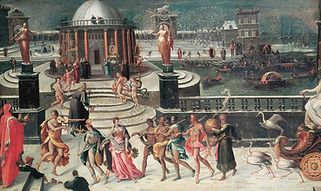
Painting titled, “The Triumph of Winter,” by Antoine Caron, Medici’s official painter

One of the eight Valois Tapestries, titled “Elephant”
Renaissance Writers
Not all women of this time played the role of patron; many of the writers of the Renaissance expressed hopeful ambitions for women at the time. The way was paved by Christine de Pizan, who is sometimes considered the first feminist. Pizan was born in Venice in 1364 but grew up in the French court where her father was the king’s astrologer. Although not noble herself, her participation in the French court gave her contacts and support.
She was married and then widowed quite young and was able to write for a living while her children grew up. She depended on patrons and tended to write whatever they hired her to write - from love ballads to military strategy handbooks. Once her career was established, Christine de Pizan wrote works designed to elevate women in society.
One work, The Book of the City of Ladies, recounted the histories of intellectual women or great leaders and heroes who were women. She wrote this to offset the hateful images of women that were common in the literature of the day. A second book, The Treasure of the City of Ladies, was written as an advice manual for a French princess. Along with advice for princesses and nobles, Christine de Pizan included sections on advice for women of each rank and role in society. She made it clear that all women were essential and that the expectations of a baroness or an artisan’s wife were just as important as those of a leader. She wrote, “No matter which way I looked at it, I could find no evidence from my own experience to bear out such a negative view of the female nature and habits. Even so [...] I could scarcely find a moral work by any author which didn't devote some chapter or paragraph to attacking the female sex."
Not everyone appreciated the role played by patrons of the arts. Dutch poet Anna Bijns lamented how creative work had been diminished by its trendiness in her poem, “’Tis a Waste to Cast Before Swine.” She considered the ability to craft words to be a gift from the Holy Spirit and lamented the fact that so many poets were willing to work on commission for ignorant patrons. In 1528, she wrote,
When Rhetoric I see on sale for money,
Like snow for sun my joy melts away,
And thus I repeat my initial remark:
‘Tis a waste to cast pearls before swine.
Bijns, sometimes referred to as “the Germanic Sappho,” in reference to the Greek poet, never hesitated to speak her mind. She wrote another controversial poem, “Unyoked is Best! Happy the Woman Without a Man.” In it, she warned maidens not to rush into marriage and to consider all their options before they commit to a husband.
Other women writers of the day promoted education for girls, even as they faced challenges. The French poet and adventurer Louise Labé went to war dressed as a man before settling down to write sonnets. Late in her life, she regretted that she had not devoted more time to studying music, philosophy, and history. She wrote to a friend in 1555, “Study differs from other recreations, of which all one can say after enjoying them that one has passed the time. But study gives a more enduring sense of satisfaction [...] for the past delights and serves us more than the present.”

Christine de Pizan lecturing to a group of men
Artists
In the visual arts, women also made an impact, even though they were usually not permitted to enroll in arts academies. Women artists tended to be the daughters of artists who learned the techniques at home. They were also limited in their subject matter in many cases because it was not appropriate for a woman to work with nude models, for example. Thus, the greatest women artists of the Renaissance got their start doing portraits—portraying their subjects at home was a fitting, domestic theme for a respectable woman.
Levina Teerlinc was an artist in Bruges in the mid-16th century. Like her father, she specialized in miniatures of exquisite detail. After her marriage, Teerlinc traveled to England, where she attracted the attention of the royal family. She became a court artist under Henry VIII and stayed in that position through the reign of Elizabeth I. Very little of her work survives today, however, accounts written during her career were especially enthusiastic about a miniature of the Holy Trinity she had presented to Queen Mary and a portrait and a decorated box she made for Elizabeth.
Sofonisba Anguissola was not the daughter of an artist but of an Italian nobleman of modest rank. He was impressed with the literature of the day that promoted education for girls, and he made sure his daughters had every opportunity open to them. Sofonisba was the oldest and her talent was obvious, even when she was a teenager. A visitor to their home saw her portrait of her sisters playing chess, one of her most famous paintings, and wrote that the girls looked almost alive on the canvas.
After her marriage, Anguissola moved to Spain and continued painting portraits. Word of her skill reached King Phillip II, and he invited her to join his court. Once there, she expanded her portraits to adopt a formal style appropriate to the high status of her subjects. Anguissola had such a grand reputation across Europe that other women were inspired to emulate her.
One such painter who sought to emulate the work of Sofonisba Anguissola, was Lavinia Fontana, the daughter of a painter. She benefited from the unique opportunities available in Bologna, where women were permitted to attend university in certain subjects. Fontana earned a doctorate at the university around 1580, and she was also unique in that she was a woman who managed to launch a career outside a court or a convent.
Fontana worked privately for commissions - just like the male artists of the day - working on portraits and also took on large projects with mythical or religious themes. She was very popular, and the noblewomen of Bologna competed for her attention. Many patrons of high status employed her, including one who would go on to become pope. Lavinia Fontana was so successful that her commissions served as her dowry in marriage. Her husband worked as her agent and assistant.
Fede Galizia was the daughter of a painter, but he did not intend to train her until he learned of Sofonisba Anguissola’s career. Reaching her prime around the turn of the 17th century, Galizia is best known for her still-lifes, and she was considered a pioneer for her delicate touch in that artform. Like Fontana, she worked on commission, and also painted portraits and religious works, and was even hired to create altar pieces for a church in Milan.
One of the most interesting things about Galizia is that she was first in a series of women artists to focus on the portrayal of heroic women in the Bible. A popular tale from the Bible was Judith decapitating Holofernes, and Galizia, like the women who emulated her, depicted subjects like Judith as strong and dignified, with none of the suggested sexualization that male artists tended to use.
Just a generation behind Galizia, Artemisia Gentileschi was one of most famous artists of her age who also famously painted Judith decapitating Holofernes. She was raised by her father, who was also a painter, and became a member of the Academy of Arts and Drawing in Florence. She was painting professionally in Venice by the time she was 15, worked on commissions, and briefly served as a court painter, especially for the Medici family. Some of the greatest houses in Italy, such as the family of Michaelangelo, hired her to create a ceiling panel.
Gentileschi also corresponded with great thinkers across Italy, including Galileo Galilei, who may have been the inspiration for the work she did on that ceiling. It features a nude holding a compass, and is entitled “The Allegory of Inclination.” Like Galizia, Gentileschi created a series of paintings of the biblical Judith, as well as other strong women such as Esther, Mary Magdalene, Cleopatra, and Saint Cecilia.
Finally, in the mid-17th century, in Bologna, Elisabetta Sirani had an amazing career, but her life was cut short by a mysterious illness when she was only 27. Her father was a painter and an art dealer who took over the school of his own master and trained Elisabetta himself at first. As Bologna offered opportunities for women, she was able to move on to other academies and eventually opened an art academy for girls.
Sirani did not hesitate to tackle grand historical or religious subjects in her paintings. More than 200 works of hers survive, and she signed just about every piece. Sirani also painted a few versions of Judith and a variety of saints, but she might be best known for her painting, Timoclea Kills the Captain of Alexander the Great. According to the ancient historian Plutarch, Timoclea was a noblewoman in Thebes who was assaulted by the titular captain. In revenge, she pretended to lead him to her hidden wealth at the bottom of a well. When he stooped to look in, Timoclea pushed him to his death.
Sirani was, by all accounts, a dazzling artist. Some observers said she painted with such speed and perfection it was almost like she was “laughing” instead of working. Male critics who refused to believe a young woman could have produced such amazing work challenged her to paint a prince’s portrait in front of an audience to prove it was her own skill. She did so. Suddenly, in August 1665, at the peak of her career she died. While one of her servants was initially accused of poisoning her, it is argued that her death was likely due to a ruptured or untreated ulcer. She had such a loyal following that upon her sudden death, contributions poured in to cover an elaborate funeral. Musicians composed works for the event and poets outdid one another with their heartfelt eulogies.

Miniature of Elizabeth I, painted by Levina Teerlinc
Miniature (n.), a small, fine portrait on vellum, card, copper, or ivory, often kept in a locket or small box.

A self portrait painted by Sofonisba Anguissola

Fontana’s painting, titled, “Wedding Feast at Cana”

Galizia’s painting, titled, “Judith with the Head of Holophernes”

Gentileschi’s painting, titled, “The Allegory of Inclination”
Titular (adj.), denoting a person or thing from whom or which the name of an artistic work or similar is taken.

Sirani’s painting, titled, “Timoclea Kills the Captain of Alexander the Great”
Eulogy (n.), a formal speech given at a funeral in honor of the person who has passed.
Ottoman Women
It is important to note that while these women of unique skill and means had emerged and influenced the world of the arts in Europe, in the same time period, in the Muslim world, just beyond Europe’s borders, women’s rights and freedoms looked considerably different. After the Mongols sacked Baghdad, destroying the riches of the Islamic Empire, the Muslim world was in disarray. Eventually, the Ottoman Empire emerged out of Turkey in the 14th century. There, the role and position of women shifted from the more public roles they had played in Turkish tribes to the more segregated lives they lived in a thriving empire.
The status of women in Islam had certainly declined as Muhammad’s original teachings and views on women melded with the existing cultures where it spread. One Ottoman writer explained, “The responsible officials [have] the great desire to restrain the barbarous and irrepressible bestiality of women who [...] with that reprobate and diabolical nature, force their men, with their honeyed poison, to submit to them.”
When the Ottomans successfully conquered Constantinople in 1453, the empire was poised to control the Mediterranean economy. The Ottoman patriarchy set about doing what all major empires had done before them: telling women what they could and could not do. Women were removed from society as a social convention more than any dictate in Islamic law. During festivals, women were allowed to appear in public, yet old concerns about women’s public morality created a backlash that forced them away again once the festivals had ended.
One of the most enduring images of Ottoman women's segregation is the harem. The exotic and eroticized image of the harem is a Western obsession that overlooks the much more complex functioning of this important institution. The harem represented a contrast between European and Ottoman societies. Ottoman harems were also much different from Chinese harems, though both were eroticized in the Western imagination. In Ottoman society, the harem served to exclude women, but also to grant them freedom of expression. One contemporary observer wrote,
the women dress themselves very richly in silk. They wear cloaks down to the ground, lined just like those of the men. They wear closed-up boots but fitting tighter on the ankle and more arched than those of the men...They are fond of black hair, and if any women by nature does not possess it, she acquires it by artificial means...They decorate their hair with small bands of ribbon and leave them spread over their shoulders and falling over their dress. Covering their hair they have a colored strip of thin silk...On the head they also have a small round cap, neat and close fitting, embroidered with satin, damask, or silk and colored.
Mothers and other relatives of sultans living cloistered lives still became powerful and influential. Women of the harem used their wealth to support important projects and charities such as schools, hospitals, caravansaries, baths, fountains, soup kitchens, hostels, and mosques. Some estimate that about a quarter of Ottoman charitable foundations were started by royal women. This shows that women who owned land in Ottoman society were able to manage their wealth reasonably easily.
Women of all social levels also had the right to manage their property without patriarchal interference. They used the courts to defend their financial control, and it seems in most instances judges upheld these rights. Women were even borrowers and lenders and had their own private businesses.
As is true of every society, lower class women lived different lives from their wealthy peers. They intermingled with men because they ran businesses, performed domestic errands, and did other work that necessitated such conduct. Women monopolized work in textile production, winding silk and spinning cotton, but women also sold food, were traders, operated public baths, brokered slave trades, and were entertainers. In the rural areas, women typically worked in agriculture and animal husbandry.
Ottoman law also created a marriage system that favored men in numerous ways. Muslim men could marry non-Muslim women, but Muslim women could not marry outside the faith. Men were permitted absolute authority over as many as four spouses, but women were permitted only one husband. Men could divorce with relative ease, but women could not. Yet, outside of the law, marriages were a bit more egalitarian than meets the eye. Marriages were arranged, but women obtained prenuptial agreements and had the right to refuse a match. Even though the law allowed up to four wives, in the Ottoman Empire, 95 percent of husbands had only one wife. Muslim women had, in reality, a much easier time getting divorced from neglectful and abusive husbands than their non-Muslim peers within the empire. So much so, that some women would convert to Islam in order to get divorced.
It can be argued that Ottoman women's status was probably equal to that of European women. In 1785, Lady Elizabeth Craven traveled through Crimea to Constantinople, and observed, “I think I never saw a country where women may enjoy so much freedom from all reproach, as in Turkey [...] The Turks in their conduct towards our sex are an example to all other nations.”

Painting titled, “The Battle of Lepanto”
Bestiality (n.), savagely cruel, animal-like, or depraved behavior.
Reprobate (adj.), unprincipled.
Diabolical (adj.), characteristic of the Devil.

Ottoman woman
Caravansaries (n.), an inn with a central courtyard for travelers in the desert regions of Asia or North Africa.
Animal Husbandry (n.), the practice of raising and caring for animals for their products or for captivity.
Prenuptial Agreements (n.), legal agreements signed by both parties before marriage that primarily address the protection and division of property and wealth in the case of divorce.
Conclusion
The Renaissance was a rebirth of art and culture, but it was, in many ways, a rebirth of the patriarchy. While some women were able to achieve great heights and fame in this period, women overall did not see widespread access to education or a major change in their status.
How many more women would we know about today if only they had had the chance to try? How would women find greater access to education and other means of self improvement? And what would bring about that shift?


