


7. 100 BCE- 100 CE Women and the Roman Empire
Roman history includes many powerful and fascinating women. Cleopatra helped to define Roman history through her relationships with Roman leaders. The wives of Roman leaders, such as Octavia and Scribonia, as well as their daughters, also played prominent roles in the empire’s history. Women also fought Roman expansion. Boudica, Zenobia, and Kandake were strong women who led powerful anti-imperial forces. Both inside and outside of Rome, women played politics, fought, and led.
How to cite this source?
Remedial Herstory Project Editors. " 100 BCE - 100 CE - WOMEN AND THE ROMAN EMPIRE" The Remedial Herstory Project. November 1, 2025. www.remedialherstory.com.
Trigger Warning: This chapter references rape and sexual assault.
As river valley settlements had become city-states, city-states became empires. The Mesopotamian empires that had dominated ancient times dissolved into the Persian and eventually Macedonian Empires, spreading Greek culture around the Mediterranean world. The Romans eventually surpassed the Greeks and conquered most of Europe, the Middle East, and North Africa, between 500 BCE to around 500 CE. In China, the first empire, the Qin, known for its harsh legal rule, was replaced by the Han from 200 BCE to 200 CE. But did women live and thrive in these empires? Likewise, were any opposed to these empires?
Join the Club
Join our email list and help us make herstory!
Rome
While Rome surpassed the Greek city-states, Roman culture was built on the Greek models that preceded it. Its polytheistic religious beliefs accounted for the renaming of most of the Greek gods with equivalent Roman names. Rome also adopted most Greek ideas about medicine, philosophy, culture, and a woman’s place.
The legal control of women’s property frequently remained with their father or male guardian. However, in order to protect family fortunes, elite women were sometimes married off without transferring legal control of property to their husbands. This allowed those women to manage their own fortunes. Likewise, during the reign of Augustus, he passed a law that stated free-born women who bore three or more children were free from guardianship. Otherwise, women were under the control of men.
Rome’s endless conquests meant that hundreds of thousands of women and men were brought into the empire as slaves. Slavery was deeply embedded in the culture of Rome as punishment from the gods. Female slaves did domestic work, worked in brothels, were dancers, actresses, and were sometimes used for sex by their male owners.
As Rome expanded, it increasingly became a warrior society where masculinity was strictly defined and men were measured on their successes as soldiers and property owners. In their private lives, this meant that Roman men had absolute control over their wives, children, and slaves, including the right to kill them without interference from anyone - not even the government. Absolute freedom became a part of the male identity. As the empire expanded and government control seeped into people's personal lives, so did the life-and-death power of the (male) head of household.
Women participated in this warrior culture by raising brave sons and passing on the values of the warrior state to their children. Roman mothers, like the Spartans before them, were known to tell their sons going off to war, "Return with your shield or on it.”
Despite the persistent belief that women should not be educated, upper class Roman women capitalized on the need to build strong and educated warriors to justify their own educations as mothers and future wives of military leaders. Still, little changed for the average Roman woman. Ordinary women were educated just enough to serve the home and rear their children.
Male contemporaries remained staunchly opposed to women’s education. Titus Livy, one of the first Roman historians, stated, “a woman’s mind is influenced by little things.” Publius Syrus said, “A woman who meditates alone meditates evil.” Roman poet Decimus Junius Juvenal
wrote his misogyny in a poem, “But out of all plagues, the greatest is untold; the book learned wife, in Greek and Latin bold.” If the scholars of the era held such derogatory views of women, there was little possibility for the training, recognition, and archiving of female achievements.
Yet, we do know about some women, notably the most elite of elite women. Their power or proximity to power meant that their lives and stories would be recorded.

Relief of Tellus Mater, the Roman earth goddess
Cleopatra
Across the Mediterranean from Rome, Cleopatra, one of the most famous female rulers in World History, came to power. Cleopatra was the last leader of Ptolemaic Egypt, but her reign had a huge influence on Rome and was a crucial element of the transition of Rome into the Roman Empire. Cleopatra tried to keep Egypt in play as a major world power in the wake of crushing Roman conquest as well as both internal and external threats.
In 51 B.C., the Egyptian throne passed to 18-year-old Cleopatra and her 10-year-old brother, Ptolemy XIII. As is all too common in politics, her brother’s advisors soon painted her as a political threat, and she was forced to flee to Syria. Refusing to see her power stripped away, she raised an army of mercenaries and returned the following year to face her brother’s forces in a civil war. She was known to be financing the war, and she also made sure to be present on the battlefield.
She used all the weapons at her disposal, including her political guile. When Julius Caesar came to Alexandria, Cleopatra had herself smuggled into his headquarters to ask for his support in this war against her brother. Finding mutually beneficial ground, they eventually united against her brother, and successfully overthrew him. She also subsequently gave birth to Caesar’s son in 47 BCE.
After this, Cleopatra maintained a long, strained relationship with Caesar and Rome, where Caesar had relocated her, but after his assassination, she saw herself potentially in the crosshairs of the new Roman Empire. Returning to Egypt, she worked to gain the respect of the people for herself and her son, even identifying herself as a vessel of the goddess Isis, which was typical of Egyptian royalty trying to secure their power.
Internal strife always followed Cleopatra. Her younger sister Arsinoe, who had been exiled, was looking to dethrone Cleopatra. Seeking additional security, Cleopatra found herself in a political and romantic alliance with Caesar’s long-time friend and ally Mark Antony - her ultimate undoing. In her first formal meeting with the general, Plutarch wrote, “she brought with her her surest hopes in her own magic arts and charms.”
Antony was in his own power struggle with Julius Caesar's designated successor, his nephew Octavian (the eventual Augustus). As a result of this power struggle, the empire had been divided into three sections. In an attempt to secure peace, Octavian's sister, Octavia the Younger, had been married off to Antony. The marriage was initially successful, but tensions mounted and Antony and Octavian were soon at war. In 36 BCE, Antony left to command troops in Parthia resuming his alliance and romantic liaison with Cleopatra. Octavia, despite his betrayal and infidelity, personally brought him troops and money. When she arrived, he refused her, and three years later obtained a divorce.
Meanwhile, Cleopatra brought her ships and soldiers to aid Antony in the Battle of Actium in 31 BCE, but they lost and she and Antony fled to Alexandria, only to be cornered by Octavian’s forces. Both committed suicide, and their bodies were carried in a victory parade in Rome, while Octavia raised Antony’s children by Cleopatra along with their own children.
Cleopatra was labeled as a seductress by Roman historians because of her relationships with powerful men. These relationships were undoubtedly romantic in nature, and she used the opportunity to protect her power, which is perhaps fitting of the label. Yet, perhaps, in protecting her own power, she protected her people in the process. In all, Cleopatra stood with some of the most famous figures of the classical world.

Cleopatra and Caesar

Painting titled, “The Triumph of Cleopatra”
Kandake Amanirenas
Further south, another female African monarch prepared to face Rome and end its expansion southward. Unlike Cleopatra, she would succeed - sort of. Romans began incursions south toward the Empire of Kush, so the Kushites planned a preemptive attack on Roman-held cities in southern Egypt and were initially successful, but their king died in battle.
Queen Kandake Amanirenas (whose name means “great woman”) and her son, again led the Kushites north to engage the Romans in 25 BCE. Romans responded by leading 10,000 soldiers southward. While each side achieved victories and sustained losses over the following three years, the result was basically a stalemate. More significantly, succeeding in negotiations, Kandake Amanirenas spared her people from domination by establishing a new Roman boundary and peace treaty that held until the 3rd century CE.

Relief depicting Kandake Amanirenas
Empresses of Rome
Back in Rome, Cleopatra’s defeat and continued Roman expansion led to wealth and a long line of powerful empresses. Caesar’s successor, Octavian, was surrounded by powerful women who defined and navigated his political leadership.
Octavian’s wife, Scribonia, bore only one child, a daughter, Julia. When she was only a few days old, Augustus fell in love with Livia Drusilla at first sight and they both promptly divorced their spouses. As empress consort, Livia was active in politics and governed her own affairs. She pushed him towards making her son, Tiberius, his heir.
Augustus forced Tiberius to divorce his wife and instead marry his daughter Julia, her second political marriage, for legitimacy. Julia already had two daughters with her first husband, another Julia and Agrippina the Elder, and this was a marriage neither Julia nor Tiberius wanted. When their only child died in infancy, any semblance of happiness they had was gone. Julia was left alone in Rome, where she lived a promiscuous life. Roman author Macrobius claimed she was a witty and intelligent woman who was loved by the people, but her sexual activity led Augustus to exile her as a “disease in my flesh.” She died from malnutrition while in exile.
Augustus gave his wife Livia the title of Augusta, guaranteeing that she would maintain her title after he died in 14 CE. He also left her one third of his estate. Her son Tiberius found her power hard to maneuver around, between her wealth and the influence she maintained through political allies. But Tiberius’s rule was problematic for other reasons; mostly because Julia the Elder’s daughters were wreaking havoc on his legitimacy. Agrippina the Elder accused him of murdering her husband, whom she had nine children with. When Tiberius’s son died, her sons came into the line of succession, so Tiberius used political maneuvering to have her and her older sons exiled. Agrippina died in 33 CE, but her cause of death is disputed.
Three of her daughters survived, and her remaining son became Tiberius’s successor, Emperor Caligula, in 37 CE. Caligula was by all accounts a terrible ruler, so his sisters - Julia and Agrippina the Younger - plotted to kill him. Agrippina was exiled for a short time, but when Caligula was finally murdered, her uncle and third husband, Claudius, brought her back to Rome. Agrippina was labeled by historians as the “first true empress of Rome.”
Despite coming out of exile, her path forward was not clear or easy. Claudius’ third wife was executed for having an affair with a Senator, so Agrippina the Younger needed to navigate her path cautiously, which she did. He eventually elevated her title to the one his grandmother, Livia, had: Augusta. He also elevated Livia to deity status. Despite being an empress consort, Agrippina wanted to exercise real power. According to some sources, Claudius was sickly, weak and not suited for imperial life, although by the standards of his successors he did a pretty okay job, and Agrippina was visible in politics and sat next to Claudius at occasions of state. For five years there was prosperity, but Roman historians tell us Agrippina wanted even more influence, so she murdered Claudius and installed her infamous son: Nero.
Her influence clearly continued, as gold coins from right after Nero became emperor show him nose-to-nose with his mom, with the title, “Wife of the Deified Claudius, Mother of Nero Caesar.” Yet, Roman historians who recorded Nero’s legacy sought to paint him as the epitome of a corrupt, debaucherous, and evil ruler and painted much the same picture of Agrippina. The Roman historian Tacitus alleged that Agrippina was so desperate for power after murdering her husband that she seduced her own son. Similarly, he had her killed because she was too powerful and Senators were teasing him for being “ruled by a woman” and his manhood was threatened.
Regardless of the likely exaggerations, Nero did order his mother killed. Later, Nero apparently had his first wife, and step-sister, Claudia Octavia (the daughter of Claudius) banished, bound, and stabbed before suffocating her in a hot bath. He then murdered his second wife, Poppaea Sabina, by kicking her pregnant belly. It’s hard to know what is true and what is not, because the authors of these texts were blatantly biased against Nero, but a lot of this probably tells us more about the historians. It is interesting that ill-treatment of women was used to demonstrate the evil nature of a ruler, which perhaps suggests that treating your women well was to be admired.
Although Nero is remembered now for killing Christians, intentionally burning Rome, and other ridiculous things, a lot of evidence shows that Nero was not unpopular with the people. He clashed with the Senate and wealthy elites because they wanted to maintain their wealth, but the Roman Empire could no longer be governed like a city-state. As Rome exploded across the known world, taxes had to be raised, and soldiers sent to defend land, as the government had difficulty defending its vast territory from the many “barbarian” tribes moving into Roman lands.
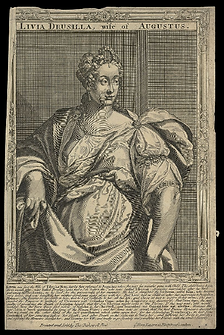
Livia Drusilla

Coins depicting Claudius and Agrippina
Debaucherous (adj.), excessive indulgence in sensual pleasures., excessive indulgence in sensual pleasures.
Boudica of Britain
In 60 CE, half a world away, an Iceni queen on the island of Britain, Boudica, took up the mantle of warrior for her people. The Iceni had once welcomed the Romans, seeing them as a powerful, and potentially beneficial ally during the early expeditions by Caesar. However, in the later colonial efforts, the Romans made a number of enemies among the tribes of Britain, including those who had offered alliances to Caesar in the years before, by forcing them into economic and political arrangements that only benefited Rome. Increased oppression over the years would lead to a number of rebellions, large and small, but none created such fear as Boudica’s.
When her husband died, he left behind a will that named the Roman emperor co-heir with his two teenage daughters. His hope had been that this would protect his people by maintaining some of their power, and would also please Rome by giving them a share of his fortune and lands. However, Rome had no interest in obeying the will of a dead king, and claimed the entirety of the tribe’s lands as their own.
Soon, the Romans appeared to take their lands. When Boudica objected, she was mercilessly flogged in front of her people. Far worse, her daughters were dragged in front of her and raped. Boudica rose up and avenged her own family, as well as her tribal family. She gained support from surrounding tribes who united to free themselves from “the Roman menace.” Some argued that she used false omens and witchcraft to convince others to follow her, though that comes mainly from biased Roman historians.
Soon, she led her united tribal armies against Roman colonial towns. Brutality was clearly not just a Roman tactic, as her armies were known to brutalize the population, even burning down a Roman temple with hundreds inside. Her pattern of success seemed marked by a blaze of glory as she destroyed multiple Roman and Roman-allied towns, to the point that Roman officials had no choice but to send an army against her.
10,000 Romans confronted Boudica and her people at an unknown location. When they met, she supposedly had an army of 230,000. While this number is extreme, it is likely that Boudica had the larger force given that they were people defending their own lands, but many of her soldiers were undertrained or ill-equipped compared to professional Roman forces. Still, it is said that Boudica’s forces consisted of men and women, young and old, following her and her daughters’ carriage into battle. According to Tacitus, she rode in front of her people on a chariot with her daughters, “avenging, not, as a queen of glorious ancestry, her ravished realm and power, but, as a woman of the people, her liberty lost, her body tortured by the lash, the tarnished honor of her daughters. Roman cupidity had progressed so far that not their very persons, not age itself, nor maidenhood, were left unpolluted."
Unfortunately, her forces were routed by the Roman legionaries, and Boudica, like Cleopatra, chose suicide over capture. She still remains a symbol of freedom, unity, and courage in British culture. Her statue stands, ironically, in the very city she burned down: London.

Boudica
Flog (v.), beat (someone) with a whip or stick as punishment or torture.

Statue of Boudica and her daughters leading their army, London
Zenobia of the Middle East
Boudica was not the only leader to challenge Rome. Zenobia was queen of the Palmyrene Empire, formed as a breakaway kingdom from the Roman Empire amid power struggles in the Third Century CE. Unlike Boudica, who fought Rome directly, Zenobia cleverly constructed an expansive empire right under their nose until her power could no longer be ignored.
Born in a Roman province, Zenobia was a Roman citizen and possibly had ties to prominent, historic Roman families. However, she proclaimed that she was a descendant of Hellenistic royalty, including Cleopatra and Dido. Long before she came to power, Arabic histories indicate that she developed her characteristic stamina, equestrian skills, and her experience in leading men.
She later married the Roman governor of Syria from the city of Palmyra, which was an important trade center on the Silk Road where merchants had to pay taxes both on their way to and from Rome. Yet, with increasing incursions by the Parthian Empire, the Romans attempted to reassert their authority and reconquer their territories in the region, which failed epically until Zenobia’s husband, Odaenthus, marched against the Persians and reinstated Roman rule. He was rewarded with governorship of the eastern portion of the empire.
Odaenthus became more and more powerful. However, around 266 CE, he was assassinated by his nephew. Some ancient historians hinted that Zenobia herself was behind the assassination. Zenobia's son inherited the throne, but because he was still a child, she ruled in his place.
Palmyra had a solid relationship with Rome at the time, and Odaenthus was even considered a possible successor for the emperor. Initially, Zenobia saw the same potential for herself and her son, but as the chaos of the Crisis of the Third Century continued, she decided not to wait. In 269 CE, she sent her army into Roman Egypt and claimed it as her own, but cleverly did so under the guise of putting down a local revolt, and thereby looking like she was doing so in favor of Rome. Contemporary historians contended that she sent instigators to start the revolt. She not only gained control of Egypt, but soon the areas of the Levant and parts of Asia Minor, all while proclaiming loyalty to Rome. Only five years into her rule as regent, and two years after her conquest of Egypt, she created an empire that began to rival the two major powers on either side of her - the Roman and Persian Empires - but neither seemed to even realize what she was doing.
When Aurelian became emperor, he was a military man who was intent on bringing order back to Rome through force. He turned on Zenobia’s blooming empire in 272 CE, destroying everything in his path. Cities soon surrendered to him before he even reached them to ensure their safety. Zenobia tried to reach the emperor and assure him of her (questionable) loyalty, but he didn't respond, and in his silence, she raised her army in preparation for battle.
Unfortunately for the warrior queen, Aurelian’s forces slaughtered her’s, not only at the Battle of Immae, but again outside of Emesa where Zenobia had retreated to regroup. Though defeated, this is not to say her and her people didn’t put up quite a fight in the process. Aurelian wrote,
It cannot be told what a store of arrows is here, what great
preparations for war, what a store of spears and of stones; there is no section of the wall that is not held by two or three engines of war, and their machines can even hurl fire. Why say more? She fears like a woman, and fights as one who fears punishment. I believe, however, that the gods will truly bring aid to the Roman commonwealth, for they have never failed our endeavors.
She and her son fled toward Persia. The skilled equestrians had outpaced his pursuing cavalry for some time, but they were finally caught trying to cross the Euphrates River and were brought back to Rome.
Her fate is contested. Some historians claimed she was paraded through the capital city, as many prisoners had been, chained and publicly shamed. Some proclaim that she died on the way to Rome. Others say she was put on trial in Rome, but was ultimately acquitted when claiming that she was innocent and simply misled by advisors. Others still say that she was not only acquitted, but actually married a prominent Roman and had a daughter who was later married to Aurelian himself.
While she may or may not have met a noble end for the warrior queen that she was, Zenobia, like the other leading women of the ancient world, had proven her ability to weather the hardships and consequences of war. Historians described her as being a leader who worked her soldiers hard, and could out-hunt and out-drink any one of them. More modern historians have analyzed that she had deftly used the stereotypes of her gender both in her methods of building her empire and possibly in her trial after the fact, allowing the men around her to assume she was weaker or more naïve than she truly was. In doing so, she created a powerful army and empire, that while short-lived, was one of her own creation, and her authority became a primary target of the greatest empire of the ancient world. Zenobia was one of the most powerful, although under-appreciated figures of the ancient world.

Zenobia
Levant (n.), a stretch of land bordering the Mediterranean Sea in western Asia which includes present-day Israel, Jordan, Lebanon, Syria, the Palestinian territories and most of Turkey southwest of the middle Euphrates.
Asia Minor (n.), the westernmost protrusion of Asia from the Mediterranean Sea to the south, the Aegean Sea to the west, the Turkish Straits to the northwest, and the Black Sea to the north.
Acquitted (v.), free (someone) from a criminal charge by a verdict of not guilty.
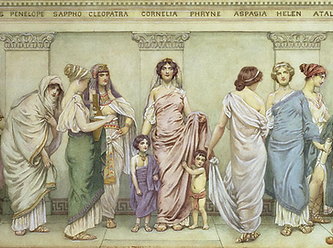
Painting titled, “Great Women Of Antiquity”
Conclusion
Inside and outside the Roman Empire, women participated in the issues of their time. Women labored in the domestic sphere as homemakers and mothers, they acted in the markets, were prostitutes and slaves, and they jockeyed for power.
Women also played prominent roles in securing and challenging the empire. They rose to power amid the restrictions and expectations of their societies. While these outliers are known, many thousands of female leaders have been lost to time.
What more can we learn about these women? How did the layers of class and region change their experiences? Why are these women symbolic of their time or region? What lessons do their stories hold for female leadership in the centuries to come?


