7. Women in the Abolition Movement
Women of all races identified with the abolition movement–some as Christians, some as humanitarians, some from personal experience–and many became notorious household names for their quest to end slavery in the United States.
How to cite this source?
Remedial Herstory Project Editors. "7. WOMEN IN THE ABOLITION MOVEMENT" The Remedial Herstory Project. November 1, 2025. www.remedialherstory.com.


It’s easy to compartmentalize the various human rights struggles of history. Most human rights issues are, and always have been, linked. The struggle for the emancipation of enslaved people was intertwined with the struggle for women’s rights: both in terms of the people advocating for it, and in the systemic and political issues they raised. As members of an oppressed class themselves, women intimately understood the issues at stake and brought empathy, compassion, intelligence, and organizational skills to the abolition movement.
Join the Club
Join our email list and help us make herstory!
Abolition was a Women's Cause
Recognizing the connection between racial and gender oppression, iconic suffrage pioneer Susan B. Anthony famously urged her followers to “make the slave’s case our own.” But she was just one of many examples.
Advocacy for the abolition movement began in the colonial period. Phyllis Wheatly brought abolitionist ideas to American culture with her poetry. Wheatley was born in West Africa and taken to Boston as a child. In 1773 she was emancipated and became the first published African-American woman poet. Her poems included the reflection on slavery, “On Being brought From Africa,” which opened people’s eyes to the humanity of enslaved people. Her work was even praised by George Washington.
One of America’s earliest advocates for ending slavery was Abigail Adams, who once counseled her husband to “remember the ladies” when he and the Continental Congress were debating independence. In September of 1774, Abigail wrote to John: “I wish most sincerely there was not a Slave in the province. It always appeared a most iniquitous scheme to me—fight ourselves for what we are daily robbing and plundering from those who have as good a right to freedom as we have.” For Abigail Adams, the cause of liberty meant liberty for all.
Leading up to the Civil War, many women called for abolition in private letters and poems, but it was highly unusual for a woman, especially an African-American woman, to speak publicly on the matter. On September 21, 1832, Maria W. Miller Stewart spoke before the African-American Female Intelligence Society in Boston’s Franklin Hall. Stewart’s jeremiad, a form of speaking derived from the sermons of New England ministers, accused white Americans of breaking their covenant with God by supporting slavery. Stewart believed that God would judge Americans for the sin of slavery. She traveled throughout New England sharing her message with Christian Americans.
Women who had experienced the horrors of slavery were incredibly powerful representatives of the abolition movement. Amy Hester (Hetty) Reckless was born into slavery in southern New Jersey. She escaped violence at the hands of her mistress and settled in Philadelphia in 1826, operating a safe house on the underground railroad and supporting education for black children. In 1833, Hetty became a founding member of the Philadelphia Female Anti-Slavery Society. Reckless also worked with the Female Vigilant Association starting in 1838, assisting enslaved people on their Underground Railroad journey, often at considerable personal risk.
Black Women Writers
Black women also wrote powerful pieces to teach people about the horrors of slavery. In 1861, Harriet Jacobs published her autobiography, "Incidents in the Life of a Slave Girl." The book chronicles Jacobs’s life on a North Carolina plantation. She wrote about her abuse and her escape from her owner who sought to sexually abuse her. She got out by hiding in a crawlspace in her grandmother’s attic for seven years. When Jacobs finally escaped to New York, she worked as a nanny while supporting both the abolitionist and feminist causes. Her employer eventually purchased her freedom, and Jacobs helped found two schools for formerly enslaved people.
Harriet Tubman was also an impressive figure. After her escape from bondage, Tubman made thirteen trips back to the south to free more than seventy enslaved people. In addition, Tubman gave many powerful speeches on behalf of abolition and women’s rights. Even though she could neither read nor write.
Sojourner Truth, who escaped from slavery in 1826, also rose to prominence speaking about intersectional equal rights. Her speech, “Ain’t I a Woman?” reminded folks that Black women were women too, and yet were not treated as such. It profoundly integrated the issues of racial and gender equality, and reminds us that women’s history isn’t experienced the same way for all women.
In spite of their own struggles to gain equal legal and social rights in American society, American women were in the forefront of the struggle to end slavery. They wrote pamphlets, gave speeches on behalf of enslaved people, and they dedicated their lives and their talents to the task of improving the lives of freed people.
.jpg)
Harriet Jacobs, Public Domain
_(LOC)_(38899564300).jpg)
Harriet Tubman, Public Domain
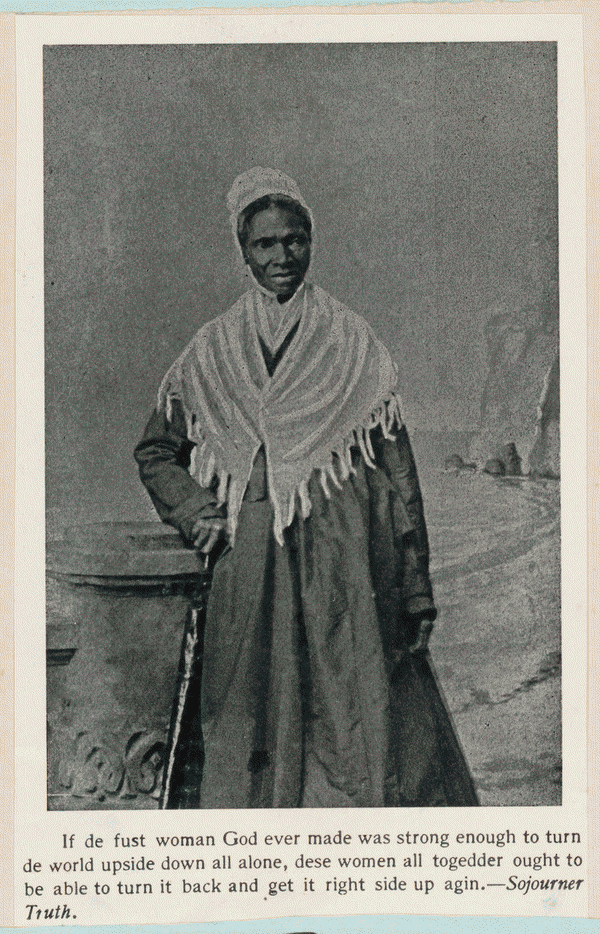
Sojourner Truth, Public Domain
White Women Writers
More and more white women began to connect the struggle for emancipation from slavery to the journey for equal legal and social rights for women. Margaret Fuller, a philosopher and Transcendentalist colleague of Thoreau and Emerson, noted that restrictions on the economic and political freedom of women were comparable to the restrictions imposed on enslaved people. To be clear, the conditions of women and enslaved persons were not the same. Legally not being allowed to own property is not the same as being property, but Fuller’s point allowed others to consider a more equality-oriented perspective.
Lucretia Mott was active in William Lloyd Garrison’s American Anti-Slavery Society and helped to found the Philadelphia Female Anti-Slavery Society in 1833. She was a Quaker preacher, accustomed to speaking her mind in religious spaces, and found it difficult to reconcile that she could not do that outside her congregation. Her sister, Martha Coffin Wright was a friend and supporter of Harriet Tubman. Both were organizers of the first women’s rights convention in 1848 at Seneca Falls, NY.
Lydia Maria Child insisted abolition should be included in a broader social reform context. Born into a religious family, Child trained to be a teacher and founded a school in Watertown, Massachusetts in 1826. She published the Juvenile Miscellany, a magazine for children, but she lost her southern subscribers when she published her anti-slavery views. However, that didn't stop her. In 1833 Child argued for immediate emancipation of enslaved people in An Appeal in Favor of that Class of Americans Called Africans.
While most people relate abolition to the northern states, there were certainly Southern women who worked to end slavery, too. Sarah and Angelina Grimke were born into unimaginable wealth and raised on a South Carolina plantation that included hundreds of enslaved people. The family was so wealthy that each family member had their own personal slave. Using Christian arguments of charity and compassion, both sisters came to abhor slavery. In the 1820s, Angelina wrote to William Llyod Garrison and he published her letter in his journal The Liberator. She was widely criticized, and her writings were burned in Charleston. Despite the ridicule, the Grimke sisters doubled down and became among the most vocal and famous critics of slavery. As feminists, they broke the taboo regarding women’s presence on the lecture circuit, which contributed to their profound and positive influence on both movements, but they faced considerable backlash. When they traveled through New England speaking to “mixed audiences,” a mob of protesters surrounded them. Their male abolitionist peers tried to withdraw them from the speaking circuit, which devastated both of them. How could the men on their side stop them from speaking against slavery?
The Grimke sisters were originally inspired to oppose slavery in part because their brother had children with an enslaved woman. One of these children was Francis James Grimke, who later served as a minister in Washington, D. C.. He married Charlotte Louise Bridges Forten, who came from a prominent free Black abolitionist family in Philadelphia. Forten’s family had a long history of helping enslaved people escape bondage. She trained as a teacher, becoming the first Black graduate of the Salem Normal School in 1856. She was one of the first African-American teachers in Salem and was a member of the Salem Female Anti-Slavery Society, a precursor of the black women’s club movement that flourished in the early twentieth century.
Another South Carolina native, Mary Boykin Chesnut, was the matriarch of a family that owned nearly 1,000 slaves. However, in February of 1861, as Confederate war sentiment was increasing in intensity, Mary Chesnut began to compose a diary that revealed the inner life of the plantation. While not specifically an abolitionist document, Chesnut’s diary, which was published long after her death, provided important material for historians hoping to understand the life of the plantation.
Some women contributed to the abolitionist cause by articulating a religious and moral position against slavery. Harriet Beecher Stowe was a member of a famous family of ministers. In 1832, Harriet moved with her father to Cincinnati, Ohio, a river town that was a northern destination for many escaping enslaved people. She’d listen to debates about slavery in her dad’s Seminary group, and after hearing about the absolutely legal terror happening to human beings, she used her talent to take a stand against oppression. In 1852, while sitting upstairs in the attic and having her sister watch her many children, Stowe wrote and published Uncle Tom’s Cabin, which detailed the horrific conditions and dangers of plantation life. The book and play based on the story were both wildly popular. Legend has it that President Abraham Lincoln told Stowe in 1862, “So you are the little woman who wrote the book that started this great war.” While perhaps a backhanded compliment, it can’t be denied that Stowe’s work affected her readers’ opinions of the political issue. Her home was even a stop along the underground railroad.

Sarah Moore Grimké, Public Domain
Talking Women
Black or white, these talking women were seen as unsexing themselves by addressing “mixed audiences” of both men and women—a practice considered inappropriate for women in the 19th century. Their bold actions drew support from some and strong criticism from others, creating a national conversation about women’s proper role in public life. Sometimes, they were even likened to whores. Mobs of people would turn up to protest—not necessarily their ideas about slavery— but the fact that they were speaking to men in public. Women even received death threats to scare them back into their sphere.
The Grimké sisters defended their right to speak publicly by arguing that women could not effectively help enslaved people if they were required to remain silent. They pointed out that women were often criticized for even small forms of activism—circulating petitions, participating in women-only meetings, or singing in church. If women accepted these restrictions, they argued, they would never be able to contribute meaningfully to the antislavery cause. Sarah Grimké took this further, explaining in her published letters that women had long been kept legally and socially subordinate to men. She wrote that women had no political existence, no right to control their own property, and were denied equal educational opportunities. For her, the struggle for women’s rights and the fight against slavery were connected, because both involved overturning unjust systems of power.
Margaret Fuller challenged the idea that women belonged only in the home and should focus solely on domestic responsibilities. She argued that this limited view of women’s “sphere” failed to recognize women’s intellectual abilities or their potential to contribute to society. Fuller pointed out that many women could not rely on men for lifelong protection and would need education, independence, and the ability to stand on their own at times. Because women’s minds were capable of growth and deep thought, she believed they should have the freedom to learn, express themselves, and participate in public discussions.
One of the ironies of women’s history is that patriarchal norms are often upheld by other women. Catharine Beecher, a well-known educator and writer, believed strongly that men and women had different roles assigned by God. In her view, men were naturally suited for public leadership, while women were meant to be peacekeepers within the home. She believed women’s influence came from their ability to guide loved ones through kindness and moral example, not through speeches or political involvement. Beecher worried that public speaking would expose women to ridicule, conflict, and even danger. She thought that once women stepped into public debates, they risked losing the special respect and protection that society granted them. According to Beecher, even signing petitions to Congress pulled women out of their “appropriate sphere” and threatened the social order.
A more complicated voice in the debate was Theodore Weld, a leading abolitionist and Angelina Grimké’s future husband. Weld personally supported women’s equality and believed that women were just as capable as men in every area of life. However, he worried that the Grimké sisters’ decision to speak publicly about women’s rights, in addition to abolition, might weaken the antislavery movement. He felt that their unique background as Southern women speaking against slavery gave them a powerful advantage that could be lost if critics focused instead on their bold statements about gender equality. Weld believed that abolition should remain the priority and that the struggle for women’s rights could follow later.
In the end, the debate over women’s public speaking was about much more than speeches—it was about Lockean views of the public and private spheres. It raised questions about whether women should be allowed to participate fully in American democracy, whether their talents were equal to men’s, and whether they had a responsibility to speak out against injustice.
By the late 1850’s the divisions between the north and south were too intense to be ignored. Talk of secession was eminent. John Brown, a radical abolitionist from New York who had done his part to protest slavery in Bleeding Kansas, led a raid on Harper’s Ferry, Virginia. Harriet Tubman was supposed to be with him, but she was on another mission. For many southerners, Brown’s raid showed the end was near. Southerners were already on edge, and when Lincoln was elected as president in 1860, it was the last straw.
When Julia Ward Howe met President Lincoln in 1861, she penned new words to the familiar tune, “John Brown’s Body,” and “The Battle Hymn of the Republic” was created. The song was a popular and invigorating anthem among Union soldiers not only toward victory, but the moral imperative to end slavery. She said:
“Let the Hero, born of woman, crush the serpent with His heel,
Since God is marching on. As He died to make men holy,
let us die to make men free; While God is marching on.
He is coming like the glory of the morning on the wave,
He is wisdom to the mighty, He is honor to the brave;
So the world shall be His footstool, and the soul of wrong His slave,
Our God is marching on.”

Julia Ward Howe, Public Domain
Conclusion
Social norms in the 19th Century demanded middle-class and wealthy women devote their energies to home and family; however, as the nation underwent dramatic shifts, those expectations were frustrating and stifling to many women. In order to fight for the causes that were important to them–morally and religiously–many of these women had to upset gender norms. In the fight for racial equality, these women had to pursue gender equality, too. Thus, American women found their voice and their place in both the struggles for women’s rights and the abolition movement. As we’ve learned, some women wrote books, others wrote songs. Some started schools, others risked their lives on the Underground Railroad. Some had power and wielded it to help others, and some women were born enslaved but became powerful through their actions. Regardless of how these women, and many more like them, attempted to create a more equal country, their attempts would not be in vain.
By the end of this era, so much remained in question. Would the federal government get involved? Would this come to war? Would women’s advocacy be well received? How would women’s politicization impact their role in society? Was suffrage an obvious next step?