


6. Mathematics
“It was due to the camouflage intentionally placed over their presence in science” — Margaret Rossiter.


Join the Club
Join our email list and help us make herstory!
Emmy Amalie Noether
Albert Einstein called her the most “significant” and “creative” female mathematician of all time. Born in Erlangen, Germany in 1882, Noether was a brilliant woman living in a time when women were not expected or accepted at Universities, and a Jewish woman who would come of age as the Nazis’ rose to power. Noether was born into a mathematical family, both her father and her brother were mathematicians. Unable to officially attend the university, Noether audited all the courses, passed the final exams, and did so well she was granted a degree.
Noether studied numbers. But not just numbers, she studied how numbers could be manipulated and still remain constant. Consider the relationship between the Earth and the Sun, while the shape of the orbit of the Earth around the Sun may changed, the gravitational attraction between the two remains the same. Or imagine a tree that rotates on its axis (its trunk), a symmetrical tree will look the same as you spin it around. Puzzling right?
After Einstein published his theory of relativity, Noether couldn’t resist. And her work with this complex theory led to link the underlying geometry of the universe and how mass and energy behave. Essentially, tying everything to everything in one inspired, revolutionary theorem — energy and momentum follow from symmetry in time and space. And you thought math was just math!
As, Natalie Angier of the New York Times explained in 2012,
“Wherever you find some sort of symmetry in nature, some predictability or homogeneity of parts, you’ll find lurking in the background a corresponding conservation of momentum, electric charge, energy or the like.” It is to Noether we owe the insight that energy can be neither created nor destroyed but merely changes form.
Noether never married. She was one of the first Jewish scientists to be fired and forced to flee as the Nazis gained power in 1930s Germany. In 1933, she was offered a position at Bryn Mawr College, where she taught for a little over a year. She died at the age of 53 in 1935.
In a letter to the New York Times after her death, Albert Einstein wrote, “In the realm of algebra, in which the most gifted mathematicians have been busy for centuries, she discovered methods which have proved of enormous importance in the development of the present-day younger generation of mathematicians. Pure mathematics is, in its way, the poetry of logical ideas. One seeks the most general ideas of operation which will bring together in simple, logical, and unified form the largest possible circle of formal relationships. In this effort toward logical beauty, spiritual formulae are discovered necessary for the deeper penetration into the laws of nature.”
Key Takeaways: Noether’s theorem linking symmetry in nature and the laws of conservation link the two central pillars of modern physics. Like Einstein’s theory of relativity, Noether’s theorem is central to research in modern physics. It is through Noether that we understand how time and energy are related and why riding a bike is safe. As Ransom Stephens, a physicist, explained of Noether, “You can make a strong case that her theorem is the backbone on which all of modern physics is built.”

Euphamia Lofton Haynes, PhD
Euphamia Lofton Hayes was born in Washington, DC in 1890, 25 years after the end of the Civil War. In 1800, ¼ of DC’s population was black, most slaves. By 1830, the majority of black Americans living in DC were free. While free black Americans living in DC had access to education, those living in neighboring states like Virginia did not. Public auctions of enslaved people continued in the capital until 1862. By the time Hayes was born, slavery had been abolished. However, American society was far from equal. In 1980, 45% of black children 14 years old or above were illiterate (compared to only 6% of whites that age). Born in a world of profound segregation and inequality, Hayes would live to be a part of the Civil Rights Movement and the effort to desegregate American schools.
After graduating from Smith College in 1914, Hayes earned a master’s degree from the University of Chicago and a PhD in mathematics from Catholic University of America in 1943, the first black woman to earn a PhD in math. In her master’s work, she traced how standardized testing had been used to classify students. Her PhD was in algebraic geometry and examined two ways geometric representations were defined on parametric rational plane curves and investigated their differences.
To her students, Hayes sought to describe the full beauty of mathematics. Rather than a discipline of repetition or memorization, math was a system of symbolic logic for Hayes, a way of thinking that encouraged observation and reflection in a search for truth. As she explained, “Mathematics is no more the art of reckoning and computation than architecture is the art of making bricks, no more than painting is the art of mixing colors.” She went further in saying, “…what is the mathematician doing? He is building notions or ideas, he is constructing, inventing, adding to his body of science. With what is he working? Ideas, relationships, implications, etc. What are his methods? Observations, experimentation, incomplete induction. He is deliberately providing time for reflection and contemplation.”
Hayes committed much of her professional life to improving how math was taught. She taught in the DC public schools for 47 years and was the first woman chair of the District of Columbia School Board. An active and outspoken critic of the school system's de facto structure of segregation and its "track system," which placed students in academic or vocational programs depending on ability, Hayes was instrumental in the desegregation of DC public schools. The track system had been used to discriminate against black and poor students by preparing them only for menial labor rather than college. Hayes oversaw its dismantling (for more, see Hobson v Hansen, 1976).
Key Takeaways: In 1960, Hayes offered a glimpse into her worldview: “I believe there are two requisites for success in life: (1) that one be always a student and (2) that he dedicate himself to the service of others.”

Florence Nightingale
Faced with the horror of the Crimean War, Florence Nightingale developed pioneering statistical methods to convince others of the need for medical reform. Through her statistical analysis, Nightingale found that more soldiers died from preventable disease than as a result of the battlefield. Rather than accept the unquestioned assumptions of those around her, Nightingale used math to find patterns that led to significant changes in healthcare and new applications for statistical analysis.
Born in 1820 Nightingale grew up in England and studied math from an early age. While her parents endorsed her education, she was still expected to marry rather than seek employment. Defying her parents’ wishes that she marry, Nightingale studied nursing, eventually becoming the superintendent of a woman’s hospital.
The Crimean War broke out in 1853. The Crimean War, as is true with all wars, was a horror. But this war, unlike the ones that came before, was made more brutal by the technology of the modern age – railways, telegraph wires, photography, and high explosive shells. Nightingale's work was well known and she was appointed to take 38 nurses to the military hospital in Turkey to tend to British troops, the first time women had been allowed to serve in the British military. When she arrived in Turkey, Nightingale found soldiers suffering and living in disgusting, dirty, inhumane conditions. The living quarters were infested with rats and fleas, the soldiers were suffering from preventable conditions like frostbite and dysentery due to lack of medical care, and there was not even a record of soldiers who had died. Nightingale began collecting data and she used this data to conclude that higher mortality rates were due to poor sanitation and overcrowding. Rather than present her numbers as raw data, Nightingale pioneered the use of graphs (now called data visualization) to make the links between higher mortality and poor sanitation clear to government reformers. She insisted on rigorous methods of data collection which allowed her to make stronger causal arguments about the deaths she witnessed.
Nightingale invented a method of data visualization polar-area charts, where the statistic being represented is proportional to the area of a wedge in a circular diagram. Recognizing that few people would read statistical tables, Nightingale used her carts to tell a story, a story that used statistics to make a core argument.
The reforms Nightingale fought for were codified in the British Public Health Act of 1875 requiring sewers, clean running water, and building codes, the impact of which would significantly improve people’s lives.
Key Takeaways: Statistics helps us to see patterns and those patterns can challenge our assumptions and allow us to see problems in a new way. Good data matters and good data collection matters. Finally, how data is presented impacts how well people can use it and learn from it.

Hypatia of Alexandria
While not much is known about the life of this extraordinary thinker, we do know a few things. We know she was born in Alexandria, Egypt. But we are not sure when. Some say 370AD, others say 355AD. Her father, a professor of mathematics at the University of Alexandria, shared his knowledge and passion for math with his daughter. During this period, most young women never had the chance to study math and science. So it is remarkable that Hypatia became one of the first women to study and teach math, astronomy, and philosophy. People came from all over the city to learn. She never married. The last thing we know about her life is that she was murdered by a mob during a period of rising political unrest in Alexandria.
Hypatia was interested in a lot of things, including astronomy and astrology, but also math and mathematical shapes. She even developed a more efficient long division method; who doesn’t like to make long division a bit easier! But what she is most known for is teaching math in a way that made it possible for others to master its concepts and build on its insights. She was exceptional at breaking down complicated subjects in ways that readers and students could understand. Her work made classic texts by thinkers like Plato accessible and the work she did to update textbooks with new ideas about geometry and algebra were influential long after her death. .
Sadly, any independent writings on conic sections have been lost. The writings and compilations that remain, however, suggest an eager mind that found a kind of spiritualism in the language of math.
Key Takeaways: Hypatia was a woman who pursued knowledge widely, shared it willingly, and found inspiration in the beauty of mathematical relationships all during a time when women were rarely afforded the opportunity to learn.
.jpg)
Katherine Johnson
Katherine Johnson loved to count. She said later, “I counted everything. I counted the steps to the road, the steps up to church, the number of dishes and silverware I washed … anything that could be counted, I did.” She was, quite simply, fascinated by numbers. Katherine was born in West Virginia in 1918. She attended high school when she was 10 years old (at a time when few black children were educated beyond the 8th grade), graduated college at 18, and would go on to work at the agency that would become NASA, making significant contributions to the space program through her astounding mastery of math. If you watched the film Hidden Figures, then you know much of her incredible life story.
Hired by the government for her mathematical skill, Johnson calculated the trajectory of the first manned space flight. Her calculations proved critical to the success of the moon landing and the start of the space shuttle program. One of the most important questions of the orbital mission was the following: what exact path will the spacecraft travel across the Earth’s surface, and where will it land? A big challenge was getting the astronaut to return in the Atlantic Ocean close enough to a retrieval Navy ship to be quickly recovered from the water to safety. Using a pencil, a slide rule, and her exceptional understanding of analytical geometry, Johnson calculated trajectories.
As Johnson explained, “The early trajectory was a parabola, and it was easy to predict where it would be at any point,” Johnson says. “Early on, when they said they wanted the capsule to come down at a certain place, they were trying to compute when it should start. I said, ‘Let me do it. You tell me when you want it and where you want it to land, and I’ll do it backwards and tell you when to take off.’ That was my forte.”
In 2015, she received the Presidential Medal of Freedom. She died in 2020 at the age of 101.
Key Takeaways: As Margot Shetterly wrote, “Katherine Johnson’s story can be a doorway to the stories of all the other women...whose contributions have been overlooked. By recognizing the full complement of extraordinary women who have contributed to the success of NASA,we can change our understanding of their abilities from the exception to the rule. Their goal wasn’t to stand out because of their differences; it was to fit in because of their talent.”

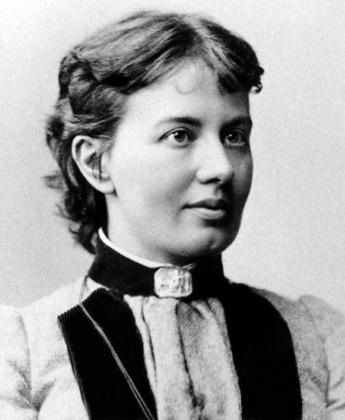
Sofia Kovalevskaya
Sofia Kovalevskaya (also known as Sonia Kovalevsky) was born in 1850, the child of minor Russian nobles and one of three children. Curious and eager to learn, Kovalevskaya taught herself trigonometry at 14 years old. She wanted to better understand optics, and when her tutor could not explain the sine function she tried to work it out herself by using a length of chord for the sine. Clever right?! To learn more, Kovalevskaya would need to find what independence she could. She would leave Russia, because Russia prevented women from attending universities. And she would “marry,” forging a relationship with a geology student, Vladimir Kowalesy. who agreed to act as her husband in name only. The pair moved to Germany, where Kovalevskaya found some universities would allow her to sit in on classes but not graduate, while others would not allow her to attend at all. Undeterred, Kovalevskaya wrote to Karl Weierstrass, a famous mathematician, and asked him to take her on as a private student. He sent her some problems to do. Kovalevskaya did them, wow did she do them. Weierstrass was so impressed, he agreed to teach her, and they would form a lifelong intellectual partnership sharing their passion for math. Weierstrass even convinced the University of Göttingen to award Kovalevskaya a PhD in mathematics, eventually becoming a professor at Stockholm University, the first woman professor in any discipline at a European university.
As a mathematician, Kovalevskaya is most associated with a theorem basic to partial differential equations, the Cauchy-Kovalevskaya theorem. Her work established the existence and uniqueness for a broad class of systems of partial differential equations. Partial differential equations are mathematical equations that help us to describe physical phenomena that vary in space and time. Scientists use them to study heat transfer, fluid dynamics, how waves work (think sound and light) and even quantum mechanics.
Consider her Kovalevskaya-top. The motion of a spinning, rotating body, like a top, is chaotic. Imagine a top that has only one point that remains fixed while everything else is rotating freely.
Only the orange dot stays fixed in space. Tricky because the top can move in many different ways. For example, it can tilt back and forth like a pendulum, or it can spin like a gyroscope. Kovalevskaya used geometry to explain all the ways this top could move. Imagine, using geometry to understand motion. This work, 150 years later, is groundbreaking and inspiring. And this crazy top united, for the first time, very different areas of mathematics and physics that are still studied today as part of the most cutting-edge science, like very precise motion sensors or high-temperature superconductors.
When she won a distinguished scientific award in 1886, the President of the Academy of Sciences noted “Our judges have found that her work bears witness not only to profound and broad knowledge, but to a mind of great inventiveness.”
Key Takeaways: In a world that continually told her no, Kovalevskaya persisted and made significant and lasting contributions to our understanding of math, physics, and the relationship between the two.

Sophie Germain
In the beginning of the 19c, Fermat’s Last Theorem was the most challenging problem in number theory. Remember, this is a time before computers so proving that there were no solutions involved an infinite number of equations. Enter Sophie German.
Germain was born April 1, 1776 the daughter of a merchant. Garmain was not born into the aristocracy, but her father was financially successful. As a young girl, Germain taught herself the basics of number theory and calculus. Her parents did not approve. They confiscated her candles so she could not read at night, took away her clothes and fuel to heat her room so she would need to stay in bed to be warm, all to discourage her interest in math. Yet she persisted, and eventually her parents relented.
As she grew older and it was clear to others her passion and talent for math, Germain was able to study with some of the greatest mathematical minds of 19c Europe. However, she did so under a pseudonym: Monsieur Le Blanc.
Germain never married and died of breast cancer in 1831 at age 55. Others would build on her contributions to proving Fermat’s Last Theorem
Germain adopted a new approach to Fermet’s problem: not to prove that one particular equation had no solutions, but to say something about several equations. Germain limited the range of variables to prime numbers p such that 2p + 1 is also a prime number. So for example, Germain's list of primes includes 5, because 11 (2 x 5 + 1) is also prime, but it does not include 13, because 27 (2 x 13 + 1) is not prime.
For values of n equal to these Germain primes, she could show that there were probably no solutions to the equation: xn + yn = zn
By "probably" Germain meant that it was unlikely that any solutions existed, because if there was a solution, then either x, y, or z would be a multiple of n. For additional discussions of her theorem see this brief explanation from Prof. Larry Riddle, Department of Mathematics Agnes Scott College.
Germain’s work on prime numbers still bears her name: Germain Primes. Germain Primes are used in cryptographic applications to ensure secure data transmission.
H.J. Mozans, an historian and author of Women in Science, wrote in 1913: “All things considered, she was probably the most profoundly intellectual woman that France has ever produced. And yet, strange as it may seem, when the state official came to make out her death certificate, he designated her as a "rentière-annuitant" (a single woman with no profession)—not as a "mathématicienne."
Key Takeaways: Germain defied the wishes of her family and the expectations of French society to become a celebrated mathematician.


