24.1850-1950- Women's Industrial Revolution
The Industrial Revolution marked a period where labor, production, and economic growth forever altered societies around the world. It also brought significant change for women. Women began to find new career options and leadership in the workforce, giving them new chances to climb and even dismantle the social ladder. Women also had union labor strikes and protests for voting rights, signifying the beginning of cultural and societal shifts in regards to women's place in society. As our industries and global sphere began to shift, so did the jobs, opportunities, and lives of women during this time.
How to cite this source?
Remedial Herstory Project Editors. "24. 1850-1950 - WOMEN’S INDUSTRIAL REVOLUTION" The Remedial Herstory Project. November 1, 2025. www.remedialherstory.com.
Trigger Warning: This chapter references rape and sexual assault
The Industrial Revolution began in England around 1750 because of the natural resources available (domestically and through their vast empire) and the shift toward capitalist production. It resulted in many changes in society, including the type of work people did, where they lived, and the nature of their daily lives. These foundational changes also led to systemic changes such as who held power, how, and where. Likewise, many women of the laboring class went from domestic servants, weavers, and shopkeepers to being factory workers. Their increasing involvement in life outside the domestic world combined with the horrible conditions in the factories led to their greater political involvement and eventually demands for political rights.
Join the Club
Join our email list and help us make herstory!
Before Industrialization
The Industrial Revolution brought about fundamental change in England, then spread throughout Europe, and later, many other societies. Production of goods shifted from small “manufactories” where craftsmen and women plied their trade on a local, specialized scale, to the mass production of goods in factories using steam and water power.
In the pre-industrial world, women had more control of their day-to-day lives. Those involved in manufacturing were typically working in a family industry alongside their parents or spouse. Like farming families, most members of the family were involved in the work - whether that be in design, production, packaging, or distribution of goods. They helped run the storefronts or market stands, purchased necessary materials, and coordinated deliveries.
As their work shifted to the factory, women worked about the same number of hours but in back breaking and repetitive labor. When they returned home, women were still responsible for their domestic duties. Caring for children in the pre-industrial world was possible because the children were always nearby, but in the industrial world, children were also working.

Painting titled, “Queen Bertha and the Spinners,” depicting traditional women’s textile work
The Industrial Revolution
All over the world, the transition from an agricultural and cottage-based society to an industrial one was painful, full of failures, insecurities, and tension. As household industries shifted to factories or centralized workshops, women in great numbers were sought to work in the production mills. Most common was work in the textile mills, and histories of industrial revolutions everywhere saw the work of women in textiles.
The nature of work done by women and men often reveals the attitudes, beliefs, and values that a society holds about gender differences. In most of Europe and East Asia, women were regarded as inherently docile, accustomed to using small muscles, and having considerable tolerance for monotony and detail. With these assumptions, women - more than men - were believed to be ideal assembly-line workers. Because of their supposed compliance, it was believed that they would be willing to take lower wages and handle repetitive assembly-line work. Accustomed to a patriarchal world in which male authority ruled, employers also counted on women to be compliant, docile workers. For example, the tradition that valued absolute allegiance to a master was used to reinforce obedience at work among girls from Samurai Japanese families.
Further, it was no coincidence that women and children comprised much of the workforce of the early factories, as to run a successful factory, an owner needed cheap labor. Women in the 1800s and 1900s had few alternatives for work, and they often took whatever pay and conditions were offered in order to feed themselves and their families. Recognizing this, one Japanese worker’s song says, “Factory girls are treasure chests for the company.”
Lower class women, who worked for a wage out of necessity, were seen as “unsexing” themselves and entering into the cutthroat “man’s world.” Teenage girls were thought to have “special skills,” which is code for the fact that they were manipulatable. Employers used these gender-based characteristics to direct women toward grueling, low paying jobs and away from work that required training or led to leadership positions. Rarely did anyone question that running large, complex machinery was anything but a “man’s job.” For example, women ran a variety of looms and spinning wheels for processing yarn and other textiles, but the more expensive spinning mule for mass production became a male-operated machine, and the male mule spinners union opposed the employment of women and children.
This pattern of gendered job segregation was notably true in Asia, where deeply-rooted gender norms and values played a large role in influencing labor patterns. Women and girls were also recruited to work in new government factories to produce industrial goods like silk, and reported that they were grateful for these jobs and felt they earned more than they could have elsewhere. At work, women were praised for “knowing their place,” for being more flexible than men, and for being subordinate to men and their masters. Women’s earnings were always lower in jobs they held equally with men, and they were unlikely to have access to supervisory positions or promotional ladders.
At first, Asian women had no mutual aid societies and were largely excluded from collective action, such as strikes, work slowdown or stoppages. Accustomed to a patriarchal world in which male authority ruled and with few alternatives, working class women took whatever pay and conditions offered them in order to feed themselves and their family. Yet, the liberalizing of roles allowed women freedoms they hadn't previously had. For example, the Japanese moga (“modern girl”) was a sexually liberated, urban woman who spent her money and consumed products of her choosing. However, they were a small minority, and as the Taishō period ended in 1925, the government passed universal male suffrage and excluded women from the vote - to their dismay.
The large demand for female labor was tempting for many women. In Europe, given the choice between taxing farm work or demeaning domestic service, many women chose factory work for the money and independence it seemed to offer. In Japan, recruiters went into the countryside with tempting offers of good wages, pleasant working conditions, and tasty food. Despite any promises, within the workplace, women remained in lower-paid and lesser-authority positions throughout their careers, even in the industries, such as textile, where they dominated.
Textile (n.), a type of cloth or woven fabric.
Docile (adj.), ready to accept control or instruction; submissive.
Monotony (n.), lack of variety and interest; tedious repetition and routine

A textile mill where a manager inspects a woman’s work

Young employees - boys and girls - of the Lane Cotton Mill, New Orleans

Textile mill in Indonesia
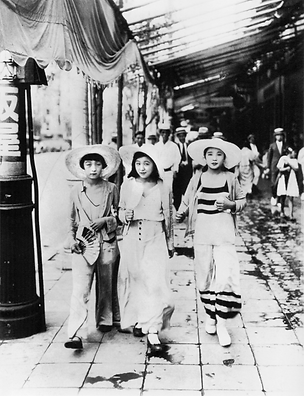
Japanese moga in 1928
Coal Mines
For women of the working class, the best occupation one could get was in domestic service - typically for a local wealthy family. Following that was factory work, and the worst option was in a coal mine.
A six-year-old girl named Mary Davis was found sleeping in a Welsh mine by a government inspector and she stated that she “went to sleep because my lamp had gone out for want of oil. I was frightened for someone had stolen my bread and cheese. I think it was the rats.” Another unnamed six-year-old girl described her grueling work, stating, "I have been down six weeks and make 10 to 14 rakes a day; I carry a full 56 lbs. of coal in a wooden bucket. I work with sister Jesse and mother. It is dark the time we go." Additionally, teenager Maria Gooder’s testimony shows the depth of their hardship. She claimed, "I hurry for a man with my sister Anne who is going 18. He is good to us. I don't like being in the pit. I am tired and afraid. I go at 4:30 after having porridge for breakfast. I start hurrying at 5. We have dinner at noon. We have dry bread and nothing else. There is water in the pit but we don't sup it."
Mary Enock worked in the mines with her sister and was just 11 years old, and her tale might be the most descriptive. She said,
We are door-keepers in the four foot level. We leave the house before six each morning and are in the level until seven o’clock and sometimes later. We get 2p a day and our light costs us 2 ½ p. a week. Rachel was in a day school and she can read a little. She was run over by a tram a while ago and was home ill a long time, but she has got over it.
Mary and her sister would have to choose between light in a pitch-black coal mine and extra pay, and a workplace injury like her sister faced was just par for the course.

A young woman “hurrying” coal while two other children help push the cart
Rake (n.), [in mining] the path cut into land or rock for mining purposes.
Hurry (v.), [in mining] transporting mined material out of the mine.
Level (n.), [in mining] an excavation or passageway driven in the coal, establishing a base from which other workings begin.
Tram (n.), [in mining] the cart used to transport mined material or workers throughout mine tunnels.
Exploitation of Female Workers
Women in the factories and mines of Europe and Asia during the formative years of industrialization were subjected to similar forms of exploitation and control. Everywhere the work tended to be dehumanizing and monotonous. 14-to-16 hour shifts, six days a week, controlled by the clock and under the watchful eye of harsh male supervisors, were normal. The workplace environment was also an incubator for illnesses such as tuberculosis and dysentery. Safety measures were weak, and accidents were frequently reported, as were physical deformities caused by hard, repetitive work and poisoning caused by unsafe chemicals. Likewise, sexual harassment and abuse at the hands of managers was common.
The Industrial Revolution is also characterized by hundreds of inventions and innovations meant to increase the rate and efficiency of production, though these inventions did not necessarily make work safer or more profitable for the workers. For example, the Spinning Jenny was invented in 1764 by James Hargreaves. This complex device cut the time and effort needed to produce cloth and transformed the textile industry. Women no longer sat at singular spinning wheels; they stood at the Jenny, 12-to-14 hours a day, working eight spools at once.
The work was often excruciating. Hannah Goode described her day to a government official, stating,
I work at Mr. Wilson's mill. I think the youngest child is about 7. I daresay there are 20 under 9 years. It is about half past five by our clock at home when we go in [...] We come out at seven by the mill. We never stop to take our meals, except at dinner. William Crookes is overlooker in our room. He is cross-tempered sometimes. He does not beat me; he beats the little children if they do not do their work right [...] I have sometimes seen the little children drop asleep or so, but not lately. If they are catched asleep they get the strap. They are always very tired at night.
Mrs. Smith had three children working at the same mill. She said,
We don't complain. If they go to drop the hours, I don't know what poor people will do. We have hard work to live as it is. [...] My husband is of the same mind about it [...] last summer my husband was 6 weeks ill; we pledged almost all our things to live; the things are not all out of pawn yet [...] We complain of nothing but short wages [...] My children have been in the mill three years. I have no complaint to make of their being beaten [...] I would rather they were beaten than fined.
Despite the mother’s hearty perspective, society was concerned about the way women in these factories were treated. One popular ballad sang,
Laboriously toiling, both night, noon, and morning/ For a wretched subsistence, now mark what I say. She's quite unprotected, forlorn, and dejected/ For sixpence, or eightpence, or tenpence a day. Come forward you nobles, and grant them assistance/ Give them employ, and a fair price them pay/ And then you will find, the poor hard working seamstress/ From honor and virtue will not go astray.
Despite the hardships and risks, around the world, working class women moved into cities and took up jobs, entering into the paid workforce in greater numbers than ever before. This changed the economic value of the unpaid domestic work women had been doing for millennia. The cultural effect of women earning a wage was that their domestic labor lost its value and importance. The work of raising children and caring for the home still needed to be done, but now it was expected as an additional responsibility on top of industrial work. Men of the working class could not earn enough to also pay for domestic labor, and thus families relied on the unpaid labor of women.
Families also played an important role in sending daughters off to factories, while daughters could simultaneously support their families in a way they hadn’t been able before. In Europe, girls’ incomes were important to their families as well as to their dowries. Japan’s first workers in government mills were women from poor farm families that had “excess” daughters. A daughter’s work away from home was seen as part of the patriotic effort to industrialize the nation, while it was also a requirement of their filial duty to contribute to the well-being of their parents by contributing to them financially. In China, a woman’s farm work was seen as less essential to the family economy than was a man’s, thus, impoverished families willingly signed contracts committing their daughters to long terms as indentured workers in the mills in return for advance cash loans.
In any case, when factory work removed young women from their parental households, factory owners often established dormitories for the workers and acted as substitute fathers. This system restricted women’s leisure-time activities and socializing habits, while ensuring that their wages would be sent home. Through promises to supervise young females and their morals - and in some cases provide safe, controlled housing in company dorms - factory owners and managers became like second parents. Familial duties, in a sense, were transferred from the home to the patriarchal factory.

Child laborer in a textile mill
Overlooker (n.), a person who supervises workers or oversees a task.
Strap (n.), a piece of leather used to beat someone.
Pledge (v.), giving up items as security for the fulfillment of a contract or the payment of a debt and is liable to forfeiture in the event of failure.
Pawn (n.), an object left as security for money lent.

The Spinning Jenny
Indentured Workers/Servants (n.), a person who agrees to work for another person for a set amount of time in exchange for payment of travel expenses, food, and shelter.
Middle and Upper Classes
Even women who would never have to take part in industrial work could feel its effects. Industrialization brought the decline of the British aristocracy and the rise of the middle class. Women of the middle classes represented the ideal woman, in contrast to her lower class counterpart. A man who could provide enough for a wife to be spared working outside the home was a sign of one’s class. Thus, working men began to agitate and unionize to protect their wages to provide for their wives at the expense of working women.
Middle and upper class women were mothers, homemakers, moral guideposts, and emotional supports. They were expected to strive for perfection in every aspect of their lives, and in return, women of this class were to be protected from the harsh realities of the capitalist world beyond the domestic sphere. Over time, this idealized woman came to be seen as natural, even though historical records tell us otherwise. In Japan and China, there was contradictory government rhetoric calling for more women to join factory work for the betterment of the nation, but there was also pressure for women to remain strictly in the home and live up to the cultural ideal of femininity.
Women were encouraged to maintain “fine” homes that included the latest decor and were neat and clean, despite the comings and goings of their typically large families. The pressure to meet all of these social demands necessitated domestic servants, and demand for servants rapidly increased; it became one of the most common jobs for English women in the 1800s. Unmarried women who previously labored in family businesses and on farms shifted to working as domestic servants, a job far preferable to dangerous factory work.
Servants provided middle and upper class women with more leisure time. These women became avid readers and writers, which made them one of the most educated groups of women in history. They threw themselves into the socially acceptable charitable work and social reforms - even addressing the ills of industrialization. While we have a plethora of middle class female voices from this period, the everyday experience of working class women was largely ignored.
Upper class women became advocates for poor women and children. They became speakers against alcoholism (known as Temperance Reformers), deeming male alcohol consumption a threat to their wives, unmarried women, and children who could face abuse. They also worked to end child labor - a staple of the Industrial Revolution. However, the idealized version of womanhood was ever present. Some of these elite women - out of touch with the realities of the poor - claimed paid labor was unsuitable for women, as it was detrimental to her domestic duties, but ignored the question of how else these women could feed their families without this work.
As an unforeseen consequence, this work forced upper class women to become political in ways not yet seen by mass groups of women. British women advocated for the Married Women’s Property Acts of 1870 and 1882, which gave women the right to control their finances, even within marriage. This also resulted in sweeping new laws that aimed to protect women but which ultimately created massive hurdles for working women. For example, they claimed women’s bodies were too weak and delicate for some types of work and thereby blocked women from competing with men in certain industries.
Some middle and upper class women also became teachers until they were married in order to provide the education needed in an industrialized society. This did not lead to an overhaul in women’s education, but in Britain, girls received education related to domestic skills for their future as housewives and domestic servants, though they remained barred from colleges and universities until the 1870s. Some European women did attend college and sat for exams, but the schools would not issue them degrees on account of their sex.

Domestic worker cooking
Inoculation (n.), the action of immunizing someone against a disease by introducing infective material, microorganisms, or vaccine into the body.

Protest against child labor in a labor parade
Labor Unions and Protest
Just as the Industrial Revolution began in Britain, eventually, so too did the call for labor reform. The realities of industry were investigated by government commissions throughout the 19th century. The documents revealed that women on average earned one-third to two-thirds of male salaries. It was a contrived pay scale that protected the male provider and head of house. This was one of many ways industrial society was designed to protect men and their wealth. Another example was that trade unions often barred women from entering and denied them training in advanced skills. Further, male unions typically resisted female labor and unionization, as it posed a real threat to male jobs and wage security. Unions enforced a gender hierarchy, describing women as cheap, unskilled labor.
Unwilling to be marginalized, some women became politically active and formed unions of their own. The Women’s Trade Union League formed in Britain in 1874, resulting in a massive influx of women’s union activity. Similar patterns were seen in Japan when women organized massive strikes in the 1880s over low wages and contracts that forced them to live in factory housing away from home. There, women showed agency by running away from their jobs to be with their families.
There were differences in women’s unionist behaviors based on marital status. Married women tended to participate less in militant activities. In part, this may be due to their inability to manage union activity, along with their industrial work, and their unpaid domestic work. Women’s involvement in labor unions resulted in incremental change. Pay, working conditions, and living conditions improved wherever unions took root, but change didn’t happen quickly enough, and this encouraged some women to seek additional political influence.
Contrived (adj.), deliberately created rather than arising naturally or spontaneously.
Trade Unions (n.), an organized association of workers in a trade, group of trades, or profession, formed to protect and further their rights and interests; a labor union.

Labor organization protest
Voting Rights
Industrialization took women and girls from farms, cottage industries, and domestic work and dragged them into a world dominated by men. Unionization led to slow change, and the failure of the unions and the law to protect women from exploitive pay, sexual harassment, and dangerous working conditions, hurled many women into political advocacy, where they eventually demanded the right to vote. They wanted the ballot, just like men.
New Zealand gave women the right to vote in 1893, making it the first nation to allow women to vote in national elections. Australia followed, when it became a federal state in 1901. Australia continues to lead the world in female leadership, largely because they focused their efforts on reforming the structures and systems that made it difficult for women to participate in politics and leadership. Their model and countless academic studies shows that where women lead, there are enormous benefits, not only for women and girls, but for all of society.
Leaders Muriel Matters and Vida Goldstein were two of the many women who fought for women’s political recognition in Australia. Goldstein also became the first Australian to visit a president at the White House. President Theodore Roosevelt found her fascinating, as she had more political rights than any US woman. He said, “I’ve got my eye on you down in Australia.”
Muriel Matters didn’t stop with Australia. Once suffrage was secure there, she headed to the United Kingdom, where suffrage had been a hot topic since the 1860s. In 1902, 37,000 women and girls who labored in the textile mills of Northern England petitioned Parliament for the right to vote, but were denied. By 1905, the mother daughter trio of Emmeline, Christabel, and Sylvia Pankhurst championed the militant wing of the English suffragette movement, the Women’s Social and Political Union (WSPU), adopting the motto, “Deeds not Words.”
In 1907, 75 WSPU suffragettes were arrested when they attempted to storm the Houses of Parliament. Their international organization promoted militancy and pageantry as a means to an end. They picketed, smashed mainstreet storefronts, bombed parliamentarian mailboxes, and performed a variety of stunts to get suffrage on the front page of British newspapers. In 1908, Australian Muriel Matters earned the title of the first woman to speak in the British House of Commons in London but not because she was invited to do so. Instead, it was because she chained herself to the grill that barred women’s view of Parliament and shouted demands for women’s rights. Guards cut her off the grill and dragged her out by force, even as she continued to demand the vote. In 1909, Marion Wallace Dunlop went on hunger strike while in prison and others soon followed her. Instead of releasing the women from prison, the jailers force fed them to keep them alive. Women also began refusing to pay taxes until they could vote for the people who taxed them. They organized into the Women's Tax Resistance League (WTRL) with the slogan “No vote, no tax.”
Of course, not all women liked these aggressive tactics, nor the goal of gaining women’s suffrage. In each nation that has seen a push for women’s suffrage, they have met resistance, which includes women. In this case, some women formed the UK’s first anti-suffrage league, while others left the Pankhursts for the more moderate Women’s Freedom League (WFL).
Sophia Duleep Singh stood out among the suffragists because of her position and heritage. She was the youngest daughter of the king of Northern India. When her father was young he was bullied into a treaty with Queen Victoria that surrendered his country to her, and he and his family were subsequently banished from India. Raised in the United Kingdom, Singh became Victoria’s goddaughter and led an opulent life. Eventually, she and her sisters returned to India, where they bore witness to the harsh realities of poverty and racism. She was a socialite and celebrity in London, but there she was just another brown face. Upon return, she threw herself into the suffrage cause, slamming into Parliamentarians and demanding female suffrage. She was eventually taken to court over her refusal to pay taxes in protest.
In 1909, a Conciliation Bill was proposed to give women who owned a certain amount of property the right to vote, but the bill failed. In response, Pankhurst and Singh led 300 women to march on Parliament where they were met with police brutality in an event known as Bloody Friday. Still, women did not back down, and militancy peaked in 1912 with more window smashing and arson attacks. Then, in 1913, Emily Wilding Davison attended the Epsom Derby where the king was racing. She stepped out onto the track with a suffrage banner as he raced by. His horse trampled her, and she died several days later from a fractured skull, creating a martyr for the suffrage cause, as thousands of suffrage sympathizers attended her subsequent funeral.
The immensity of World War I in Europe disrupted women's suffrage activities, even an ocean away in America. Eventually, as the war came to a close, Nancy Astor became the first female member of Parliament in 1919, and with continued resistance and protest, women in the UK finally won the right to vote in 1928.
Women around the world were awed by the achievements of the New Zealand, Australian, American, and British women. Slowly, most countries followed suit, especially after World War II, but in some authoritarian places today, women remain disenfranchised. Further, the vote didn’t transform everything. One could argue that the vote without changing the structures that deny women equal opportunity to hold power, did little. Further still, we should keep in mind that amid these struggles for suffrage, not all groups cared much for the enfranchisement of those who did not share their ethnic or racial backgrounds. Quite often, suffrage movements could become divided over these lines.

Part of Davison’s funeral procession

Kate Sheppard, New Zealand's leading suffrage campaigner who appears on the current New Zealand ten-dollar note
Suffragette (n.), a woman campaigning for women’s right to vote (suffrage).
Picket (v.), standing outside a place of work or other venue, protesting something or trying to persuade others not to enter during a strike.
Parliamentarian (n.), a member of Parliament (a political body).
Grill (n.), a grating or screen of metal bars or wires, placed in front of something as protection or to allow ventilation or discreet observation.

1908 WSPU meeting

Muriel Matters being removed from Parliament

A jailed woman being force fed.

Sophia Duleep Singh
Disenfranchise (v.), deprive (someone) of the right to vote.
Midwives and Doctors
Another significant shift amid the Industrial Revolution was in relation to women’s medical care. Advancements in technology and science in the wake of the Enlightenment coalesced into a rethinking of birthing practices and women’s health. Long before factories opened up labor opportunities, the practice of midwifery was one of the accepted ways that women worked outside the home around the world, throughout history. However, increasingly, governments worked to certify and professionalize industries, including medicine. Midwifery was generally a safe option in birth for women, but high maternal death rates led to scholars examining the field scientifically, and men entered the field as trained obstetricians. Many of the men drawn to this field had personally lost loved ones at birth.
In the 1500s, The Rosengarten became the first obstetrical textbook written by a male apothecary. It provided instructions, probably taken from common midwife practices, on how to rotate the baby with pressure on the abdomen to get it into the proper position and introduced new methods and tools to extract the baby. Women at the time were largely illiterate, so how many of the midwives attending women at birth were familiar with the content of the text is hard to say, but the result of this over the next few centuries was tension between the midwives who had made careers in a field available to them and the male doctors who took over in the name of professionalism.
In the battle between midwives and male doctors, it’s wrong to assume that there was one party that unilaterally knew more, performed better, or cared more deeply about the women they were attending. There were undoubtedly good and bad actors in both professions. It is also wrong to assume that a professionalization of the practice meant that midwives were not well-versed and qualified to assist in birthing children, nor that they weren’t using modern and evolving medical instruments for interventions.
Further the “professionalization” of midwifery could really damage female patients. Their male physicians had never been through what they were going through, but far worse, Victorian gendered expectations respected women’s modesty. Sometimes, the doctors wouldn’t even look at the woman’s body during the birthing process. Thus, women died at higher rates under these male doctors, but still the doctors drove female midwives out of their jobs.
The male doctors won the battle for the monopoly on birth. In America by the 1800s, especially among the wealthy and urban, doctors were preferred. No longer did women give birth with their female neighbors there for support and advice. Rather, they gave birth alone with just their mother, sister, or other trusted woman, and a male doctor in attendance. In Philadelphia over a ten-year period, the number of midwives fell from 21 to six. As men were not allowed to look at a naked woman, even during childbirth, male medical students weren’t allowed to watch births, so instead only learned from textbooks until they were active in the field.
Normal, healthy births remained largely successful, but complications in birth are quite common. Babies can get stuck in the birth canal, be poorly positioned, and need an alternative, emergency removal. Throughout history, caesarian sections (today known as c-sections) had been performed in many of these cases. The surgery was reserved for extreme circumstances when it was evident the mother was dying or already dead and there was a chance to save the baby. Having a caesarian section was basically a death sentence for the mother for centuries. In 1814, a report from London announced that only 20-22 known cesarean sections had been attempted in the empire and only nine had succeeded in saving the babies, while just two had succeeded in saving the mother.
The first undisputed and well-documented caesarian section in Ireland took place in 1738 and saved both mother and baby; it was performed by a female midwife, Mary Donally. She was called to help Alice O’Neal, the 30-year-old wife of an Irish farmer who had been in labor for 12 days. Mary cut Alice’s stomach with a razor while an assistant walked a mile to get silk to stitch the mother up. Even though the surgery worked, the medical community in Europe debated the validity of the procedure and few were willing to perform it, even into the 1900s. As the surgery put the mother’s life at extreme risk, much of the debate was about which life was more valuable. In Britain, for example, there was much more support for killing the baby to save the mother.
Life without the cesarean section meant many women continued to die, regardless of their status and access to the best medical care. Most notably, in 1817, Princess Charlotte, George IV's only child, died in childbirth at the young age of 21. Her baby was two weeks late and labor lasted for 50 hours, but no doctors were willing to perform the radical emergency procedure with the princess’s life on the line. In the end, the nine-pound baby was stillborn. Doctors removed the placenta with difficulty, and six hours later, Charlotte died. The obstetrician, Sir Richard Croft, was harassed mercilessly by the masses, and he shot himself a few days later. King George was left without an heir, and the throne passed first to his brother and then to his niece, Queen Victoria.
While it remained a debated and extreme surgical option, this does not mean that practitioners did not still attempt it as a means of survival. A notable case of a successful cesarean section occurred in South Africa in 1826, by Dr. James Barry. Barry was identified as female at birth and raised as a girl by the name of Margaret Ann Bulkley. Barry had been raped as a youth and the resulting child was raised by his mother, but the stretch marks from pregnancy remained for his entire life. When his uncle died, he assumed the name James in his stead and used his new identity as an opportunity for self-betterment, enrolling in medical school in Edinburgh - a school where he would not have gained access as a woman. This does not appear to be a simple matter of education access, but rather, Barry seems to have identified as male, for he remained James for the rest of his life.
Barry had a highly successful and controversial medical career, serving as a physician all over the world and in the Crimean War. While in South Africa, he performed a caesarian section that saved both the mother and child. The grateful mother named her new baby James in his honor. When Barry died years later, it was discovered that he was biologically female or perhaps intersex. How he would have liked to be remembered is sadly unknown, but one can only presume it was as he had lived.
An additional concern of the professionalization of childbirth was that in hospitals, before germs were understood and sterilization common, doctors would often go from surgery to surgery, carrying infections to women in labor. By the 1800s, the maternal death rate reached between two and eight per 100 deliveries, around ten times the rate outside the hospital. In New York, in 1840, 80 percent of women who gave birth in a hospital died.
The field continued to progress in its study of how to preserve the lives of babies and their mothers through various methods of care and surgery. This grew in leaps and bounds through the 20th century, particularly, as more women were able to join the field and concepts of safety surpassed antiquated concepts of enforced modesty. Medical providers - women and men alike - worked to make childbirth safer, faster, and less painful for both mother and child. The discovery of anesthetics like chloroform was not far behind, but like the c-section, many were reluctant to use it in labor. Only after Queen Victoria consented to its use during the birth of her eighth child did it quickly become widely accepted in obstetric practice.
Obstetrician (n.), a physician or surgeon qualified to practice in childbirth.
Apothecary (n.), a person who prepared and sold medicines and drugs; pharmacist.

Labor with a midwife

15th century woodcut depicting a cesarean section being performed on a dying mother
Stillborn (adj.), (of an infant) born dead.

Dr. James Barry
Intersex (n.), a condition in which individuals have biological sex characteristics that do not fit into the typical male or female categories
Anesthetic (n.), a substance that induces insensitivity to pain.
Conclusion
Industrialization improved women’s lives, perhaps more than it did men’s. It led to somewhat better medical care in pregnancy and women and men in industrial work did better economically than their agrarian peers. Thus, the standard of living increased considerably as a result. Despite low wages, some women did find means of supporting themselves, and a few even acquired considerable wealth. Industrialization also upended the patriarchal norms in some ways because it challenged the idea of a “male provider,” as it was increasingly obvious that more and more women needed to work to make ends meet. Women’s income also allowed them to become independent consumers, and with that new role came great power to influence production.
It is important to note that industrialization also fueled western imperial expansion. Factories could produce more weapons, fueling military conquests in Africa, Asia, Siberia, the Pacific Islands, and the western Americas - all of which were desired for raw materials and laborers to fuel production. Whether in positions of leadership or in missionary efforts, women both supported imperialism and fought against it.
Industrialization changed the global make-up, shifted power structures, and allowed the Global North to impose its systems on others, including their views of women. How did class and region change the effects of industrialization? Did the benefits of industrialization outweigh the costs? How would women’s role in the labor force influence policy and social change? Would women be able to enter industries considered “male”? How would society adapt to allow for women to be wage earners and mothers? Maybe the greatest question of all - what would it take for women to earn the vote and thereby increase their say in these matters?