19. Women and World War II
Women in World War II, again, entered new fields. They became members of the military, and even faced combat. Took over their families, became correspondents, spies, and code breakers. The war created an opportunity for women to branch out to better paying jobs, but still many struggled financially or were prevented, from things such as racism, to grow. At the war’s end, American women were encouraged to return to hearth and home.
How to cite this source?
Remedial Herstory Project Editors. "19. WOMEN AND WORLD WAR II." The Remedial Herstory Project. November 1, 2025. www.remedialherstory.com.


Wartime is often regarded as the province of men. But contrary to popular belief, women don’t disappear during war. During World War II, American women’s individual and collective contributions to the war effort, at home and at the front, proved essential to victory.
After World War I, the US experienced the Roaring Twenties followed by the Great Depression. Then, the world was at war again. Nazi German troops annexed nearby lands. Then they signed a non-aggression pact with the USSE and invaded Poland, the old allies of WWI had had enough. Germany’s neighbors quickly fell to the Blitzkrieg. Blitzkrieg was a lighting war strategy that caused much of Europe to fall under occupation.
Join the Club
Join our email list and help us make herstory!
Before the War
The US, sheltered by the Atlantic and the Pacific, stayed out of the war despite cries from Europe for support. European nobility Princess Märtha of Sweden even came to live in the states with her children and regularly appealed to her new friends President Franklin Roosevelt and First Lady Eleanor Roosevelt, to take up Norway's cause. She urged them to provide Norway with war materials, and return her family to their home. But Roosevelt was in a political pickle, and kept the US out of the war.
Meanwhile, women war correspondents reported the situation in Europe to the American public. Martha Gellhorn, Josephine Herbst, and Frances Davis were among the women who told the story of the war to an international audience. They faced the discrimination common to women reporters--they were often ignored by the men. Davis observed that, “Somewhere within me there is the cloud of discomfort at being where I am not wanted.” She eventually won over her male colleagues…by smuggling their stories to France in her underwear.
Eleanor Roosevelt knew the situation in Europe was increasingly dire, particularly for Jewish communities. In May 1939, more than 900 Jews fled Germany aboard a ship bound for the US, but were turned away and forced to return to Europe, where, tragically, more than 250 were killed by the Nazis. Passed in 1924, the National Origins Act placed strict quotas on the number of immigrants permitted to enter the US and made it almost impossible for Jewish communities from eastern and southern Europe to find safe harbor. A year later when another ship of Jewish refugees docked in New York, they sent a telegram directly to the First Lady begging for support. Eleanor answered the call, took the Secretary of State to court, and saved the lives of 81 refugees seeking asylum.
Eleanor Roosevelt’s efforts were technically against the political will of the American public who approved of the drastic limits immigrants and favored staying out of war. But on December 7th, 1941, public opinion changed after Japan attacked Pearl Harbor in Hawaii and other Pacific island sites.
Roosevelt had started a column, My Day, to help Americans through the Depression. The day after Pearl Harbor she wrote, “Our people had been killed not suspecting there was an enemy, who attacked in the usual ruthless way which Hitler has prepared us to suspect. None of us can help but regret the choice which Japan has made, but having made it, she has taken on a coalition of enemies she must underestimate; unless she believes we have sadly deteriorated since our first ships sailed into her harbor.”

Eleanor Roosevelt in New York City, 1940, Public Domain
Rosie the Riveter
Women had long been laboring outside the home in “gendered” jobs. As war production increased and men volunteered or were drafted into the military, factories needed women workers to shift industries and fill positions making tanks, jeeps, planes, and munitions. The symbol of “Rosie the Riveter” came to represent the woman who left the domestic sphere to support the war effort. Rosie was even the subject of a popular song in 1942 by Redd Evans and John Jacob Loeb. The song was a hit and made famous by The Four Vagabonds. In both the song and the image, women are encouraged to work to support the American war effort, but that effort, they are assured will not make them any less feminine. While Rosie may be strong, she is also pretty and has make up. As the song explains, her work in traditionally male industries, was for all in support of the men in her life. Her duty is to family and country:
Rosie's got a boyfriend, Charlie.
Charlie, he's a Marine.
Rosie is protecting Charlie,
Working overtime,
On the riveting machine.
Rosie was often portrayed as white, but in reality, a lot of Rosies were poor women of color. In fact 40 percent of Black women in America were already in the workforce, compared to only 25 percent of white women. Women of color made less than white women, who then made less than men. In wartime Black women finally had opportunities for new types of jobs with better pay and union protections. For most white women, the war inspired them to leave their traditional home life to learn new skills, do their patriotic duty, and earn a paycheck. Rosie the Riveter became a feminist symbol of women’s competence and independence.
Hortense Johnson, a Black Rosie wrote, “Of course I’m vital to victory, just as millions of men and women who are fighting to save America’s chances for Democracy, even if they never shoulder a gun… I am an inspector in a war plant… When we approve them they are ready to be… headaches for Hitler or Hirohito.”
Secretary of Labor Frances Perkins, the first woman ever to hold a cabinet position, was instrumental in encouraging major manufacturers to hire women in defense industries. She importantly expressed the hope that the advances made by women in the workforce would continue after the war.

Rosie the Riveter, Public Domain
Japanese American Internment
After the Pearl Harbor attack, more than 110,000 people of Japanese descent were removed from their homes and forced to live in internment camps in remote areas of the United States. Executive Order 9066 was a response to fears on the West Coast that Japanese Americans, even those who were born in the United States, maintained a primary allegiance to Japan. These families were given very little time to settle their affairs or pack before their confinement began. Many were sent to initial staging locations–like fairgrounds or horse racing tracks–where they were sometimes forced to stay for weeks before being sent to their assigned internment camp. In the camps, women got to work. They served as teachers, nurses, and organizers who did everything in their power to establish supportive communities. Their roles were domestic and maternal, but they were essential to the survival of the deportees.
Sadly, most Americans were essentially blind to the hypocrisy of fighting for democracy while fellow Americans were in camps. They went on with war life. Besides joining the job force, American women learned new skills and assumed typically “male” roles in society. They learned to drive, manage household finances, did home repairs, and in New Orleans even became street car “conductresses.” Women wrote letters to men serving overseas to provide glimpses of home. They grew victory gardens to feed their families, as basic necessities such as gasoline, coffee, sugar, butter, rubber, and canned milk were rationed. Women even gave up wearing silk stockings because that valuable fabric was used to manufacture parachutes. The slogan “Use it up-Wear it out-Make it do-or Do without” inspired creative solutions to the challenge of wartime shortages.

Eleanor Roosevelt visits Japanese Internment Camp in Arizona, Public Domain
Baseball, LGBTQ+, and Queer Identity
With the departure of many Major League Baseball players for the front lines, Chicago Cubs owner Philip K. Wrigley organized the All-American Girls Professional Baseball League. The League began play in 1943 with four teams. It expanded to ten teams and nearly six hundred players in its twelve-year tenure. The women played to enthusiastic crowds throughout the Midwest. Although the women were professional athletes, they were expected to maintain a “feminine” image that included dress uniforms, making it difficult to slide into a base while maintaining one’s modesty or avoiding scraped legs. Despite poor pay and long bus travel, the “girls” provided popular entertainment. They saw their job as a positive aspect of the war effort and laid the groundwork for women's sports and Title IX of the future.
For queer women, things began to change during World War II. Recruited to sports teams and service supporting the troops or on the home front, queer women were pulled from their small towns and had new opportunities to meet other queer women. Many women had their first lesbian experiences in the league and during the service. However, female baseball players like Josephine "JoJo" D'Angelo faced challenges in the All-American Girls Professional Baseball League because her more-butch identity led her to defy the strict league rules. The players were expected to look feminine and attend charm school. The unspoken reason for these rules was to prevent them from being perceived as lesbians, even though many of the players were. Same-sex relationships were often kept secret. Obituaries sometimes hint at these relationships, but the players remained closeted during their lives.
Discrimination against LGBTQ+ people was rampant. People were more likely to lose their jobs due to accusations of being homosexual than being communist. Many states had anti-sodomy laws, which banned certain types of sexual activity. And if that wasn’t enough society, as well as the medical community, considered them mentally ill. Established religions labeled them as sinners causing them to deny knowing one another in public and leading dual lives. When the war ended, discrimination and harassment of queer people would become part of broader effort to eliminate what a rising anti-communist movement saw as threats to traditional American life. Organizations like the Daughters of Bilitis responded by publishing The Ladder and organizing meetings of queer women to provide space for community and support.
Yet, queer people existed even in the most public spaces. Eleanor Roosevelt's marriage was well known to be a political one. Franklin’s affairs with other women are well documented, especially Lucy Mercer Rutherford. Eleanor also sought emotional fulfillment outside the marriage with both men and women. Eleanor connected with a variety of men including Lou Howe, John Boettinger, and Earl Miller. She also had a series of Boston Marriages with women like Esther Lape, Elizabeth Read, Nancy Coo, Marion Dickerman, Marie Souvestre, Rose Schneiderman, Molly Dewson, and most notably, a journalist, Lorena Hickock. Scholars have debated whether these were sexual in nature, some of the letters exchanged with Hickock seem to suggest sexual intimacy, but other historians dismiss Eleanor’s bisexuality entirely. While it seems obvious that many of those women were lesbians, they consider Eleanor almost asexual claiming such intimacy was beyond her capacity as a single-minded advocate. Again, with figures in the closet during the early 20th century, challenges about defining them through 21st century terms remain. How any individual thinks about their sexuality or their gender identity is difficult to find in historical records, and people of the past used different words to talk about their sense of self and the full meaning may be difficult for us to fully grasp. For many the possibility that she could be bisexual like them is important to find connections in the past.
It is hard to fault anyone who remained closeted in this hostile environment. Interestingly, one of the only public spaces available for queer individuals to find community was the gay bar. For many people before Stonewall, these bars served as alternative to religious spaces where they could connect and escape with friends. One lesbian of the period explained, “I came out as gay in 1945, the year that the war ended[…]I was dating a softball player that I met at the gay bar. I met her at Mona's, or as it was the Paper Pony. My first night in a gay bar was freedom.” Bars provided a sense of freedom, camaraderie, and acceptance. The bars became the primary social spaces for queer women and men, offering them connections, companionship, and an escape from the confines of societal expectations.

All American Girls Professional Baseball League player Marg Callaghan Sliding into Home, Public Domain
Women’s Service Branches
But women weren’t just serving on the home and job fronts. Nearly three million women volunteered with the Red Cross in the US and abroad. They delivered packages of needed supplies to civilians in Europe as early as 1939, established a blood donor service that provided plasma for wounded soldiers, and even drove ambulances.
More than any war before, women were mobilized in the combat effort. One of the first ways they were used were as code breakers. Elizebeth Smith Friedman (1892–1980) cracked hundreds of ciphers during her career as America’s first female cryptanalyst. She was well known for her service in WWI and busting smugglers during Prohibition. Though she and her husband both worked as contractors in intelligence, she earned half her husband’s pay for the same work. After Pearl Harbor the Navy took over Friedman’s unit and demoted her.
Friedman did not let the sexism and setbacks stop her. She and her team used analog methods (that means pen and paper) to break three separate Enigma machine codes. One year after Pearl Harbor, her team had cracked every one of the Nazi’s new codes. In March of 1942, she made an amazing discovery. She decoded messages that indicated the Nazis had located the Queen Mary carrying 8,000 soldiers off the coast of Brazil, and they were preparing to sink it. Friedman’s decoding success allowed the Queen Mary to evade German submarines and sail to safety.
Besides Friedman, 10,000 American women codebreakers managed the conveyor belt of wartime communications and intercepts from the Axis Powers. They were pulled from schools as teachers, found in colleges as math majors, or discovered through newspaper advertisements for crossword puzzles. Their work was instrumental in winning key naval battles and gunning down the plane of Isoroku Yamamoto, the architect of Pearl Harbor. They embodied patriotism and determination.
Historian Liza Mundy claims, "The recruitment of these American women—and the fact that women were behind some of the most significant individual code-breaking triumphs of the war—was one of the best-kept secrets of the conflict.”
Women code breakers and their unbelievable value to the war effort opened the doors for women across the armed forces. First, Edith Nourse Rogers, a Congressperson from Massachusetts, pressed Congress to create the Women’s Army Auxiliary Corps, nicknamed the WACs in 1942. Women rushed to enlist and be of service. More than 300,000 women volunteered.
Women led many clerical tasks, rigged parachutes, and maintained aircraft and military vehicles. The symbol of the WACs was Pallas Athena, the ancient goddess of industries of peace and arts of war. She was also the goddess of storms and battle. Segregation policies in the armed forces limited the number of Black women allowed in the overall WAC force, so only 10 percent of WACs were Black women. They faced racism from white service members and discrimination in job placement and advancement.
Shortly after WACs was established, the Navy began recruiting women into their own brach–the WAVES. The Marine Corps and Coast Guard had a Women’s Reserve, and the budding civilian air force added a branch of Women Airforce Service Pilots (or WASPS) in 1947. They flew B-26 and B-29 planes on pre-combat flights.
In the final months of the war, a war weary public grew frustrated and frightened as their efforts to send mail and packages to husbands and sons fighting in Europe. In response, 855 women of color, members of the 6888 Battalion (often called the Six Triple Eight), developed, organized and instituted a complex system of mail identification and delivery that found a way to get mail to soldiers on the frontline. No easy task given that military locations were often classified and letters often lacked information about the recipient. The backlog of mail dated about five years, as a result the mail was mildewed picked at by rats. The Six Triple Eight maintained millions of locator cards to properly place them with soldiers in Europe.
The Six Triple Eight were led by Charity Adams, the highest ranking Black female Army officer during World War II. She commanded a great deal of respect from the women in her battalion because of her extraordinary leadership skills, attention to detail, and boldness. When the group was given segregated recreational facilities, she replied to a commanding officer, “over my dead body.”
The experiences of the Six Triple Eight were not unique. Black women in these branches were often relegated to low-skill assignments or segregated entirely. Tina Hill, an aircraft worker, said, “I could see where they made a difference in placing you in certain jobs… all the negroes went to Department 17 because there was nothing but shooting and bucketing rivets… I just didn’t like it… [Negroes] fought hand, tooth, and nail to get in[to better work]... they were educated, but they started them off as janitors… they had to start fighting all over again to get off that broom and get something decent.” Worse, if Black women challenged their treatment, they were sometimes court martialed. The brewing hypocrisy of patriotism and racism is part of what led to the Civil Rights Movement following the war.
Indigenous women volunteered and participated in the war effort as well. In terms of the WAC and WASP, some 800 women answered the call to serve and did so in a variety of roles. For instance, Grace Thorpe of the Sac and Fox people was initially a WAC recruiter before being transferred to New Guinea where she would later earn a Bronze Star (and later Congressional recognition) for service during battle. Towards the end of the war, she also worked in the headquarters of General MacArthur. Like many other women, those of Indigenous descent also played an active role on the home front. In Wisconsin, for instance, Menominee women worked in sawmills. Elsewhere, Indigenous women also joined domestic defense units; one even remarked: “We have rifles, we have ammunition, and we know how to shoot.”
Mary McLeod Bethune, an advisor to President Franklin Roosevelt in the Black Cabinet, worked endlessly to end racial discrimination that hindered progress for women and men of color in the military. In 1941, the National Council of Negro Women (NCNW) was left out of a conference about women in the War Department. Bethune sent a furious letter to Secretary of War Henry L. Stimson, stating, “We are anxious for you to know that we want to be and insist upon being considered a part of Our American democracy, not something apart from it… We are incensed!”
Some women possessed exceptional skills that were exploited for the war effort. Virginia Hall was an American woman who lost her leg to gangrene in a hunting accident. She was fluent in French, having studied abroad and determined to be of service…but she was relegated to a desk. Defiant, she volunteered to drive ambulances for the French army on the front line during the Nazi invasion of 1940. When France fell, she offered her services to the British in London. While the Allies were not keen on employing women, months of trying to infiltrate the Nazis with spies had failed. Ironically, Prime Minister Winston Churchill branded his emerging spy network as “ungentlemanly” warfare. Hall was recruited by Vera Atkins, a British intelligence officer keen on getting women into France. She knew since France fell, the countryside was mostly female, so a male spy would stick out.
Hall was dropped into France to operate a radio and pass messages back to the Allies. She helped the British land planes and supplied the French resistance in preparation for D-Day. When American boys landed, there would be an armed and ready French population waiting to help. Hall emerged as a dauntless guerrilla leader. She blew up bridges and attacked German convoys.
Hall was rewarded by becoming the only civilian woman of the war to be decorated with the Distinguished Service Cross for “extraordinary heroism.” CIA officers continue–to this day–to use the techniques developed in France.
When Americans finally landed on mainland Europe on June 6, 1944, no women were allowed. However, Martha Gelhorn, a journalist, stowed away on a ship because all the male journalists were going and she was not going to be excluded. Her account of D-Day is raw and was widely read. Nevertheless, she was found out and sent back to Britain to sit in military prison for defying orders. Gelhorn escaped and flew to Italy to cover the remainder of the war.
Eleanor Roosevelt addressed the nation about D-Day and insisted that all roles, those relegated to men and those to women, were integral to the war effort, , “The best way in which we can help is by doing our jobs here better than ever before, no matter what these jobs may be.”
It would take a year for the Allies to take Berlin. The Soviet Union got there first, and soldiers brutally raped German women and girls of all ages as they entered the city. There is evidence that the British and the Americans also raped French and German women in their advance toward Berlin.

Elizabeth Friedman, Public Domain

Charity Adams Inspects 6888 Battalion, Public Domain

Virginia Hall with Gen. William Donovan, 1945, Public Domain
Women in the Manhattan Project
Back in the US, women scientists helped win the war for the Allies. Leona Woods Marshall worked on Enrico Fermi’s Manhattan Project team that created a self-sustaining nuclear chain reaction at the University of Chicago. Think of how complicated it was to make. Her contributions were overlooked when Fermi received the Nobel Prize in Chemistry, but another woman scientist, Maria Goepert Mayer, did earn a Nobel prize for her work in nuclear physics. Both women’s work was key to the development of the atomic bomb.
Lilli Hornig was a Harvard chemist recruited with her fellow scientist husband to work at the Los Alamos site in New Mexico. But when she arrived and met with the site’s officials, they asked how fast she could type. She retorted, “I don’t type.” Her later work was in plutonium chemistry.
Chien-Shiung Wu was also a major contributor to the Manhattan Project. Born in Jiangsu Province, China in 1912, she excelled in academics from an early age. In 1936, she traveled to the United States to undertake her Ph.D. in Physics at the University of California Berkeley. There, J. Robert Oppenheimer served on her degree committee. After graduation, she was invited to work on the Manhattan Project, where her work directly contributed to the creation of the atomic bomb. After WWII, she joined Columbia University where she was the first woman to become a tenured physics professor at the university. Her work on parity was instrumental in her colleagues Tsung-Dao Lee and Chen-Ning Yang winning the Nobel Prize in Physics in 1957, despite later protests insisting she should also have won. She was awarded the inaugural Wolf Prize in Physics in 1978.
Many women who worked at the Y-12 Electromagnetic Separation Plant had no idea of the critical nature of their work. The “Girls of Atomic City” operated uranium separation machines to create the U-235 isotope that fueled atomic devices. Women who came to these top secret sites as wives and children of scientists had no idea what their spouses did for work, but did the work that kept these sites functioning.
When the first atomic weapon was successfully detonated–known as the Trinity Test–Lilli Hornig remarked, “We thought in our innocence … if we petitioned hard enough, they may do a demonstration test… But of course the military made the decision well before... [that] they were going to use it no matter what.”
While the introduction of atomic warfare is a deeply complicated part of American history, on August 6 and 9th the first atomic bombs dropped in Hiroshima and Nagasaki effectively ended the war in Japan. And the women involved–for better or worse–were part of that history.

Leona Woods Marshall at the University of Chicago in 1946, Public Domain
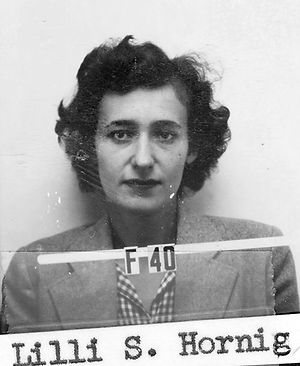
Lilli S. Hornig, Public Domain
Conclusion
In the wake of the Axis forces surrendering, the United States maintained a military presence in Japan to support rehabilitation efforts. The war was over, but the Cold War was beginning. Many women stayed on to help finish the job. As men returned from wartime service there was pressure on women to give up their high-paying war jobs and go back to their lower paid, often segregated work– a move many women resisted, becoming the catalyst for the Civil Rights and Women’s Rights movements that shortly followed. From efforts at home, in the job force, overseas in the military, in the science lab, to even on the baseball field–American women made extensive and important contributions to the United States in the Second World War.
By the end of this era, so much remained in question. Would the progress made by women in this time remain into the post-war period? How would the mistreatment of people of color impact the post-war years and what role would those women play in transforming American society? Would the new options for women in the military and the workforce remain? Or would WWII be like other wars when women returned to more traditionally feminine roles?