24.1850-1950- Women's Industrial Revolution
Die Industrielle Revolution markierte eine Ära, in der Arbeit, Produktion und Wirtschaftswachstum die Gesellschaften weltweit nachhaltig veränderten. Sie brachte auch bedeutende Veränderungen für Frauen mit sich. Frauen eröffneten sich neue Karrierewege und Führungspositionen in der Arbeitswelt, was ihnen neue Aufstiegschancen und sogar die Möglichkeit bot, die traditionelle soziale Hierarchie zu durchbrechen. Gewerkschaftsstreiks und Proteste für das Wahlrecht läuteten den Beginn kultureller und gesellschaftlicher Veränderungen hinsichtlich der Rolle der Frau in der Gesellschaft ein. Mit dem Wandel unserer Industrien und der globalen Wirtschaft veränderten sich auch die Berufe, Chancen und Lebensumstände von Frauen in dieser Zeit.
Wie zitiert man diese Quelle?
Herausgeber des Remedial Herstory Project. „24. 1850–1950 – Die industrielle Revolution der Frauen“. Das Remedial Herstory Project. 1. November 2025. www.remedialherstory.com.


Triggerwarnung: Dieses Kapitel thematisiert Vergewaltigung und sexuelle Übergriffe.
Die Industrielle Revolution begann um 1750 in England aufgrund der dort verfügbaren natürlichen Ressourcen (im Inland und im riesigen Kolonialreich) und der Umstellung auf kapitalistische Produktionsweisen. Sie führte zu tiefgreifenden gesellschaftlichen Veränderungen, unter anderem hinsichtlich der Art der Arbeit, des Wohnorts und des Alltags. Diese grundlegenden Veränderungen zogen auch systemische Umwälzungen nach sich, beispielsweise in Bezug auf Machtverhältnisse, deren Verteilung und Lage. Viele Frauen der Arbeiterklasse wechselten von Tätigkeiten als Hausangestellte, Weberinnen und Ladenbesitzerinnen zu Fabrikarbeiterinnen. Ihre zunehmende Beteiligung am öffentlichen Leben außerhalb des Hauses, verbunden mit den unmenschlichen Arbeitsbedingungen in den Fabriken, führte zu verstärktem politischen Engagement und schließlich zu Forderungen nach politischen Rechten.
Tritt dem Club bei
Melden Sie sich für unseren E-Mail-Verteiler an und helfen Sie uns, Frauengeschichte zu schreiben!
Vor der Industrialisierung
Die Industrielle Revolution brachte in England grundlegende Veränderungen mit sich, die sich dann in ganz Europa und später in vielen anderen Gesellschaften ausbreiteten. Die Warenproduktion verlagerte sich von kleinen Manufakturen, in denen Handwerkerinnen und Handwerker ihrem Gewerbe lokal und spezialisiert nachgingen, hin zur Massenproduktion in Fabriken, die Dampf- und Wasserkraft nutzten.
In der vorindustriellen Welt hatten Frauen mehr Kontrolle über ihren Alltag. Diejenigen, die in der Produktion tätig waren, arbeiteten typischerweise im Familienbetrieb mit ihren Eltern oder ihrem Ehepartner zusammen. Ähnlich wie in bäuerlichen Familien waren die meisten Familienmitglieder in die Arbeit eingebunden – sei es im Design, in der Produktion, im Verpacken oder im Vertrieb von Waren. Sie halfen beim Betrieb der Läden oder Marktstände, kauften die benötigten Materialien ein und koordinierten die Lieferungen.
Mit der Verlagerung ihrer Arbeit in die Fabriken arbeiteten Frauen zwar etwa gleich viele Stunden, verrichteten aber körperlich extrem anstrengende und monotone Arbeit. Nach ihrer Rückkehr nach Hause waren sie weiterhin für ihre häuslichen Pflichten zuständig. In der vorindustriellen Welt war die Kinderbetreuung möglich, da die Kinder stets in der Nähe waren; in der industrialisierten Welt hingegen arbeiteten auch die Kinder.

Gemälde mit dem Titel „Königin Bertha und die Spinnerinnen“, das traditionelle Textilarbeiten von Frauen darstellt.
Die industrielle Revolution
All over the world, the transition from an agricultural and cottage-based society to an industrial one was painful, full of failures, insecurities, and tension. As household industries shifted to factories or centralized workshops, women in great numbers were sought to work in the production mills. Most common was work in the textile mills, and histories of industrial revolutions everywhere saw the work of women in textiles.
The nature of work done by women and men often reveals the attitudes, beliefs, and values that a society holds about gender differences. In most of Europe and East Asia, women were regarded as inherently docile, accustomed to using small muscles, and having considerable tolerance for monotony and detail. With these assumptions, women - more than men - were believed to be ideal assembly-line workers. Because of their supposed compliance, it was believed that they would be willing to take lower wages and handle repetitive assembly-line work. Accustomed to a patriarchal world in which male authority ruled, employers also counted on women to be compliant, docile workers. For example, the tradition that valued absolute allegiance to a master was used to reinforce obedience at work among girls from Samurai Japanese families.
Further, it was no coincidence that women and children comprised much of the workforce of the early factories, as to run a successful factory, an owner needed cheap labor. Women in the 1800s and 1900s had few alternatives for work, and they often took whatever pay and conditions were offered in order to feed themselves and their families. Recognizing this, one Japanese worker’s song says, “Factory girls are treasure chests for the company.”
Lower class women, who worked for a wage out of necessity, were seen as “unsexing” themselves and entering into the cutthroat “man’s world.” Teenage girls were thought to have “special skills,” which is code for the fact that they were manipulatable. Employers used these gender-based characteristics to direct women toward grueling, low paying jobs and away from work that required training or led to leadership positions. Rarely did anyone question that running large, complex machinery was anything but a “man’s job.” For example, women ran a variety of looms and spinning wheels for processing yarn and other textiles, but the more expensive spinning mule for mass production became a male-operated machine, and the male mule spinners union opposed the employment of women and children.
This pattern of gendered job segregation was notably true in Asia, where deeply-rooted gender norms and values played a large role in influencing labor patterns. Women and girls were also recruited to work in new government factories to produce industrial goods like silk, and reported that they were grateful for these jobs and felt they earned more than they could have elsewhere. At work, women were praised for “knowing their place,” for being more flexible than men, and for being subordinate to men and their masters. Women’s earnings were always lower in jobs they held equally with men, and they were unlikely to have access to supervisory positions or promotional ladders.
At first, Asian women had no mutual aid societies and were largely excluded from collective action, such as strikes, work slowdown or stoppages. Accustomed to a patriarchal world in which male authority ruled and with few alternatives, working class women took whatever pay and conditions offered them in order to feed themselves and their family. Yet, the liberalizing of roles allowed women freedoms they hadn't previously had. For example, the Japanese moga (“modern girl”) was a sexually liberated, urban woman who spent her money and consumed products of her choosing. However, they were a small minority, and as the Taishō period ended in 1925, the government passed universal male suffrage and excluded women from the vote - to their dismay.
The large demand for female labor was tempting for many women. In Europe, given the choice between taxing farm work or demeaning domestic service, many women chose factory work for the money and independence it seemed to offer. In Japan, recruiters went into the countryside with tempting offers of good wages, pleasant working conditions, and tasty food. Despite any promises, within the workplace, women remained in lower-paid and lesser-authority positions throughout their careers, even in the industries, such as textile, where they dominated.
Textil (Subst.) , eine Art Stoff oder gewebtes Gewebe.
Fügsam (Adj.) , bereit, Kontrolle oder Anweisungen anzunehmen; unterwürfig.
Monotonie (Subst.) , Mangel an Abwechslung und Interesse; ermüdende Wiederholung und Routine

A textile mill where a manager inspects a woman’s work

Junge Angestellte – Jungen und Mädchen – der Lane Cotton Mill, New Orleans

Textilfabrik in Indonesien
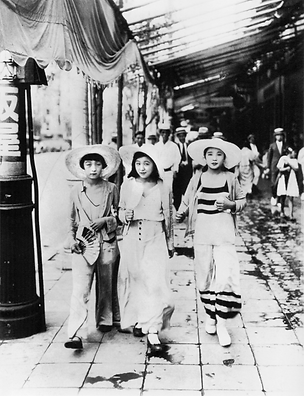
Japanische Moga im Jahr 1928
Kohlebergwerke
Für Frauen aus der Arbeiterklasse war die beste Beschäftigungsmöglichkeit die Arbeit als Hausangestellte – typischerweise bei einer wohlhabenden Familie aus der Gegend. Danach folgte die Fabrikarbeit, und die schlechteste Option war die Arbeit in einem Kohlebergwerk.
Die sechsjährige Mary Davis wurde von einem Regierungsinspektor schlafend in einem walisischen Bergwerk gefunden. Sie erklärte: „Ich bin eingeschlafen, weil meine Lampe wegen Ölmangels ausgegangen war. Ich hatte Angst, weil mir jemand Brot und Käse gestohlen hatte. Ich glaube, es waren die Ratten.“ Ein anderes, ebenfalls sechsjähriges Mädchen, dessen Name nicht genannt wurde, beschrieb ihre schwere Arbeit: „Ich bin seit sechs Wochen im Bergwerk und mache zehn bis vierzehn Rechengänge am Tag. Ich trage 25 Kilo Kohle in einem Holzeimer. Ich arbeite mit meiner Schwester Jesse und meiner Mutter. Es ist dunkel, wenn wir anfangen.“ Auch die Aussage der Teenagerin Maria Gooder verdeutlicht das Ausmaß ihrer Not. Sie behauptete: „Ich eile mit meiner Schwester Anne, die achtzehn wird, zu einem Mann. Er ist gut zu uns. Ich mag es nicht, in der Grube zu sein. Ich bin müde und habe Angst. Ich gehe um 4:30 Uhr, nachdem ich Haferbrei gefrühstückt habe. Um 5 Uhr beginne ich zu eilen. Wir essen mittags zu Abend. Wir bekommen trockenes Brot und sonst nichts. Es gibt Wasser in der Grube, aber wir trinken es nicht.“
Mary Enock arbeitete mit ihrer Schwester in den Minen und war erst elf Jahre alt, und ihre Geschichte ist vielleicht die anschaulichste. Sie sagte:
Wir sind Türsteher im Viertel „Vier-Fuß- Ebene“ . Wir verlassen das Haus jeden Morgen vor sechs Uhr und bleiben bis sieben Uhr, manchmal auch länger, im Viertel. Wir bekommen zwei Pence am Tag, und unser Strom kostet uns zweieinhalb Pence pro Woche. Rachel war in einer Tagesschule und kann schon ein bisschen lesen. Sie wurde vor einiger Zeit von einer Straßenbahn angefahren und war lange krank zu Hause, aber sie hat sich erholt.
Mary und ihre Schwester mussten sich zwischen Licht in einem stockfinsteren Kohlebergwerk und einem höheren Lohn entscheiden, und eine Arbeitsunfallverletzung, wie sie ihre Schwester erlitten hatte, war einfach an der Tagesordnung.

A young woman “hurrying” coal while two other children help push the cart
Rechen (Subst.) , [im Bergbau] der in den Boden oder ins Gestein geschnittene Weg zum Zweck des Bergbaus.
Eile (v.) , [im Bergbau] das Abtransportieren des abgebauten Materials aus der Mine.
Sohle (Subst.) , [im Bergbau] eine in die Kohle getriebene Grube oder ein Stollen, der als Basis für weitere Abbauarbeiten dient.
Tram (n.) , [im Bergbau] die Karre, die zum Transport von abgebautem Material oder Arbeitern durch die Bergwerksstollen verwendet wird.
Ausbeutung von Arbeiterinnen
Women in the factories and mines of Europe and Asia during the formative years of industrialization were subjected to similar forms of exploitation and control. Everywhere the work tended to be dehumanizing and monotonous. 14-to-16 hour shifts, six days a week, controlled by the clock and under the watchful eye of harsh male supervisors, were normal. The workplace environment was also an incubator for illnesses such as tuberculosis and dysentery. Safety measures were weak, and accidents were frequently reported, as were physical deformities caused by hard, repetitive work and poisoning caused by unsafe chemicals. Likewise, sexual harassment and abuse at the hands of managers was common.
The Industrial Revolution is also characterized by hundreds of inventions and innovations meant to increase the rate and efficiency of production, though these inventions did not necessarily make work safer or more profitable for the workers. For example, the Spinning Jenny was invented in 1764 by James Hargreaves. This complex device cut the time and effort needed to produce cloth and transformed the textile industry. Women no longer sat at singular spinning wheels; they stood at the Jenny, 12-to-14 hours a day, working eight spools at once.
The work was often excruciating. Hannah Goode described her day to a government official, stating,
I work at Mr. Wilson's mill. I think the youngest child is about 7. I daresay there are 20 under 9 years. It is about half past five by our clock at home when we go in [...] We come out at seven by the mill. We never stop to take our meals, except at dinner. William Crookes is overlooker in our room. He is cross-tempered sometimes. He does not beat me; he beats the little children if they do not do their work right [...] I have sometimes seen the little children drop asleep or so, but not lately. If they are catched asleep they get the strap. They are always very tired at night.
Mrs. Smith had three children working at the same mill. She said,
We don't complain. If they go to drop the hours, I don't know what poor people will do. We have hard work to live as it is. [...] My husband is of the same mind about it [...] last summer my husband was 6 weeks ill; we pledged almost all our things to live; the things are not all out of pawn yet [...] We complain of nothing but short wages [...] My children have been in the mill three years. I have no complaint to make of their being beaten [...] I would rather they were beaten than fined.
Despite the mother’s hearty perspective, society was concerned about the way women in these factories were treated. One popular ballad sang,
Laboriously toiling, both night, noon, and morning/ For a wretched subsistence, now mark what I say. She's quite unprotected, forlorn, and dejected/ For sixpence, or eightpence, or tenpence a day. Come forward you nobles, and grant them assistance/ Give them employ, and a fair price them pay/ And then you will find, the poor hard working seamstress/ From honor and virtue will not go astray.
Despite the hardships and risks, around the world, working class women moved into cities and took up jobs, entering into the paid workforce in greater numbers than ever before. This changed the economic value of the unpaid domestic work women had been doing for millennia. The cultural effect of women earning a wage was that their domestic labor lost its value and importance. The work of raising children and caring for the home still needed to be done, but now it was expected as an additional responsibility on top of industrial work. Men of the working class could not earn enough to also pay for domestic labor, and thus families relied on the unpaid labor of women.
Families also played an important role in sending daughters off to factories, while daughters could simultaneously support their families in a way they hadn’t been able before. In Europe, girls’ incomes were important to their families as well as to their dowries. Japan’s first workers in government mills were women from poor farm families that had “excess” daughters. A daughter’s work away from home was seen as part of the patriotic effort to industrialize the nation, while it was also a requirement of their filial duty to contribute to the well-being of their parents by contributing to them financially. In China, a woman’s farm work was seen as less essential to the family economy than was a man’s, thus, impoverished families willingly signed contracts committing their daughters to long terms as indentured workers in the mills in return for advance cash loans.
In any case, when factory work removed young women from their parental households, factory owners often established dormitories for the workers and acted as substitute fathers. This system restricted women’s leisure-time activities and socializing habits, while ensuring that their wages would be sent home. Through promises to supervise young females and their morals - and in some cases provide safe, controlled housing in company dorms - factory owners and managers became like second parents. Familial duties, in a sense, were transferred from the home to the patriarchal factory.

Kinderarbeiter in einer Textilfabrik
Aufsichtsperson (Subst.) , eine Person, die Arbeiter beaufsichtigt oder eine Aufgabe überwacht.
Riemen (Subst.) , ein Stück Leder, mit dem man jemanden schlägt.
Pfand (v.), die Überlassung von Gegenständen als Sicherheit für die Erfüllung eines Vertrags oder die Zahlung einer Schuld, wobei im Falle des Scheiterns der Pfandanspruch verfällt.
Pfand (Subst.) , ein Gegenstand, der als Sicherheit für geliehenes Geld hinterlegt wird.

Die Spinning Jenny
Vertragsarbeiter/Bedienstete (n.) , eine Person, die sich verpflichtet, für eine andere Person für eine festgelegte Zeit gegen Zahlung von Reisekosten, Nahrung und Unterkunft zu arbeiten.
Mittel- und Oberschicht
Even women who would never have to take part in industrial work could feel its effects. Industrialization brought the decline of the British aristocracy and the rise of the middle class. Women of the middle classes represented the ideal woman, in contrast to her lower class counterpart. A man who could provide enough for a wife to be spared working outside the home was a sign of one’s class. Thus, working men began to agitate and unionize to protect their wages to provide for their wives at the expense of working women.
Middle and upper class women were mothers, homemakers, moral guideposts, and emotional supports. They were expected to strive for perfection in every aspect of their lives, and in return, women of this class were to be protected from the harsh realities of the capitalist world beyond the domestic sphere. Over time, this idealized woman came to be seen as natural, even though historical records tell us otherwise. In Japan and China, there was contradictory government rhetoric calling for more women to join factory work for the betterment of the nation, but there was also pressure for women to remain strictly in the home and live up to the cultural ideal of femininity.
Women were encouraged to maintain “fine” homes that included the latest decor and were neat and clean, despite the comings and goings of their typically large families. The pressure to meet all of these social demands necessitated domestic servants, and demand for servants rapidly increased; it became one of the most common jobs for English women in the 1800s. Unmarried women who previously labored in family businesses and on farms shifted to working as domestic servants, a job far preferable to dangerous factory work.
Servants provided middle and upper class women with more leisure time. These women became avid readers and writers, which made them one of the most educated groups of women in history. They threw themselves into the socially acceptable charitable work and social reforms - even addressing the ills of industrialization. While we have a plethora of middle class female voices from this period, the everyday experience of working class women was largely ignored.
Upper class women became advocates for poor women and children. They became speakers against alcoholism (known as Temperance Reformers), deeming male alcohol consumption a threat to their wives, unmarried women, and children who could face abuse. They also worked to end child labor - a staple of the Industrial Revolution. However, the idealized version of womanhood was ever present. Some of these elite women - out of touch with the realities of the poor - claimed paid labor was unsuitable for women, as it was detrimental to her domestic duties, but ignored the question of how else these women could feed their families without this work.
As an unforeseen consequence, this work forced upper class women to become political in ways not yet seen by mass groups of women. British women advocated for the Married Women’s Property Acts of 1870 and 1882, which gave women the right to control their finances, even within marriage. This also resulted in sweeping new laws that aimed to protect women but which ultimately created massive hurdles for working women. For example, they claimed women’s bodies were too weak and delicate for some types of work and thereby blocked women from competing with men in certain industries.
Some middle and upper class women also became teachers until they were married in order to provide the education needed in an industrialized society. This did not lead to an overhaul in women’s education, but in Britain, girls received education related to domestic skills for their future as housewives and domestic servants, though they remained barred from colleges and universities until the 1870s. Some European women did attend college and sat for exams, but the schools would not issue them degrees on account of their sex.

Hausangestellte kocht
Impfung (Subst.) , die Handlung, jemanden gegen eine Krankheit zu immunisieren, indem infektiöses Material, Mikroorganismen oder ein Impfstoff in den Körper eingeführt werden.

Protest gegen Kinderarbeit bei einer Arbeiterparade
Gewerkschaften und Protest
Mit dem Beginn der Industriellen Revolution in Großbritannien wurde schließlich auch der Ruf nach einer Arbeitsmarktreform laut. Die Realität der Industrie wurde im gesamten 19. Jahrhundert von Regierungskommissionen untersucht. Die Dokumente enthüllten, dass Frauen im Durchschnitt nur ein Drittel bis zwei Drittel des Gehalts ihrer Männer verdienten. Es handelte sich um eine künstlich geschaffene Lohnstruktur, die den männlichen Ernährer und Familienoberhaupt schützte. Dies war nur eine von vielen Maßnahmen, mit denen die Industriegesellschaft darauf ausgelegt war, Männer und ihren Reichtum zu sichern. Ein weiteres Beispiel: Gewerkschaften schlossen Frauen oft vom Beitritt aus und verweigerten ihnen Weiterbildungen in höheren Berufen. Darüber hinaus wehrten sich die von Männern dominierten Gewerkschaften typischerweise gegen weibliche Erwerbstätigkeit und die gewerkschaftliche Organisierung von Frauen, da dies eine reale Bedrohung für die Arbeitsplätze und die Lohnsicherheit der Männer darstellte. Die Gewerkschaften hielten an einer Geschlechterhierarchie fest und bezeichneten Frauen als billige, ungelernte Arbeitskräfte.
Um nicht an den Rand gedrängt zu werden, engagierten sich einige Frauen politisch und gründeten eigene Gewerkschaften. Die Women’s Trade Union League (WTU) entstand 1874 in Großbritannien und führte zu einem massiven Anstieg gewerkschaftlicher Aktivitäten von Frauen. Ähnliche Entwicklungen zeigten sich in Japan, wo Frauen in den 1880er Jahren Massenstreiks gegen niedrige Löhne und Verträge organisierten, die sie zwangen, in Fabrikwohnungen fernab ihrer Familien zu leben. Dort bewiesen Frauen ihre Handlungsfähigkeit, indem sie ihre Arbeitsplätze verließen, um bei ihren Familien zu sein.
Das gewerkschaftliche Verhalten von Frauen unterschied sich je nach Familienstand. Verheiratete Frauen beteiligten sich tendenziell weniger an militanten Aktionen. Dies mag zum Teil daran gelegen haben, dass sie neben ihrer Arbeit in der Industrie und ihrer unbezahlten Hausarbeit die Gewerkschaftsarbeit nicht bewältigen konnten. Die Beteiligung von Frauen an Gewerkschaften führte zu schrittweisen Veränderungen. Löhne, Arbeits- und Lebensbedingungen verbesserten sich überall dort, wo Gewerkschaften Fuß fassten. Diese Veränderungen vollzogen sich jedoch nicht schnell genug, was einige Frauen dazu ermutigte, zusätzlichen politischen Einfluss anzustreben.
Konstruiert (Adj.) , absichtlich geschaffen und nicht natürlich oder spontan entstanden.
Gewerkschaften (Subst.) , ein organisierter Zusammenschluss von Arbeitnehmern eines Gewerbes, einer Gruppe von Gewerben oder eines Berufsstandes, der zum Schutz und zur Förderung ihrer Rechte und Interessen gegründet wurde; eine Gewerkschaft.

Protest der Gewerkschaften
Wahlrecht
Industrialization took women and girls from farms, cottage industries, and domestic work and dragged them into a world dominated by men. Unionization led to slow change, and the failure of the unions and the law to protect women from exploitive pay, sexual harassment, and dangerous working conditions, hurled many women into political advocacy, where they eventually demanded the right to vote. They wanted the ballot, just like men.
New Zealand gave women the right to vote in 1893, making it the first nation to allow women to vote in national elections. Australia followed, when it became a federal state in 1901. Australia continues to lead the world in female leadership, largely because they focused their efforts on reforming the structures and systems that made it difficult for women to participate in politics and leadership. Their model and countless academic studies shows that where women lead, there are enormous benefits, not only for women and girls, but for all of society.
Leaders Muriel Matters and Vida Goldstein were two of the many women who fought for women’s political recognition in Australia. Goldstein also became the first Australian to visit a president at the White House. President Theodore Roosevelt found her fascinating, as she had more political rights than any US woman. He said, “I’ve got my eye on you down in Australia.”
Muriel Matters didn’t stop with Australia. Once suffrage was secure there, she headed to the United Kingdom, where suffrage had been a hot topic since the 1860s. In 1902, 37,000 women and girls who labored in the textile mills of Northern England petitioned Parliament for the right to vote, but were denied. By 1905, the mother daughter trio of Emmeline, Christabel, and Sylvia Pankhurst championed the militant wing of the English suffragette movement, the Women’s Social and Political Union (WSPU), adopting the motto, “Deeds not Words.”
In 1907, 75 WSPU suffragettes were arrested when they attempted to storm the Houses of Parliament. Their international organization promoted militancy and pageantry as a means to an end. They picketed, smashed mainstreet storefronts, bombed parliamentarian mailboxes, and performed a variety of stunts to get suffrage on the front page of British newspapers. In 1908, Australian Muriel Matters earned the title of the first woman to speak in the British House of Commons in London but not because she was invited to do so. Instead, it was because she chained herself to the grill that barred women’s view of Parliament and shouted demands for women’s rights. Guards cut her off the grill and dragged her out by force, even as she continued to demand the vote. In 1909, Marion Wallace Dunlop went on hunger strike while in prison and others soon followed her. Instead of releasing the women from prison, the jailers force fed them to keep them alive. Women also began refusing to pay taxes until they could vote for the people who taxed them. They organized into the Women's Tax Resistance League (WTRL) with the slogan “No vote, no tax.”
Of course, not all women liked these aggressive tactics, nor the goal of gaining women’s suffrage. In each nation that has seen a push for women’s suffrage, they have met resistance, which includes women. In this case, some women formed the UK’s first anti-suffrage league, while others left the Pankhursts for the more moderate Women’s Freedom League (WFL).
Sophia Duleep Singh stood out among the suffragists because of her position and heritage. She was the youngest daughter of the king of Northern India. When her father was young he was bullied into a treaty with Queen Victoria that surrendered his country to her, and he and his family were subsequently banished from India. Raised in the United Kingdom, Singh became Victoria’s goddaughter and led an opulent life. Eventually, she and her sisters returned to India, where they bore witness to the harsh realities of poverty and racism. She was a socialite and celebrity in London, but there she was just another brown face. Upon return, she threw herself into the suffrage cause, slamming into Parliamentarians and demanding female suffrage. She was eventually taken to court over her refusal to pay taxes in protest.
In 1909, a Conciliation Bill was proposed to give women who owned a certain amount of property the right to vote, but the bill failed. In response, Pankhurst and Singh led 300 women to march on Parliament where they were met with police brutality in an event known as Bloody Friday. Still, women did not back down, and militancy peaked in 1912 with more window smashing and arson attacks. Then, in 1913, Emily Wilding Davison attended the Epsom Derby where the king was racing. She stepped out onto the track with a suffrage banner as he raced by. His horse trampled her, and she died several days later from a fractured skull, creating a martyr for the suffrage cause, as thousands of suffrage sympathizers attended her subsequent funeral.
The immensity of World War I in Europe disrupted women's suffrage activities, even an ocean away in America. Eventually, as the war came to a close, Nancy Astor became the first female member of Parliament in 1919, and with continued resistance and protest, women in the UK finally won the right to vote in 1928.
Women around the world were awed by the achievements of the New Zealand, Australian, American, and British women. Slowly, most countries followed suit, especially after World War II, but in some authoritarian places today, women remain disenfranchised. Further, the vote didn’t transform everything. One could argue that the vote without changing the structures that deny women equal opportunity to hold power, did little. Further still, we should keep in mind that amid these struggles for suffrage, not all groups cared much for the enfranchisement of those who did not share their ethnic or racial backgrounds. Quite often, suffrage movements could become divided over these lines.

Kate Sheppard, Neuseelands führende Suffragettenkämpferin, die auf der aktuellen neuseeländischen Zehn-Dollar-Note abgebildet ist
Suffragette (Subst.) , eine Frau, die sich für das Frauenwahlrecht (Frauenwahlrecht) einsetzt.
Streikposten (v.) , vor einem Arbeitsplatz oder einem anderen Ort stehen, um gegen etwas zu protestieren oder andere davon zu überzeugen, während eines Streiks nicht einzutreten.
Parlamentarier (Subst.) , ein Mitglied des Parlaments (eines politischen Gremiums).
Grill (Subst.) , ein Gitter oder Sieb aus Metallstäben oder -drähten, das vor etwas angebracht wird, um es zu schützen oder um Belüftung oder diskrete Beobachtung zu ermöglichen.

1908 WSPU meeting

Muriel Matters wird aus dem Parlament entfernt

Eine inhaftierte Frau wird zwangsernährt.

Sophia Duleep Singh

Teil von Davisons Trauerzug
Disenfranchise (v.) , jemanden des Wahlrechts berauben.
Hebammen und Ärzte
Another significant shift amid the Industrial Revolution was in relation to women’s medical care. Advancements in technology and science in the wake of the Enlightenment coalesced into a rethinking of birthing practices and women’s health. Long before factories opened up labor opportunities, the practice of midwifery was one of the accepted ways that women worked outside the home around the world, throughout history. However, increasingly, governments worked to certify and professionalize industries, including medicine. Midwifery was generally a safe option in birth for women, but high maternal death rates led to scholars examining the field scientifically, and men entered the field as trained obstetricians. Many of the men drawn to this field had personally lost loved ones at birth.
In the 1500s, The Rosengarten became the first obstetrical textbook written by a male apothecary. It provided instructions, probably taken from common midwife practices, on how to rotate the baby with pressure on the abdomen to get it into the proper position and introduced new methods and tools to extract the baby. Women at the time were largely illiterate, so how many of the midwives attending women at birth were familiar with the content of the text is hard to say, but the result of this over the next few centuries was tension between the midwives who had made careers in a field available to them and the male doctors who took over in the name of professionalism.
In the battle between midwives and male doctors, it’s wrong to assume that there was one party that unilaterally knew more, performed better, or cared more deeply about the women they were attending. There were undoubtedly good and bad actors in both professions. It is also wrong to assume that a professionalization of the practice meant that midwives were not well-versed and qualified to assist in birthing children, nor that they weren’t using modern and evolving medical instruments for interventions.
Further the “professionalization” of midwifery could really damage female patients. Their male physicians had never been through what they were going through, but far worse, Victorian gendered expectations respected women’s modesty. Sometimes, the doctors wouldn’t even look at the woman’s body during the birthing process. Thus, women died at higher rates under these male doctors, but still the doctors drove female midwives out of their jobs.
The male doctors won the battle for the monopoly on birth. In America by the 1800s, especially among the wealthy and urban, doctors were preferred. No longer did women give birth with their female neighbors there for support and advice. Rather, they gave birth alone with just their mother, sister, or other trusted woman, and a male doctor in attendance. In Philadelphia over a ten-year period, the number of midwives fell from 21 to six. As men were not allowed to look at a naked woman, even during childbirth, male medical students weren’t allowed to watch births, so instead only learned from textbooks until they were active in the field.
Normal, healthy births remained largely successful, but complications in birth are quite common. Babies can get stuck in the birth canal, be poorly positioned, and need an alternative, emergency removal. Throughout history, caesarian sections (today known as c-sections) had been performed in many of these cases. The surgery was reserved for extreme circumstances when it was evident the mother was dying or already dead and there was a chance to save the baby. Having a caesarian section was basically a death sentence for the mother for centuries. In 1814, a report from London announced that only 20-22 known cesarean sections had been attempted in the empire and only nine had succeeded in saving the babies, while just two had succeeded in saving the mother.
The first undisputed and well-documented caesarian section in Ireland took place in 1738 and saved both mother and baby; it was performed by a female midwife, Mary Donally. She was called to help Alice O’Neal, the 30-year-old wife of an Irish farmer who had been in labor for 12 days. Mary cut Alice’s stomach with a razor while an assistant walked a mile to get silk to stitch the mother up. Even though the surgery worked, the medical community in Europe debated the validity of the procedure and few were willing to perform it, even into the 1900s. As the surgery put the mother’s life at extreme risk, much of the debate was about which life was more valuable. In Britain, for example, there was much more support for killing the baby to save the mother.
Life without the cesarean section meant many women continued to die, regardless of their status and access to the best medical care. Most notably, in 1817, Princess Charlotte, George IV's only child, died in childbirth at the young age of 21. Her baby was two weeks late and labor lasted for 50 hours, but no doctors were willing to perform the radical emergency procedure with the princess’s life on the line. In the end, the nine-pound baby was stillborn. Doctors removed the placenta with difficulty, and six hours later, Charlotte died. The obstetrician, Sir Richard Croft, was harassed mercilessly by the masses, and he shot himself a few days later. King George was left without an heir, and the throne passed first to his brother and then to his niece, Queen Victoria.
While it remained a debated and extreme surgical option, this does not mean that practitioners did not still attempt it as a means of survival. A notable case of a successful cesarean section occurred in South Africa in 1826, by Dr. James Barry. Barry was identified as female at birth and raised as a girl by the name of Margaret Ann Bulkley. Barry had been raped as a youth and the resulting child was raised by his mother, but the stretch marks from pregnancy remained for his entire life. When his uncle died, he assumed the name James in his stead and used his new identity as an opportunity for self-betterment, enrolling in medical school in Edinburgh - a school where he would not have gained access as a woman. This does not appear to be a simple matter of education access, but rather, Barry seems to have identified as male, for he remained James for the rest of his life.
Barry had a highly successful and controversial medical career, serving as a physician all over the world and in the Crimean War. While in South Africa, he performed a caesarian section that saved both the mother and child. The grateful mother named her new baby James in his honor. When Barry died years later, it was discovered that he was biologically female or perhaps intersex. How he would have liked to be remembered is sadly unknown, but one can only presume it was as he had lived.
An additional concern of the professionalization of childbirth was that in hospitals, before germs were understood and sterilization common, doctors would often go from surgery to surgery, carrying infections to women in labor. By the 1800s, the maternal death rate reached between two and eight per 100 deliveries, around ten times the rate outside the hospital. In New York, in 1840, 80 percent of women who gave birth in a hospital died.
The field continued to progress in its study of how to preserve the lives of babies and their mothers through various methods of care and surgery. This grew in leaps and bounds through the 20th century, particularly, as more women were able to join the field and concepts of safety surpassed antiquated concepts of enforced modesty. Medical providers - women and men alike - worked to make childbirth safer, faster, and less painful for both mother and child. The discovery of anesthetics like chloroform was not far behind, but like the c-section, many were reluctant to use it in labor. Only after Queen Victoria consented to its use during the birth of her eighth child did it quickly become widely accepted in obstetric practice.
Geburtshelfer (Subst.) , ein Arzt oder Chirurg, der zur Durchführung von Geburten qualifiziert ist.
Apotheker (Subst.) , eine Person, die Arzneimittel und Medikamente zubereitet und verkauft; Pharmazeut.

Geburt mit einer Hebamme

15th century woodcut depicting a cesarean section being performed on a dying mother
Totgeboren (Adj.) , (von einem Säugling) tot geboren.

Dr. James Barry
Intersexualität (n.) , ein Zustand, bei dem Individuen biologische Geschlechtsmerkmale aufweisen, die nicht in die typischen Kategorien männlich oder weiblich passen.
Anästhetikum (Subst.) , eine Substanz, die Unempfindlichkeit gegenüber Schmerzen hervorruft.
Abschluss
Die Industrialisierung verbesserte das Leben von Frauen, möglicherweise sogar stärker als das von Männern. Sie führte zu einer etwas besseren medizinischen Versorgung während der Schwangerschaft, und Frauen wie Männer in der Industrie waren wirtschaftlich besser gestellt als ihre landwirtschaftlichen Kollegen. Dadurch stieg der Lebensstandard erheblich. Trotz niedriger Löhne fanden einige Frauen Wege, ihren Lebensunterhalt zu bestreiten, und einige wenige erlangten sogar beträchtliches Vermögen. Die Industrialisierung stellte auch die patriarchalen Normen in gewisser Weise infrage, da sie die Vorstellung des „männlichen Ernährers“ infrage stellte. Es wurde zunehmend deutlich, dass immer mehr Frauen arbeiten mussten, um ihren Lebensunterhalt zu verdienen. Das Einkommen der Frauen ermöglichte es ihnen außerdem, unabhängige Konsumentinnen zu werden, und mit dieser neuen Rolle ging ihnen ein großer Einfluss auf die Produktion einher.
Es ist wichtig festzuhalten, dass die Industrialisierung auch die westliche imperialistische Expansion befeuerte. Fabriken konnten mehr Waffen produzieren und so militärische Eroberungen in Afrika, Asien, Sibirien, den Pazifikinseln und Westamerika ermöglichen – allesamt begehrte Gebiete wegen ihrer Rohstoffe und Arbeitskräfte. Ob in Führungspositionen oder in der Missionsarbeit, Frauen unterstützten den Imperialismus und kämpften gleichzeitig gegen ihn.
Die Industrialisierung veränderte die globale Zusammensetzung, verschob Machtstrukturen und ermöglichte es dem globalen Norden, seine Systeme anderen aufzuzwingen, darunter auch seine Ansichten über Frauen. Wie beeinflussten Klasse und Region die Auswirkungen der Industrialisierung? Überwogen die Vorteile die Nachteile? Wie würde die Rolle der Frau auf dem Arbeitsmarkt Politik und sozialen Wandel beeinflussen? Würden Frauen Zugang zu als „männlich“ geltenden Branchen erhalten? Wie würde sich die Gesellschaft anpassen, damit Frauen sowohl Erwerbstätige als auch Mütter sein können? Und vielleicht die wichtigste Frage von allen: Was wäre nötig, damit Frauen das Wahlrecht erlangen und dadurch mehr Mitspracherecht in diesen Angelegenheiten erhalten?